


Incidence and management of patients with colorectal cancer and synchronous and metachronous colorectal metastases: a population-based study
- PMID: 32543788
- PMCID: PMC7397359
- DOI: 10.1002/bjs5.50299
Incidence and management of patients with colorectal cancer and synchronous and metachronous colorectal metastases: a population-based study
Abstract
Background: This population-based study aimed to examine the incidence, patterns and results of multimodal management of metastatic colorectal cancer.
Methods: A retrospective population-based study was conducted on patients with metastatic colorectal cancer in Central Finland in 2000-2015. Clinical and histopathological data were retrieved and descriptive analysis was conducted to determine the pattern of metastatic disease, defined as synchronous, early metachronous (within 12 months of diagnosis of primary disease) and late metachronous (more than 12 months after diagnosis). Subgroups were compared for resection and overall survival (OS) rates.
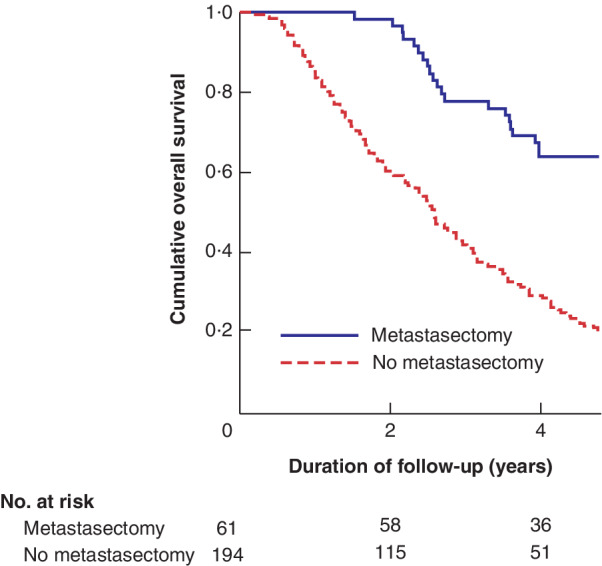
Results: Of 1671 patients, 296 (17·7 per cent) had synchronous metastases, and 255 (19·6 per cent) of 1302 patients with resected stage I-III tumours developed metachronous metastases (94 early and 161 late metastases). Liver, pulmonary and intraperitoneal metastases were the most common sites. The commonest metastatic patterns were a combination of liver and lung metastases. The overall metastasectomy rate for patients with synchronous metastases was 16·2 per cent; in this subgroup, 3- and 5-year OS rates after any resection were 63 and 44 per cent respectively, compared with 7·1 and 3·3 per cent following no resection (P < 0·001). The resection rate was higher for late than for early metachronous disease (28·0 versus 17 per cent respectively; P = 0·048). Three- and 5-year OS rates after any resection of metachronous metastases were 78 and 62 per cent respectively versus 42·1 and 18·2 per cent with no metastasectomy (P < 0·001). Similarly, 3- and 5-year OS rates after any metastasectomy for early metachronous metastases were 57 and 50 per cent versus 84 and 66 per cent for late metachronous metastases (P = 0·293).
Conclusion: The proportion of patients with metastatic colorectal cancer was consistent with that in earlier population-based studies, as were resection rates for liver and lung metastases and survival after resection. Differentiation between synchronous, early and late metachronous metastases can improve assessment of resectability and survival.
Antecedentes: El objetivo de este estudio de base poblacional fue analizar la incidencia, la forma de presentación y los resultados del tratamiento multimodal del cáncer colorrectal metastásico (metastatic colorectal cancer, mCRC). MÉTODOS: Se realizó un estudio retrospectivo de base poblacional en pacientes con mCRC en la región central de Finlandia entre 2000 a 2015. Se recuperaron los datos clínicos e histopatológicos y se realizó un análisis descriptivo con el objetivo de analizar la forma de presentación de la enfermedad metastásica. La enfermedad metastásica se definió como sincrónica, metacrónica precoz (< 12 meses) y metacrónica tardía (> 12 meses después del diagnóstico de la enfermedad primaria) y se compararon las tasas de resección y de supervivencia global (overall survival, OS) en estos subgrupos.
Resultados: De los 1.671 pacientes revisados, 296 (17,7%) presentaron metástasis sincrónicas, mientras que de los 1.302 pacientes resecados en estadios I-III, 255 (19,6%) tuvieron metástasis metacrónicas: 94 precoces y 161 tardías. La localización metastásica más frecuente fue el hígado, los pulmones y el peritoneo. La combinación más frecuente fue la de metástasis hepáticas y pulmonares. La tasa de resección para pacientes con metástasis sincrónicas fue del 16,2%; en este subgrupo, la OS a 3 y 5 años después de cualquier tipo de resección fue del 62,6% y 44,2% versus 7,1% y 3,3% en los pacientes sin resección, respectivamente (P < 0,001). La tasa de resección fue mayor en la enfermedad metacrónica tardía que en la enfermedad metacrónica precoz (28% versus 17%, P = 0,048). Las tasas de OS a 3 y 5 años después de cualquier resección en los casos de metástasis metacrónicas fueron del 77,8% y 61,9% versus 42,1% y 18,2% en los pacientes sin metastasectomía, P < 0,001. Las tasas de OS a 3 y 5 años después de cualquier metastasectomía en los casos de metástasis metacrónicas precoces fueron del 57,4% y 50,3%, versus 84,3% y 65,6% en las tardías (P = 0,29) CONCLUSIÓN: La proporción de pacientes con mCRC fue similar a la de estudios anteriores de base poblacional, así como las tasas de resección para metástasis hepáticas y pulmonares y la supervivencia después de la resección. Diferenciar entre metástasis sincrónicas, metacrónicas precoces y tardías puede mejorar la posibilidad de resecabilidad y la supervivencia.
© 2020 The Authors. BJS Open published by John Wiley & Sons Ltd on behalf of British Journal of Surgery Society.
Figures

References
-
- Ferlay J, Soerjomataram I, Ervik M, Dikshit R, Eser S, Mathers C et al. GLOBOCAN 2012 v1.0, Cancer Incidence and Mortality Worldwide: IARC Cancer Base No. 11 International Agency for Research on Cancer: Lyon, 2013.
-
- Arnold M, Sierra MS, Laversanne M, Soerjomataram I, Jemal A, Bray F. Global patterns and trends in colorectal cancer incidence and mortality. Gut 2017; 66: 683–691. - PubMed
-
- Schmoll HJ, Van Cutsem E, Stein A, Valentini V, Glimelius B, Haustermans K et al ESMO consensus guidelines for management of patients with colon and rectal cancer. A personalized approach to clinical decision making. Ann Oncol 2012; 23: 2479–2516. - PubMed
-
- Adam R, De Gramont A, Figueras J, Guthrie A, Kokudo N, Kunstlinger F et al; Jean‐Nicolas Vauthey of the EGOSLIM (Expert Group on OncoSurgery management of Liver Metastases) group . The oncosurgery approach to managing liver metastases from colorectal cancer: a multidisciplinary international consensus. Oncologist 2012; 17: 1225–1239. - PMC - PubMed
-
- Adam R, de Gramont A, Figueras J, Kokudo N, Kunstlinger F, Loyer E et al; of the EGOSLIM (Expert Group on OncoSurgery management of Liver Metastases) group . Managing synchronous liver metastases from colorectal cancer: a multidisciplinary international consensus. Cancer Treat Rev 2015; 41: 729–741. - PubMed
MeSH terms
LinkOut - more resources
Full Text Sources
Medical
