. 2020 Sep;26(9):1978-1986.
doi: 10.3201/eid2609.201840. Epub 2020 Jun 16.

Seroepidemiologic Study Designs for Determining SARS-COV-2 Transmission and Immunity

Seroepidemiologic Study Designs for Determining SARS-COV-2 Transmission and Immunity

Hannah Clapham et al. Emerg Infect Dis. 2020 Sep.

Abstract

Serologic studies are crucial for clarifying dynamics of the coronavirus disease pandemic. Past work on serologic studies (e.g., during influenza pandemics) has made relevant contributions, but specific conditions of the current situation require adaptation. Although detection of antibodies to measure exposure, immunity, or both seems straightforward conceptually, numerous challenges exist in terms of sample collection, what the presence of antibodies actually means, and appropriate analysis and interpretation to account for test accuracy and sampling biases. Successful deployment of serologic studies depends on type and performance of serologic tests, population studied, use of adequate study designs, and appropriate analysis and interpretation of data. We highlight key questions that serologic studies can help answer at different times, review strengths and limitations of different assay types and study designs, and discuss methods for rapid sharing and analysis of serologic data to determine global transmission of severe acute respiratory syndrome coronavirus 2.

Keywords: COVID-19; SARS-CoV-2; coronavirus disease; immunity; respiratory infections; seroepidemiologic; severe acute respiratory syndrome coronavirus 2; study design; viruses; zoonoses.


Figures
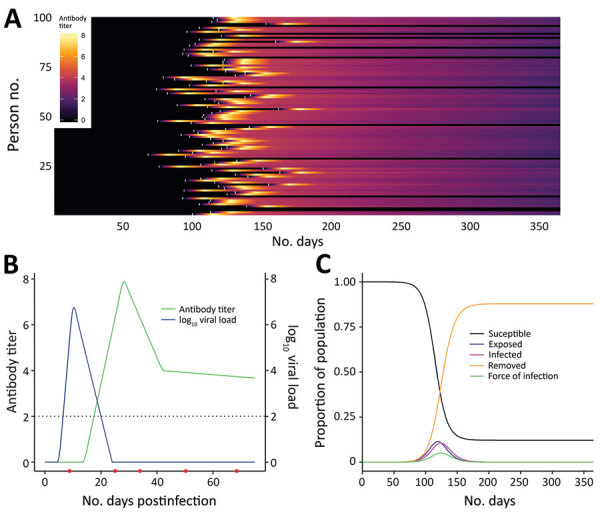
Figure 1
Figure 1
Link between severe acute respiratory syndrome coronavirus 2 infection dynamics and antibody levels in the population. A) Each line shows a person’s antibody titer. After infection, each person’s antibody levels undergo a dynamic process. A lag occurs from time of infection (white marks) to the generation of antibodies, which peaks several weeks postinfection and varies across persons depending on the time since infection and the parameters governing dynamics of the immune response. B) Antibody and virus dynamics in a person from time of infection. Frequent follow-up samples from the same person (indicated by red dots along the horizonal axis) would inform models of viral load and antibody kinetics. The dashed horizontal line represents the limit of detection of the assay. Early on, viral loads are more sensitive for diagnosing recent infection, whereas antibody titers become more sensitive once the humoral response is mounted and persons recover. C) Severe acute respiratory syndrome coronavirus 2 infections generated under an epidemic process (using a susceptible-exposed-infectious-removed model), modelling susceptible, exposed, infected, and recovered persons.
Figure 2
Figure 2
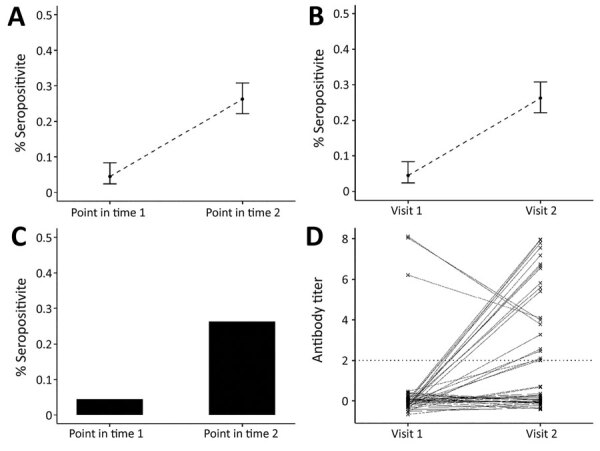
Link between severe acute respiratory syndrome coronavirus 2 infection dynamics and serologic analysis designs. A) Example of results from cross-sectional population study design, indicating percentage of study population who are seropositive at each sample time point. B) Example of results from a cohort study design: percentage of study population who are seropositive at each sample time point. The difference in the study designs is shown in panels C and D. C) In a cross-sectional design, we only know proportions in the population; however, panel D shows an example of each person’s antibody titers over time, illustrating that in a cohort study we can follow the dynamics of antibody response over time (e.g., the proportion who seroconvert and person-to-person variability).

References

    1. Amanat F, Stadlbauer D, Strohmeier S, Nguyen THO, Chromikova V, McMahon M, et al. A serological assay to detect SARS-CoV-2 seroconversion in humans. Nat Med. 2020; Epub ahead of print. 10.1038/s41591-020-0913-5 - DOI - PMC - PubMed
    1. Center for Health Security. Serology-based-tests-for-COVID-19 [cited 2020 Apr 3]. http://www.centerforhealthsecurity.org/resources/COVID-19/Serology-based...
    1. Okba NMA, Müller MA, Li W, Wang C, GeurtsvanKessel CH, Corman VM, et al. Severe acute respiratory syndrome coronavirus 2–specific antibody responses in coronavirus disease 2019 patients. Emerg Infect Dis. 2020;26:1478–88; Epub ahead of print. 10.3201/eid2607.200841 - DOI - PMC - PubMed
    1. World Health Organization. Population-based age-stratified seroepidemiological investigation protocol for COVID-19 virus infection [cited 2020 Apr 6]. https://www.who.int/publications-detail/population-based-age-stratified-...
    1. World Health Organization. Laboratory biosafety guidance related to coronavirus disease 2019. (COVID-19): interim guidance [cited 2020 May 6]. https://apps.who.int/iris/bitstream/handle/10665/331138/WHO-WPE-GIH-2020...

Substances