. 2020 Jul 27;48(13):7584-7594.
doi: 10.1093/nar/gkaa512.

Intrinsic disorder is essential for Cas9 inhibition of anti-CRISPR AcrIIA5

Affiliations

Intrinsic disorder is essential for Cas9 inhibition of anti-CRISPR AcrIIA5

So Young An et al. Nucleic Acids Res. .

Abstract

Clustered regularly interspaced short palindromic repeats (CRISPRs) and CRISPR-associated (Cas) proteins provide adaptive immunity to prokaryotes against invading phages and plasmids. As a countermeasure, phages have evolved anti-CRISPR (Acr) proteins that neutralize the CRISPR immunity. AcrIIA5, isolated from a virulent phage of Streptococcus thermophilus, strongly inhibits diverse Cas9 homologs, but the molecular mechanism underlying the Cas9 inhibition remains unknown. Here, we report the solution structure of AcrIIA5, which features a novel α/β fold connected to an N-terminal intrinsically disordered region (IDR). Remarkably, truncation of the N-terminal IDR abrogates the inhibitory activity against Cas9, revealing that the IDR is essential for Cas9 inhibition by AcrIIA5. Progressive truncations and mutations of the IDR illustrate that the disordered region not only modulates the association between AcrIIA5 and Cas9-sgRNA, but also alters the catalytic efficiency of the inhibitory complex. The length of IDR is critical for the Cas9-sgRNA recognition by AcrIIA5, whereas the charge content of IDR dictates the inhibitory activity. Conformational plasticity of IDR may be linked to the broad-spectrum inhibition of Cas9 homologs by AcrIIA5. Identification of the IDR as the main determinant for Cas9 inhibition expands the inventory of phage anti-CRISPR mechanisms.


Figures

Figure 1.
Figure 1.
The chromatogram and the solution structure of AcrIIA5. (A) The size exclusion chromatogram of AcrIIA5 using a Superdex 75 30/100 GL column. The elution profiles of standard marker proteins are shown on top of the chromatogram as a reference, and the calculated molecular weight of AcrIIA5 is annotated. (B) Schematic representation of the secondary structure of AcrIIA5 shown above the amino acid sequence. (C) The lowest-energy solution structure of AcrIIA5 in a cartoon diagram and rainbow color scheme. The disordered N-terminal residues (a.a. 1–22) are omitted for visual clarity, and the secondary structures are annotated. (D) Superimposition of the backbone atoms of the final 20 simulated annealing structures of AcrIIA5.
Figure 2.
Figure 2.
Characterization of the N-terminal IDR of AcrIIA5. (A) Illustration of the N-terminal IDR of AcrIIA5. The ensemble of 20 NMR structures was superimposed using the secondary structural region, and presented in a cartoon diagram. (B) 1H–15N heteronuclear NOE data as a function of the residue number of AcrIIA5. A dashed line denotes the heteronuclear NOE value of 0.6, and secondary structures are shown above the NOE data.
Figure 3.
Figure 3.
Impact of the IDR length and charge on Cas9 inhibition by AcrIIA5. (A) DNA cleavage assay of S. pyogenes Cas9−sgRNA (0.5 μM) in the presence of AcrIIA4 (3 μM) and AcrIIA5 (0.25, 0.5, 1 and 3 μM). (B) Analysis of sgRNA (0.2 μM) cleavage in the presence and absence of Cas9 (0.4 μM), AcrIIA4 (4 μM) and AcrIIA5 (4 μM) on a urea gel. (C) DNA cleavage assay of Cas9−sgRNA (0.5 μM) in the presence of AcrIIA5 (1 μM) or AcrIIA5Δ20 (1 μM). (D) Domain constructs of AcrIIA5 with serial truncations (top) and charge mutations of the IDR (middle), and the IDR peptide sequence (bottom). (E−G) DNA cleavage assay of Cas9−sgRNA (0.5 μM) in the presence of (E) AcrIIA5 with serial truncations of IDR (3 μM), (F) AcrIIA5 with charge mutations of IDR (3 μM), and (G) the isolated IDR peptide (a.a. 1–20; 0.25, 0.5, 1, 3, and 5 μM) of AcrIIA5.
Figure 4.
Figure 4.
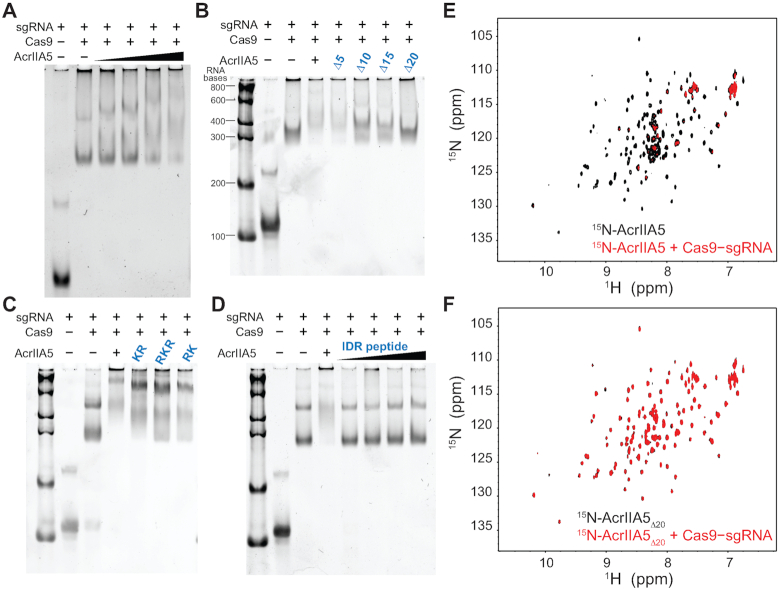
Interaction between AcrIIA5 and Cas9–sgRNA via gel shift assay and NMR spectroscopy. Changes in the electrophoretic mobility shift profiles of Cas9–sgRNA (0.2 μM) in the presence of (A) AcrIIA5 (0.4, 0.8, 2 and 4 μM), (B) AcrIIA5 (4 μM) with serial truncations of IDR, (C) AcrIIA5 (4 μM) with positive charge mutations of IDR and (D) the isolated IDR peptide (0.4, 0.8, 2 and 4 μM). 2D 1H–15N HSQC spectra of (E) 15N-AcrIIA5 and (F) 15N-AcrIIA5Δ20 are shown in the absence (black) and in the presence (red) of Cas9–sgRNA.
Figure 5.
Figure 5.
Electrostatic surface potential of AcrIIA5, and the influence of surface charge mutations on Cas9 inhibition. (A) Structure of AcrIIA5 with electrostatic surface potential in a surface representation for the positively- and negatively-charged surface. (B) Basic residues (blue) and (C) acidic residues (red) selected for mutagenesis are shown in a space-filling model. DNA cleavage assay of S. pyogenes Cas9−sgRNA (0.5 μM) in the presence of AcrIIA5 mutants (3 μM) for (D) basic residues and (E) acidic residues. (F) Residues that affect the Acr activity of AcrIIA5 in vivo are shown in a space-filling model: Asp50/Asp74 (orange), Arg62/Lys88 (cyan), and His66/Asn70/His73 (green). (G) DNA cleavage assay, and (H) gel shift assay of S. pyogenes Cas9−sgRNA against AcrIIA5 mutants.

References

    1. Jansen R., van Embden J.D.A., Gaastra W., Schouls L.M.. Identification of genes that are associated with DNA repeats in prokaryotes. Mol. Microbiol. 2002; 43:1565–1575. - PubMed
    1. Deveau D., Garneau J.E., Moineau S.. CRISPR/Cas system and its role in phage-bacteria interactions. Annu. Rev. Microbiol. 2010; 64:475–493. - PubMed
    1. van der Oost J., Westra E.R., Jackson R.N., Wiedenheft B.. Unravelling the structural and mechanistic basis of CRISPR–Cas systems. Nat. Rev. Microbiol. 2014; 12:479–492. - PMC - PubMed
    1. Horvath P., Barrangou R.. CRISPR/Cas, the immune system of bacteria and archaea. Science. 2010; 327:167–170. - PubMed
    1. Marraffini L.A. CRISPR–Cas immunity in prokaryotes. Nature. 2015; 526:55–61. - PubMed

Publication types

MeSH terms

Substances