Review
. 2020 Jul;19(14):1716-1726.
doi: 10.1080/15384101.2020.1780382. Epub 2020 Jun 16.

RZZ-SPINDLY-DYNEIN: you got to keep 'em separated

Affiliations
Review

RZZ-SPINDLY-DYNEIN: you got to keep 'em separated

João Barbosa et al. Cell Cycle. 2020 Jul.

Abstract

To maintain genome stability, chromosomes must be equally distributed among daughter cells at the end of mitosis. The accuracy of chromosome segregation requires sister-kinetochores to stably attach to microtubules emanating from opposite spindle poles. However, initial kinetochore-microtubule interactions are able to turnover so that defective attachment configurations that typically arise during early mitosis may be corrected. Growing evidence supports a role for the RZZ complex in preventing the stabilization of erroneous kinetochore-microtubule attachments. This inhibitory function of RZZ toward end-on attachments is relieved by DYNEIN-mediated transport of the complex as chromosomes congress and appropriate interactions with microtubules are established. However, it remains unclear how DYNEIN is antagonized to prevent premature RZZ removal. We recently described a new mechanism that sheds new light on this matter. We found that POLO kinase phosphorylates the DYNEIN adaptor SPINDLY to promote the uncoupling between RZZ and DYNEIN. Elevated POLO activity during prometaphase ensures that RZZ is retained at kinetochores to allow the dynamic turnover of kinetochore-microtubule interactions and prevent the stabilization of erroneous attachments. Here, we discuss additional interpretations to explain a model for POLO-dependent regulation of the RZZ-SPINDLY-DYNEIN module during mitosis.

Keywords: POLO/PLK1; RZZ; SPINDLY; dynein adaptor; kinetochore-microtubule attachments.


Conflict of interest statement

No potential conflict of interest was reported by the authors.

Figures
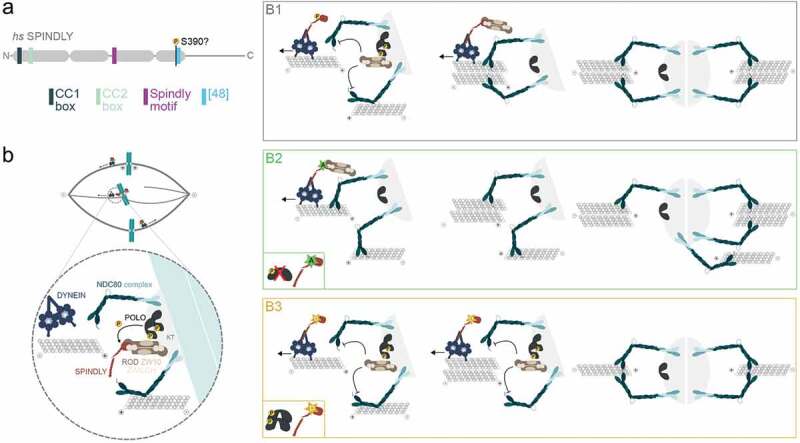
Figure 1.
Figure 1.
POLO regulates DYNEIN-dependent removal of RZZ-SPINDLY to fine-tune KT-MT attachments in mitosis. (a) Schematic representation of the different motifs present in human SPINDLY. Regions predicted to adopt coiled-coil conformations are represented in gray. We propose that an additional motif exists C-terminal to the Spindly motif [47]. A putative Plk1-dependent phosphorylation site on human SPINDLY is shown (S390). Our work identifies a Polo-dependent phosphorylation site within an equivalent motif on Drosophila SPINDLY (S499) [47]. (b) Proposed model for POLO-dependent regulation of the RZZ-SPINDLY-DYNEIN module at KTs: (B1) During prometaphase, POLO activity promotes RZZ disengagement from SPINDLY-DYNEIN by phosphorylating SPINDLY. The transient enrichment in RZZ at KTs opposes MT binding by NDC80, thereby, inhibiting the formation of stable attachments. This regulatory mechanism may be important to prevent premature stabilization of erroneous interactions that can form. (B2) In the absence of POLO activity or upon expression of non-phosphorylatable SPINDLY (A) mutant, DYNEIN can shed RZZ-SPINDLY of KTs. Consequently, untimely removal of RZZ can contribute to the stabilization of erroneous attachments (for instance, merotelic interaction). (B3) Conversely, in cells expressing phospho-mimetic SPINDLY (d) mutant or with unrestricted POLO kinase activity, RZZ is uncoupled from SPINDLY-DYNEIN. This allows the RZZ to inhibit NDC80 affinity toward MTs and promote MT turnover at KTs. Nevertheless, continuous destabilization of KT-MT interactions may affect the robustness of attachments.

References

    1. Musacchio A, Desai A.. A molecular view of kinetochore assembly and function. Biology (Basel). 2017;6(1):5. - PMC - PubMed
    1. Schukken KM, Foijer F. CIN and aneuploidy: different concepts, different consequences. Bioessays. 2018;40(1):1700147. - PubMed
    1. Cimini D, Howell B, Maddox P, et al. Merotelic kinetochore orientation is a major mechanism of aneuploidy in mitotic mammalian tissue cells. J Cell Biol. 2001;153(3):517–527. - PMC - PubMed
    1. Thompson SL, Compton DA. Chromosome missegregation in human cells arises through specific types of kinetochore-microtubule attachment errors. Proc Natl Acad Sci USA. 2011;108(44):17974–17978. - PMC - PubMed
    1. Bakhoum SF, Genovese G, Compton DA. Deviant kinetochore microtubule dynamics underlie chromosomal instability. Curr Biol. 2009;19(22):1937–1942. - PMC - PubMed

Publication types

LinkOut - more resources
