


A predictive tool for identification of SARS-CoV-2 PCR-negative emergency department patients using routine test results
- PMID: 32544861
- PMCID: PMC7286235
- DOI: 10.1016/j.jcv.2020.104502
A predictive tool for identification of SARS-CoV-2 PCR-negative emergency department patients using routine test results
Abstract
Background: Testing for COVID-19 remains limited in the United States and across the world. Poor allocation of limited testing resources leads to misutilization of health system resources, which complementary rapid testing tools could ameliorate.
Objective: To predict SARS-CoV-2 PCR positivity based on complete blood count components and patient sex.
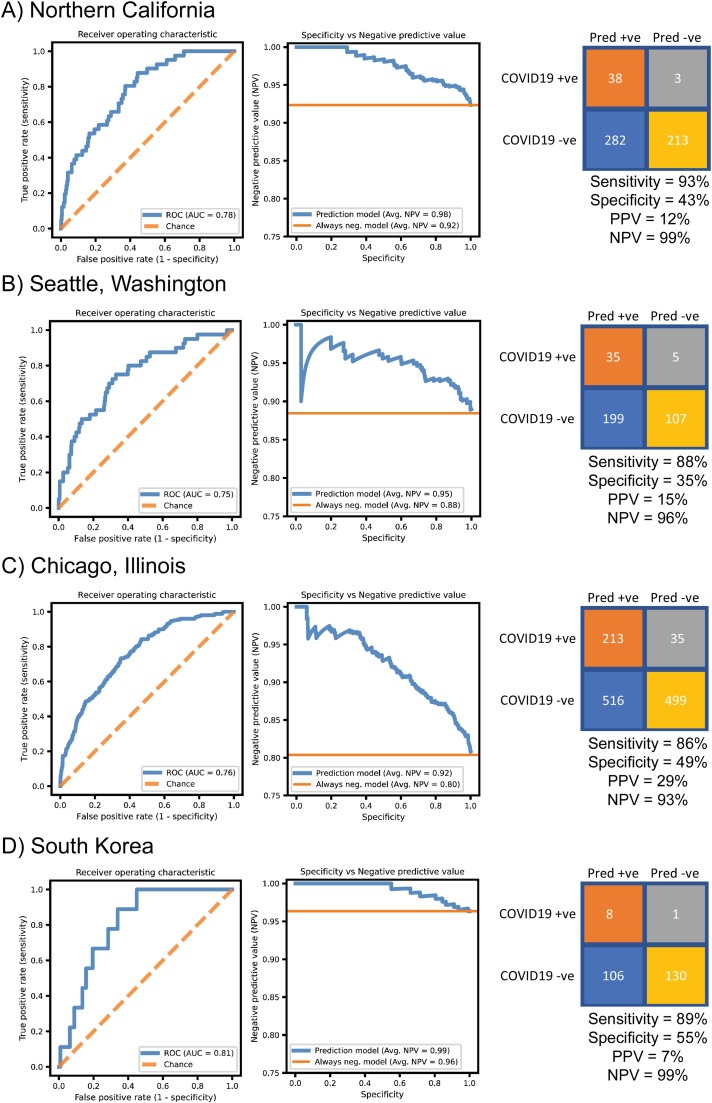
Study design: A retrospective case-control design for collection of data and a logistic regression prediction model was used. Participants were emergency department patients > 18 years old who had concurrent complete blood counts and SARS-CoV-2 PCR testing. 33 confirmed SARS-CoV-2 PCR positive and 357 negative patients at Stanford Health Care were used for model training. Validation cohorts consisted of emergency department patients > 18 years old who had concurrent complete blood counts and SARS-CoV-2 PCR testing in Northern California (41 PCR positive, 495 PCR negative), Seattle, Washington (40 PCR positive, 306 PCR negative), Chicago, Illinois (245 PCR positive, 1015 PCR negative), and South Korea (9 PCR positive, 236 PCR negative).
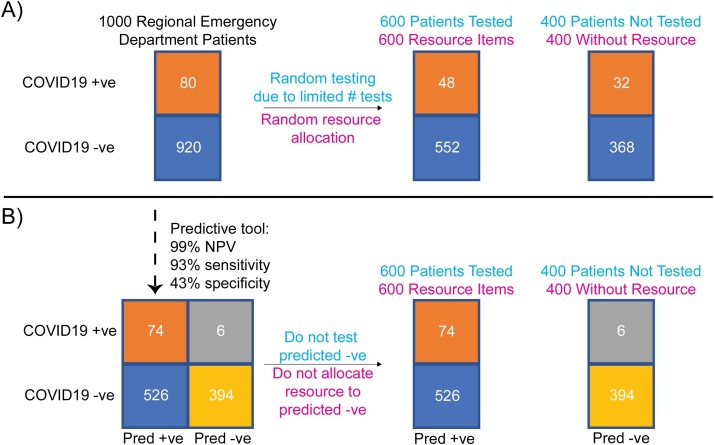
Results: A decision support tool that utilizes components of complete blood count and patient sex for prediction of SARS-CoV-2 PCR positivity demonstrated a C-statistic of 78 %, an optimized sensitivity of 93 %, and generalizability to other emergency department populations. By restricting PCR testing to predicted positive patients in a hypothetical scenario of 1000 patients requiring testing but testing resources limited to 60 % of patients, this tool would allow a 33 % increase in properly allocated resources.
Conclusions: A prediction tool based on complete blood count results can better allocate SARS-CoV-2 testing and other health care resources such as personal protective equipment during a pandemic surge.
Keywords: COVID-19; Machine learning; Prediction tool; Rapid testing; SARS-CoV-2.
Copyright © 2020 Elsevier B.V. All rights reserved.
Conflict of interest statement
Declaration of Competing Interest The authors declare no competing interests.
Figures
References
-
- Emanuel E.J. Fair allocation of scarce medical resources in the time of Covid-19. N. Engl. J. Med. 2020;0 - PubMed
-
- Eitel D.R., Travers D.A., Rosenau A.M., Gilboy N., Wuerz R.C. The emergency severity index triage algorithm version 2 is reliable and valid. Acad. Emerg. Med. Off. J. Soc. Acad. Emerg. Med. 2003;10:1070–1080. - PubMed
Publication types
MeSH terms
Grants and funding
LinkOut - more resources
Full Text Sources
Other Literature Sources
Medical
Miscellaneous
