


Low-Dose Aspirin Use Significantly Improves the Survival of Late-stage NPC: A Propensity Score-Matched Cohort Study in Taiwan
- PMID: 32545461
- PMCID: PMC7352863
- DOI: 10.3390/cancers12061551
Low-Dose Aspirin Use Significantly Improves the Survival of Late-stage NPC: A Propensity Score-Matched Cohort Study in Taiwan
Abstract
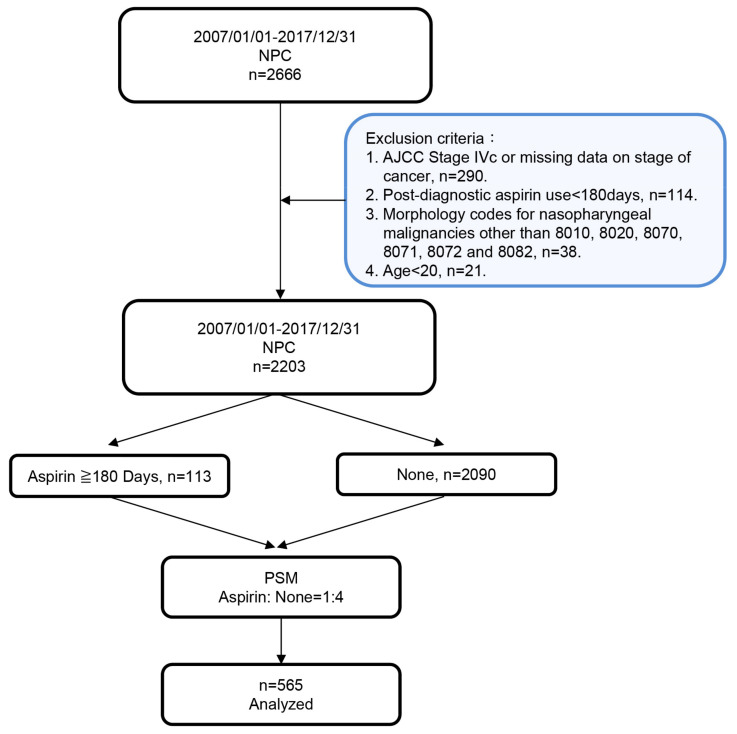
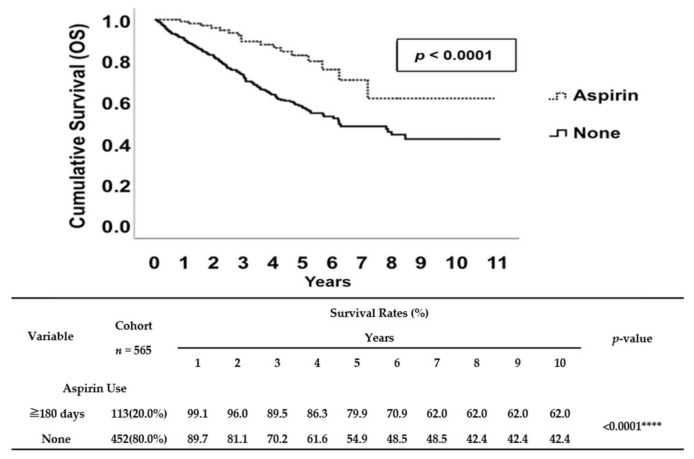
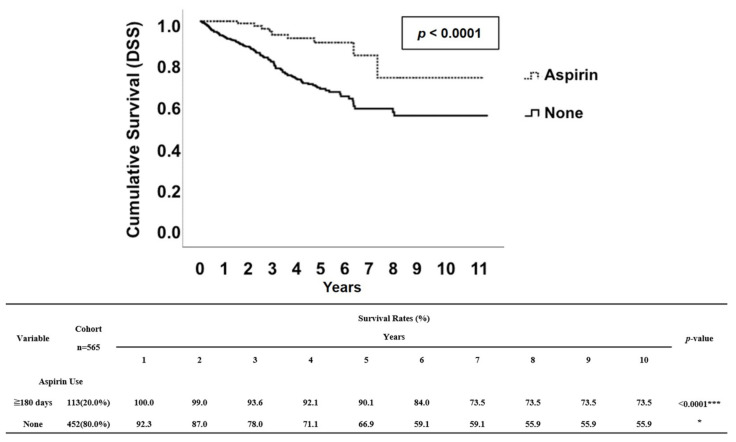
Background: Aspirin use has been associated with improved survival rates in various cancers. However, it remains unclear if aspirin confers a survival benefit on patients with nasopharyngeal carcinoma (NPC). The aim of this study was to assess the associations between aspirin use and survival in different stages of NPC. Methods: This is a 10-year retrospective cohort study of NPC patients. A total of 565 NPC patients were recruited after we performed a 1:4 propensity score match between aspirin users and non-users. Cox regression models with adjusted covariates were employed to evaluate factors that influence the survival rate of NPC patients. Results: The Kaplan-Meier analysis revealed that the overall survival (p < 0.0001) and disease-specific survival (p < 0.0001) rates of 180-day aspirin users increased. Increased survival rates were also observed in 180-day aspirin users with Stages III and IV, T, N1 and 2, and N3 categories. Cox regression models indicated that factors, including aspirin use (univariate: HR = 0.28, 95% CI = 0.14-0.55, p < 0.001; multivariate: HR = 0.23, 95% CI = 0.12-0.46, p < 0.001), were independent prognostic factors for survival. Conclusions: Aspirin use for more than 180 days is associated with an increased survival rate and is a positive independent prognostic factor in NPC.
Keywords: 10-year follow-up time; disease-specific survival rate; low-dose aspirin; nasopharyngeal carcinoma; overall survival rate.
Conflict of interest statement
The authors declare no conflict of interest.
Figures
References
-
- Almeida J., Brasil R., Miyamura F., Magarinos N., Portes A., Neto A.F. Nasopharyngeal carcinoma. Int. Arch. Otorhinolaryngol. 2012;394:64–80. doi: 10.7162/S1809-977720120S1PO-124. - DOI
-
- Vincent I., de Vita J., Hellmann S., Rosenberg A. Principles and Practice of Oncology. 6th ed. Lippincott Williams & Wilkins; Philadelphia, PA, USA: 2001.
-
- Thawley S.E., Panje W.R., Batsakis J.G., Lindberg R.D. Comprehensive Management of Head and Neck Tumors. 1st ed. WB Sanders Co; Philadelphia, PA, USA: 1987.
Grants and funding
LinkOut - more resources
Full Text Sources
