. 2020 Jun 12;10(6):899.
doi: 10.3390/biom10060899.

Bicyclic Boronates as Potent Inhibitors of AmpC, the Class C β-Lactamase from Escherichia coli

Affiliations

Bicyclic Boronates as Potent Inhibitors of AmpC, the Class C β-Lactamase from Escherichia coli

Pauline A Lang et al. Biomolecules. .

Abstract

Resistance to β-lactam antibacterials, importantly via production of β-lactamases, threatens their widespread use. Bicyclic boronates show promise as clinically useful, dual-action inhibitors of both serine- (SBL) and metallo- (MBL) β-lactamases. In combination with cefepime, the bicyclic boronate taniborbactam is in phase 3 clinical trials for treatment of complicated urinary tract infections. We report kinetic and crystallographic studies on the inhibition of AmpC, the class C β‑lactamase from Escherichia coli, by bicyclic boronates, including taniborbactam, with different C-3 side chains. The combined studies reveal that an acylamino side chain is not essential for potent AmpC inhibition by active site binding bicyclic boronates. The tricyclic form of taniborbactam was observed bound to the surface of crystalline AmpC, but not at the active site, where the bicyclic form was observed. Structural comparisons reveal insights into why active site binding of a tricyclic form has been observed with the NDM-1 MBL, but not with other studied β-lactamases. Together with reported studies on the structural basis of inhibition of class A, B and D β‑lactamases, our data support the proposal that bicyclic boronates are broad-spectrum β‑lactamase inhibitors that work by mimicking a high energy 'tetrahedral' intermediate. These results suggest further SAR guided development could improve the breadth of clinically useful β-lactamase inhibition.

Keywords: VNRX-5133/taniborbactam; antibiotic resistance; bicyclic boronate inhibitors; metallo- and serine-β-lactamase inhibition; transition state analogue.; vaborbactam; β-lactam antibacterial.


Conflict of interest statement

The authors declare no conflict of interest.

Figures
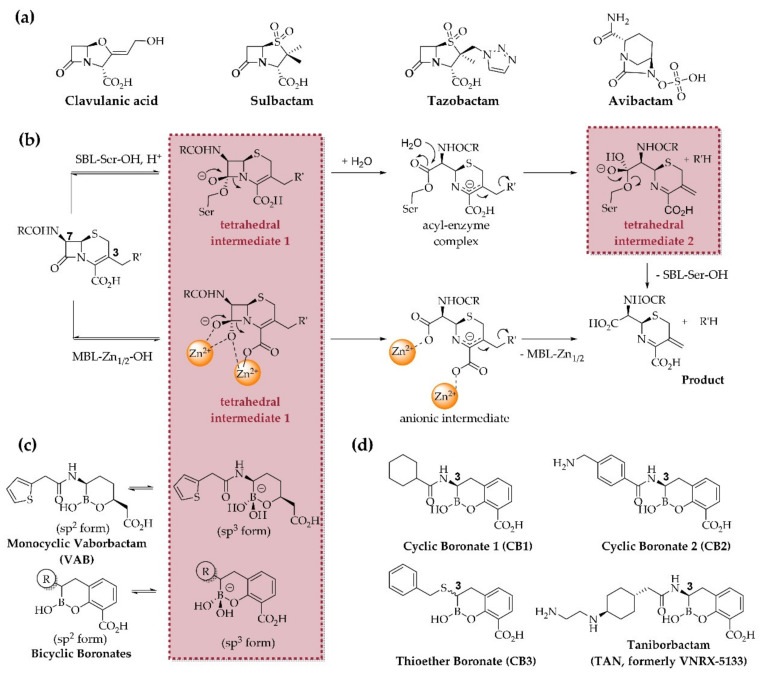
Figure 1
Figure 1
Mechanistic basis for β-lactamase inhibition by (bi)cyclic boronates. (a) clinically used β-lactamase inhibitors; (b) outline general mechanisms of SBLs and MBLs, exemplified by hydrolysis of a cephalosporin with elimination at C-3’. The tetrahedral intermediates, common to both SBL and MBL catalysis, may be mimicked by the sp3 form of (bi)cyclic boronates; (c) equilibria between sp2- and sp3-hybridized forms of mono- and bi-cyclic boronates; (d) structures of bicyclic boronate β-lactamase inhibitors cyclic boronate 1 (CB1), cyclic boronate 2 (CB2), the thioether boronate (CB3), and taniborbactam (TAN, formerly VNRX-5133). Note that the CB3 used in this study contained a mixture of the (3S)- and (3R)-enantiomers (~1:3, respectively) [16].
Figure 2
Figure 2
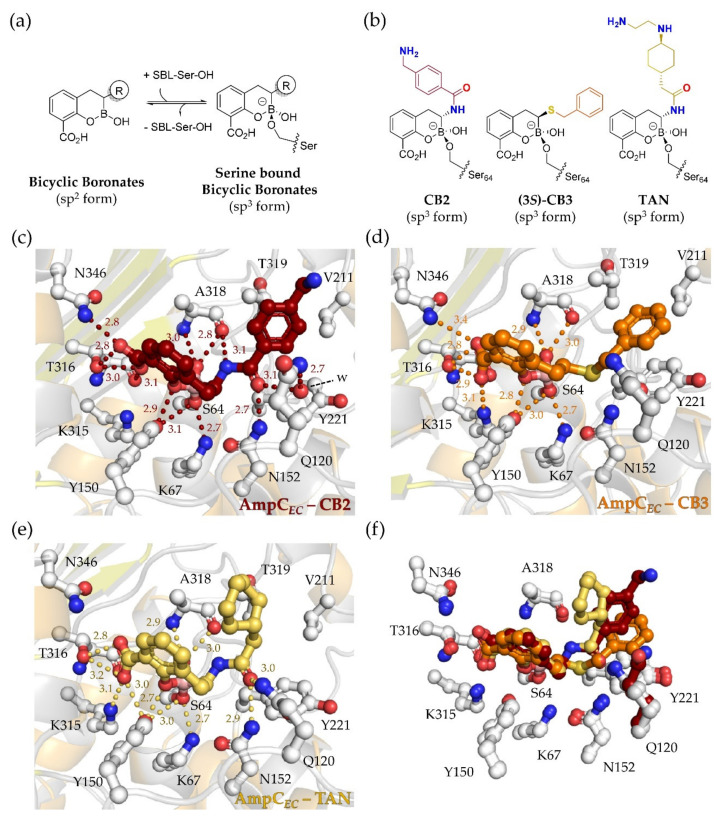
Structural basis for AmpCEC inhibition by bicyclic boronates. (a) reaction between sp2-hybridized bicyclic boronates and SBLs give a serine-bonded anionic sp3-hybridized species; (b) structures of serine-bonded sp3 forms of the bicyclic boronates; (ce) active site views of complexes of AmpCEC with CB2, CB3, and TAN. Hydrogen-bonding interactions are shown in colored dashes, distances are in Å; (f) overlay of active site views, color coding as in (ce). Note that the Q120 side chain is rotated in AmpCEC-CB2 structure (highlighted in dark red); it is unclear whether this is induced by binding of CB2, or due to the crystallization conditions (see text).
Figure 3
Figure 3
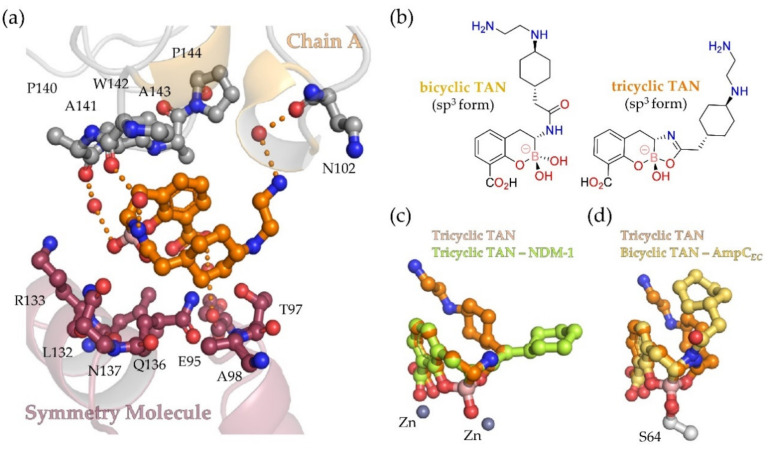
Comparison of bi- and tri-cyclic forms of sp3 hybridized taniborbactam in complex with AmpCEC. (a) The tricyclic form of TAN as observed at the interface between symmetry related AmpCEC molecules along a three-fold rotation axis (see Figure S3a for overview, PDB ID 6YEN). Residues within 6 Å of TAN are shown as grey/purple sticks, hydrogen-bonding interactions as orange dashes, and waters as red spheres; (b) structures of proposed bi- and tricyclic sp3 forms of TAN; (c) overlay of the ‘interface’ tricyclic TAN (AmpCEC, orange) with active site bound tricyclic TAN (NDM-1, green); (d) overlay of the ‘interface’ tricyclic TAN (AmpCEC, orange) with active site bound bicyclic TAN bonded to AmpCEC S64 (yellow). Note, with the MBL NDM-1 (PDB ID: 6RMF), both the bicyclic and the tricyclic forms were observed in one chain of the crystallographic dimer (chain A, shown here), while, in the second chain, only the tricyclic form was observed [24].
Figure 4
Figure 4
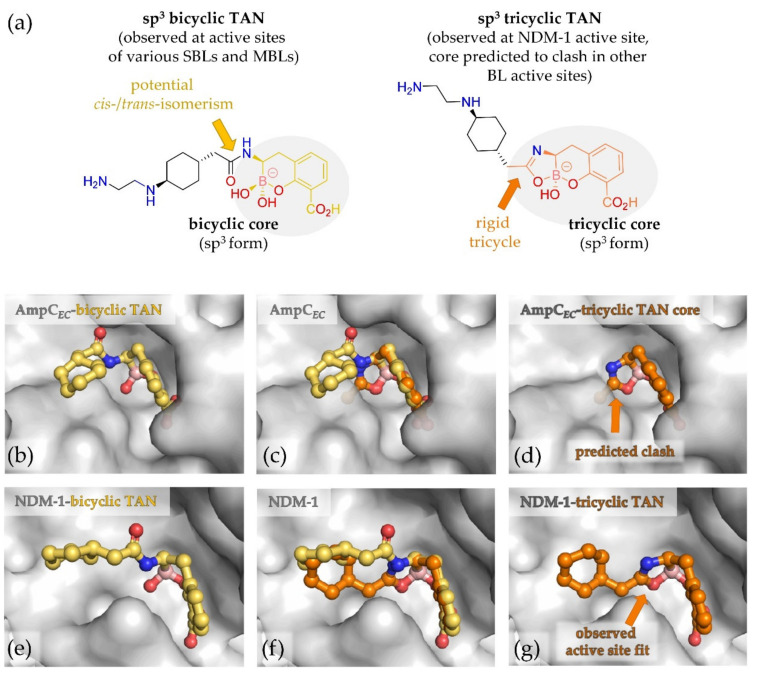
Tricyclic TAN likely cannot bind at the AmpCEC active site due to a steric clash of the putative tricyclic core and side chain. (a) Structural comparison of tricyclic and bicyclic forms of TAN; (bg) overlay of tricyclic TAN core (orange, not crystallographically observed at AmpCEC active site) with bicyclic TAN (yellow) crystallographically observed bound to active site S64 of AmpCEC (PDB ID: 6YEN) reveals a likely steric clash of the rigid tricycle in the AmpCEC active site as well as active sites of other β-lactamases (Figure S5). By contrast, both tricyclic (orange) and bicyclic (yellow) forms of TAN have been crystallographically observed at the active site of the B1 MBL NDM-1 (PDB ID: 6RMF) [24]. Note, in both structures, that the terminal amine of the side chain was disordered and therefore excluded from the model; (b) observed conformation of bicyclic TAN at the AmpCEC active site; (c) alignment of tricyclic TAN core to bicyclic TAN observed at the AmpCEC active site; (d) putative steric clash of tricyclic TAN in the AmpCEC active site based on the overlay in c). Note the apparently flexible parts of the side chain are not shown, but would make a clear steric clash with the active site; (e) observed conformation of bicyclic TAN at the NDM-1 active site; (f) overlay of tricyclic TAN and bicyclic TAN, both as observed at the NDM-1 active site; (g) observed conformation of tricyclic TAN at the NDM-1 active site.

References

    1. Versporten A., Bolokhovets G., Ghazaryan L., Abilova V., Pyshnik G., Spasojevic T., Korinteli I., Raka L., Kambaralieva B., Cizmovic L., et al. Antibiotic use in eastern Europe: A cross-national database study in coordination with the WHO Regional Office for Europe. Lancet Infect. Dis. 2014;14:381–387. doi: 10.1016/S1473-3099(14)70071-4. - DOI - PubMed
    1. Bush K. Past and Present Perspectives on β-Lactamases. Antimicrob. Agents Chemother. 2018;62:e01076-18. doi: 10.1128/AAC.01076-18. - DOI - PMC - PubMed
    1. Drawz S.M., Bonomo R.A. Three decades of β-lactamase inhibitors. Clin. Microbiol. Rev. 2010;23:160–201. doi: 10.1128/CMR.00037-09. - DOI - PMC - PubMed
    1. Bush K., Jacoby G.A. Updated Functional Classification of β-Lactamases. Antimicrob. Agents Chemother. 2010;54:969–976. doi: 10.1128/AAC.01009-09. - DOI - PMC - PubMed
    1. Leigh D.A., Bradnock K., Marriner J.M. Augmentin (amoxycillin and clavulanic acid) therapy in complicated infections due to β-lactamase producing bacteria. J. Antimicrob. Chemother. 1981;7:229–236. doi: 10.1093/jac/7.3.229. - DOI - PubMed

Publication types

MeSH terms