. 2020 Jun 13;12(6):642.
doi: 10.3390/v12060642.

Potential Antiviral Options against SARS-CoV-2 Infection

Affiliations

Potential Antiviral Options against SARS-CoV-2 Infection

Aleksandr Ianevski et al. Viruses. .

Abstract

As of June 2020, the number of people infected with severe acute respiratory coronavirus 2 (SARS-CoV-2) continues to skyrocket, with more than 6.7 million cases worldwide. Both the World Health Organization (WHO) and United Nations (UN) has highlighted the need for better control of SARS-CoV-2 infections. However, developing novel virus-specific vaccines, monoclonal antibodies and antiviral drugs against SARS-CoV-2 can be time-consuming and costly. Convalescent sera and safe-in-man broad-spectrum antivirals (BSAAs) are readily available treatment options. Here, we developed a neutralization assay using SARS-CoV-2 strain and Vero-E6 cells. We identified the most potent sera from recovered patients for the treatment of SARS-CoV-2-infected patients. We also screened 136 safe-in-man broad-spectrum antivirals against the SARS-CoV-2 infection in Vero-E6 cells and identified nelfinavir, salinomycin, amodiaquine, obatoclax, emetine and homoharringtonine. We found that a combination of orally available virus-directed nelfinavir and host-directed amodiaquine exhibited the highest synergy. Finally, we developed a website to disseminate the knowledge on available and emerging treatments of COVID-19.

Keywords: antiviral drug combinations; antivirals; broad-spectrum antivirals.


Conflict of interest statement

The authors declare no conflicts of interest. The funders had no role in the design of the study; in the collection, analyses, or interpretation of data; in the writing of the manuscript, or in the decision to publish the results.

Figures
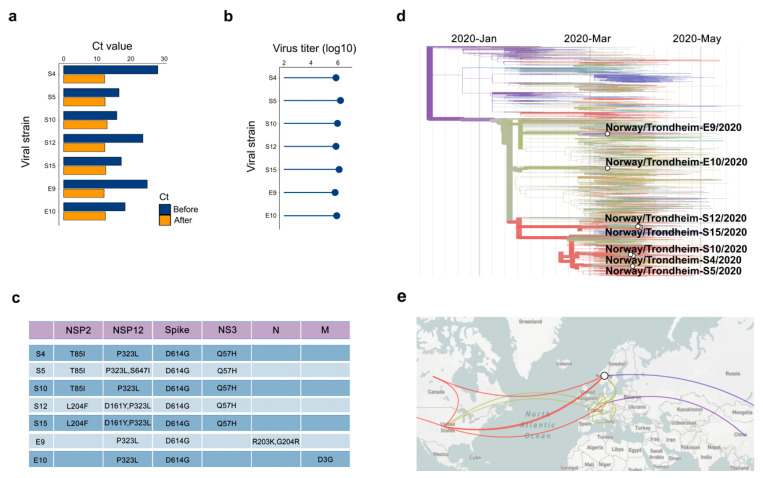
Figure 1
Figure 1
Isolation and characterization of 7 SARS-CoV-2 strains used in this study. (a) RT-qPCR analysis of 7 SARS-CoV-2 strains isolated from nasopharyngeal swabs. (b) Viruses amplified in Vero-E6 cells were quantified by plaque assay. (c) Table showing variations in amino acids between our SARS-CoV-2 strains and the reference hCoV-19/Wuhan/WIV04/2019 strain. (d) Phylogenetic analysis of 7 SARS-CoV-2 strains from Trondheim and other viral strains, which full-genome sequences were submitted to the GISAID database. (e) The origin of our 7 strains according to nextstrain.org.
Figure 2
Figure 2
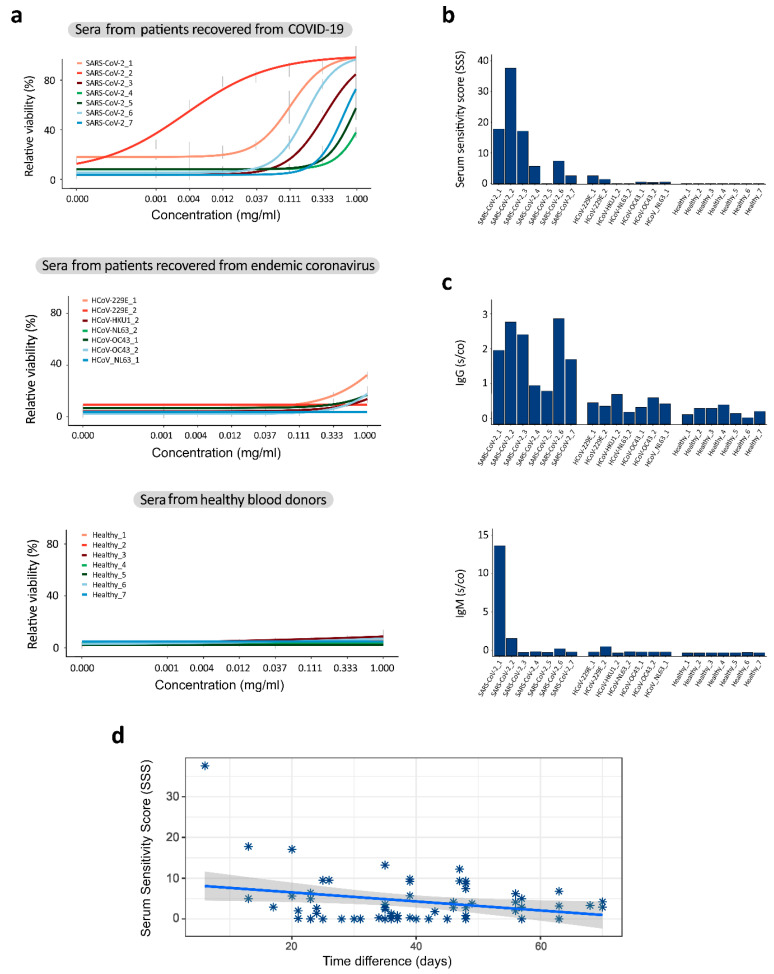
Sera from patients recovered from COVID-19 neutralized the SARS-CoV-2 virus and prevented the virus-mediated death of Vero-E6 cells. (a) The HCoV-19/Norway/Trondheim-E9/2020 strain (moi 0.1) was incubated with indicated concentrations of sera obtained from 7 patients recovered from COVID-19, 7 patients recovered from endemic coronavirus infections and 7 healthy blood donors. The mixtures were added to Vero-E6 cells. Cell viability was measured after 72 h. Mean ± SD, n = 3. (b) Serum sensitivity scores (SSS) were calculated based on curves in (a). (b,c) The IgG and IgM levels were analyzed in the sera of these patients using commercial Elisa kits. (d) Correlation analysis of serum sensitivity scores and time intervals between the SARS-CoV-2 diagnosis and sera collection.3.3. Repurposing Safe-In-Man BSAAs.
Figure 3
Figure 3
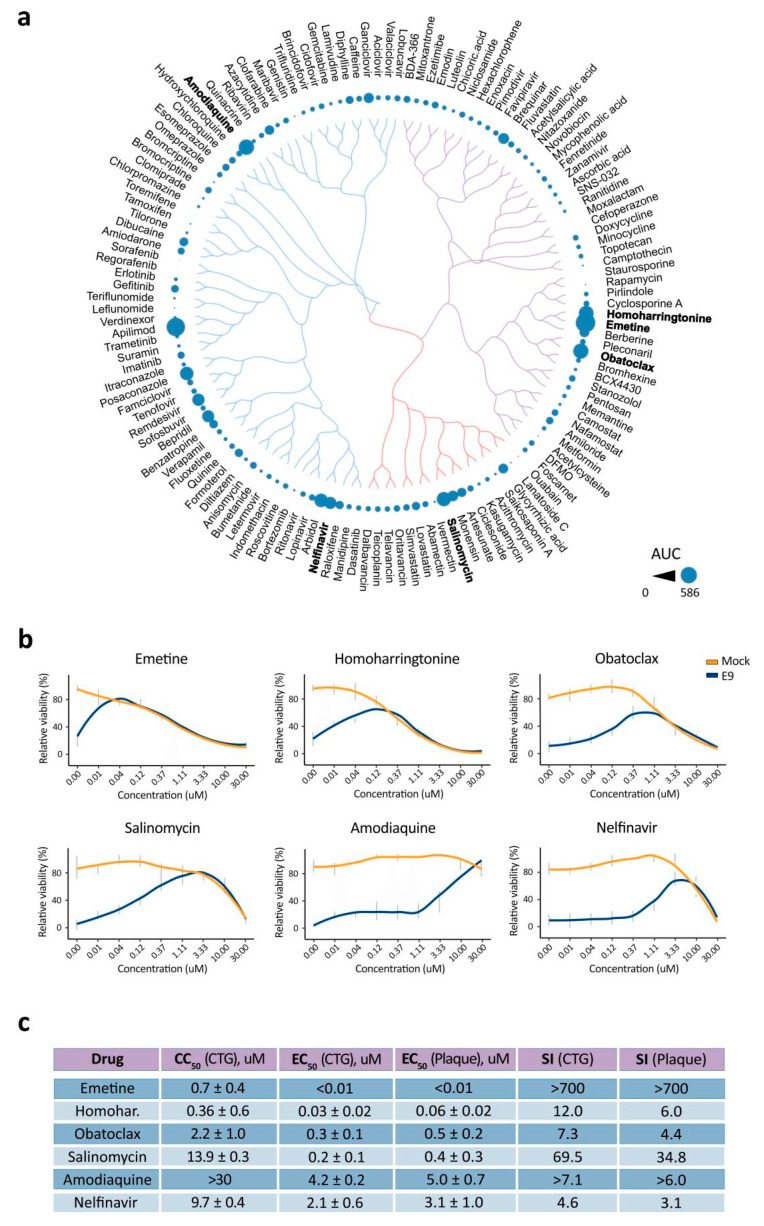
Anti-SARS-CoV-2 activity of safe-in man broad-spectrum antivirals in Vero-E6 cells. (a) Structure-antiviral activity relation of 136 broad-spectrum antivirals (BSAAs). The compounds were clustered based on their structural similarity calculated by ECPF4 fingerprints and visualized using the D3 JavaScript library. The anti-SARS-CoV-2 activity of the compounds was quantified using the AUC and shown as bubbles. Bubble size corresponds to compounds AUCs. (b) Vero-E6 cells were treated with increasing concentrations of a compound and infected with the HCoV-19/Norway/Trondheim-E9/2020 strain (moi, 0.1) or mock. After 72 h, the viability of the cells was determined using the CellTiter-Glo assay. Mean ± SD; n = 3. (c) Table showing half-maximal cytotoxic concentration (CC50), the half-maximal effective concentration (EC50) and selectivity indexes (SI = CC50/EC50) for selected anti-SARS-CoV-2 compounds calculated from CTG and plaque assays. Mean ± SD; n = 3.
Figure 4
Figure 4
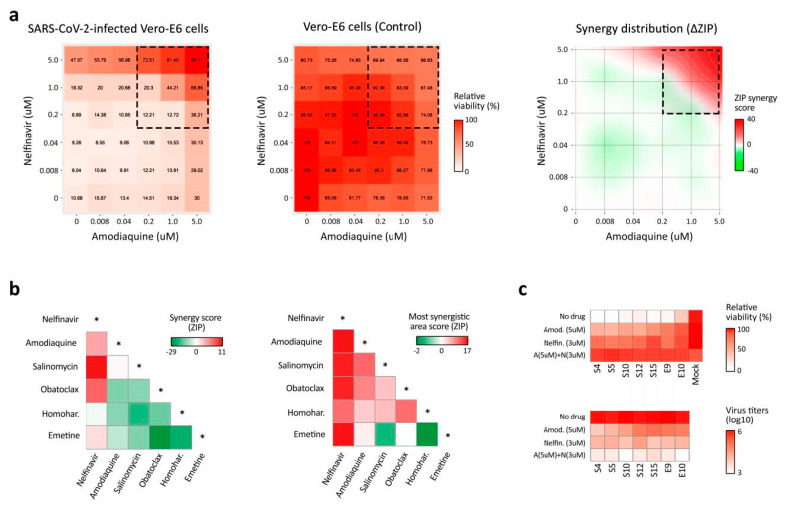
Effects of drug combinations on the SARS-CoV-2 infection. (a) The representative interaction landscapes of one of the drug combinations (amodiaquine-nelfinavir) measured using a CTG assay and SARS-CoV-2- and mock-infected cells (left and central panels). Synergy distribution is shown for virus-infected cells (right panel). (b) Synergy scores and the most synergistic area scores of 15 drug combinations. (c) The effects of the amodiaquine-nelfinavir combination on viral replication (lower panel), and the viability of cells infected with 7 different SARS-CoV-2 strains (upper panel).

References

    1. WHO WHO Publishes List of Top Emerging Diseases Likely to Cause Major Epidemics. [(accessed on 12 June 2020)]; Available online: www.who.int/medicines/ebola-treatment/WHO-list-of-top-emerging-diseases/en/
    1. Howard C.R., Fletcher N.F. Emerging virus diseases: Can we ever expect the unexpected? Emerg. Microbes Infect. 2012;1:e46. doi: 10.1038/emi.2012.47. - DOI - PMC - PubMed
    1. Bekerman E., Einav S. Infectious disease. Combating emerging viral threats. Science. 2015;348:282–283. doi: 10.1126/science.aaa3778. - DOI - PMC - PubMed
    1. Yuan S., Chu H., Chan J.F., Ye Z.W., Wen L., Yan B., Lai P.M., Tee K.M., Huang J., Chen D., et al. SREBP-dependent lipidomic reprogramming as a broad-spectrum antiviral target. Nat. Commun. 2019;10:120. doi: 10.1038/s41467-018-08015-x. - DOI - PMC - PubMed
    1. Hayden E.C. Experimental drugs poised for use in Ebola outbreak. Nature. 2018;557:475–476. doi: 10.1038/d41586-018-05205-x. - DOI - PubMed

Publication types

MeSH terms

LinkOut - more resources