An analysis of International Health Regulations Emergency Committees and Public Health Emergency of International Concern Designations
- PMID: 32546587
- PMCID: PMC7299007
- DOI: 10.1136/bmjgh-2020-002502
An analysis of International Health Regulations Emergency Committees and Public Health Emergency of International Concern Designations
Abstract
Introduction: Nine events have been assessed for potential declaration of a Public Health Emergency of International Concern (PHEIC). A PHEIC is defined as an extraordinary event that constitutes a public health risk to other states through international spread and requires a coordinated international response. The WHO Director-General convenes Emergency Committees (ECs) to provide their advice on whether an event constitutes a PHEIC. The EC rationales have been criticised for being non-transparent and contradictory to the International Health Regulations (IHR). This first comprehensive analysis of EC rationale provides recommendations to increase clarity of EC decisions which will strengthen the IHR and WHO's legitimacy in future outbreaks.
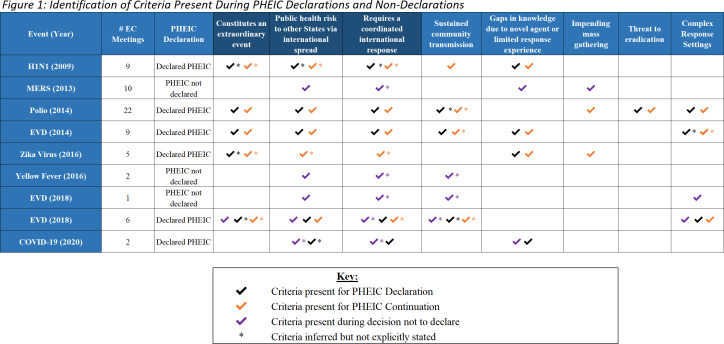
Methods: 66 EC statements were reviewed from nine public health outbreaks of influenza A, Middle East respiratory syndrome coronavirus, polio, Ebola virus disease, Zika, yellow fever and coronavirus disease-2019. Statements were analysed to determine which of the three IHR criteria were noted as contributing towards the EC's justification on whether to declare a PHEIC and what language was used to explain the decision.
Results: Interpretation of the criteria were often vague and applied inconsistently. ECs often failed to describe and justify which criteria had been satisfied.
Discussion: Guidelines must be developed for the standardised interpretation of IHR core criteria. The ECs must clearly identify and justify which criteria have contributed to their rationale for or against PHEIC declaration.
Conclusion: Striving for more consistency and transparency in EC justifications would benefit future deliberations and provide more understanding and support for the process.
Keywords: health policy; public health; review.
© Author(s) (or their employer(s)) 2020. Re-use permitted under CC BY-NC. No commercial re-use. See rights and permissions. Published by BMJ.
Conflict of interest statement
Competing interests: None declared.
Figures
References
-
- World Health Organization International health regulations. 3 edn World Health Organization, 2016.
-
- World Health Organization International health regulations committees and expert roster. Available: http://www.who.int/ihr/procedures/ihr_committees/en/
-
- World Health Organization Statement on the meeting of the international health regulations (2005) emergency committee for Ebola virus disease in the Democratic Republic of the Congo on 12 February 2020. Available: https://www.who.int/news-room/detail/12-02-2020-statement-on-the-meeting...
-
- Joseph A. WHO declares coronavirus outbreak a global health emergency. STAT, 2020.
Publication types
MeSH terms
LinkOut - more resources
Full Text Sources
Medical