. 2020 Jun 16;11(1):3059.
doi: 10.1038/s41467-020-16765-w.

Recurrent horizontal transfer identifies mitochondrial positive selection in a transmissible cancer

Andrea Strakova  1 Thomas J Nicholls #  2   3 Adrian Baez-Ortega #  1 Máire Ní Leathlobhair  1 Alexander T Sampson  1 Katherine Hughes  4 Isobelle A G Bolton  1 Kevin Gori  1 Jinhong Wang  1 Ilona Airikkala-Otter  5 Janice L Allen  6 Karen M Allum  7 Clara L Arnold  8 Leontine Bansse-Issa  9 Thinlay N Bhutia  10 Jocelyn L Bisson  1 Kelli Blank  8 Cristóbal Briceño  11 Artemio Castillo Domracheva  12 Anne M Corrigan  13 Hugh R Cran  14 Jane T Crawford  15 Stephen M Cutter  6 Eric Davis  16 Karina F de Castro  17 Andrigo B De Nardi  18 Anna P de Vos  19 Laura Delgadillo Keenan  20 Edward M Donelan  6 Adela R Espinoza Huerta  21 Ibikunle A Faramade  22 Mohammed Fazil  23 Eleni Fotopoulou  24 Skye N Fruean  25 Fanny Gallardo-Arrieta  26 Olga Glebova  27 Pagona G Gouletsou  28 Rodrigo F Häfelin Manrique  29 Joaquim J G P Henriques  30 Rodrigo S Horta  31 Natalia Ignatenko  32 Yaghouba Kane  33 Cathy King  7 Debbie Koenig  7 Ada Krupa  34 Steven J Kruzeniski  21 Marta Lanza-Perea  13 Mihran Lazyan  35 Adriana M Lopez Quintana  36 Thibault Losfelt  37 Gabriele Marino  38 Simón Martínez Castañeda  39 Mayra F Martínez-López  40 Bedan M Masuruli  41 Michael Meyer  42 Edward J Migneco  43 Berna Nakanwagi  44 Karter B Neal  45 Winifred Neunzig  7 Sally J Nixon  46 Antonio Ortega-Pacheco  47 Francisco Pedraza-Ordoñez  48 Maria C Peleteiro  49 Katherine Polak  50 Ruth J Pye  51 Juan C Ramirez-Ante  48 John F Reece  52 Jose Rojas Gutierrez  53 Haleema Sadia  54 Sheila K Schmeling  55 Olga Shamanova  56 Alan G Sherlock  51 Audrey E Steenland-Smit  9 Alla Svitich  57 Lester J Tapia Martínez  21 Ismail Thoya Ngoka  58 Cristian G Torres  59 Elizabeth M Tudor  60 Mirjam G van der Wel  61 Bogdan A Vițălaru  62 Sevil A Vural  63 Oliver Walkinton  51 Alvaro S Wehrle-Martinez  64 Sophie A E Widdowson  65 Irina Zvarich  66 Patrick F Chinnery  67 Maria Falkenberg  2 Claes M Gustafsson  2 Elizabeth P Murchison  68
Affiliations

Recurrent horizontal transfer identifies mitochondrial positive selection in a transmissible cancer

Andrea Strakova et al. Nat Commun. .

Abstract

Autonomous replication and segregation of mitochondrial DNA (mtDNA) creates the potential for evolutionary conflict driven by emergence of haplotypes under positive selection for 'selfish' traits, such as replicative advantage. However, few cases of this phenomenon arising within natural populations have been described. Here, we survey the frequency of mtDNA horizontal transfer within the canine transmissible venereal tumour (CTVT), a contagious cancer clone that occasionally acquires mtDNA from its hosts. Remarkably, one canine mtDNA haplotype, A1d1a, has repeatedly and recently colonised CTVT cells, recurrently replacing incumbent CTVT haplotypes. An A1d1a control region polymorphism predicted to influence transcription is fixed in the products of an A1d1a recombination event and occurs somatically on other CTVT mtDNA backgrounds. We present a model whereby 'selfish' positive selection acting on a regulatory variant drives repeated fixation of A1d1a within CTVT cells.


Conflict of interest statement

The authors declare no competing interests.

Figures
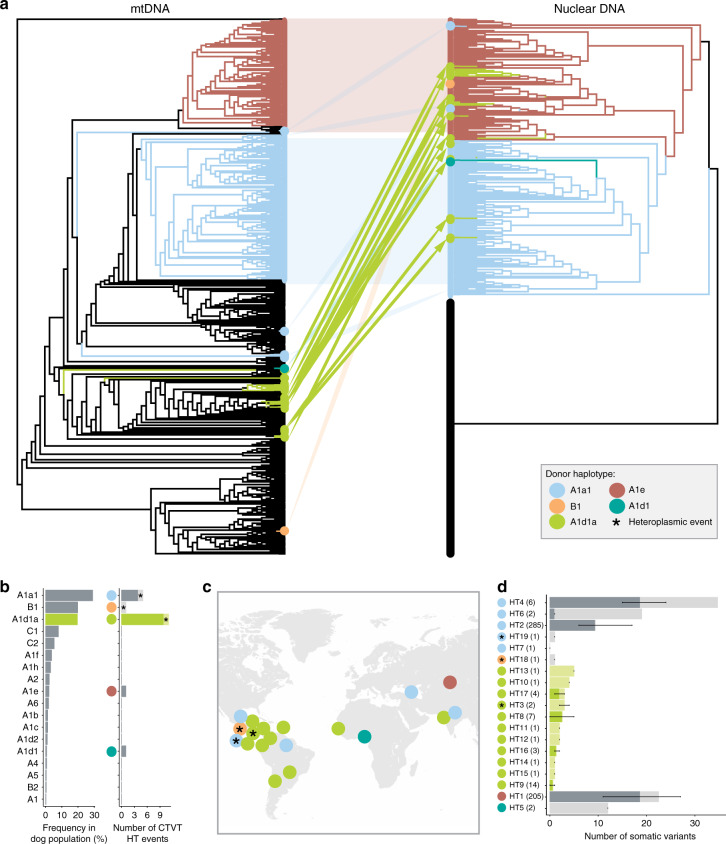
Fig. 1
Fig. 1. Recurrent and recent horizontal transfer of canine mitochondrial haplotype A1d1a.
a MtDNA (left) and nuclear DNA (right) maximum likelihood phylogenetic trees for 539 CTVT tumours (coloured) and 494 dogs (black). Correspondence between equivalent CTVTs on mtDNA and nuclear trees is indicated and coloured by mtDNA donor haplotype. Trees are presented as cladograms without informative branch lengths. High resolution trees are presented in Supplementary Figs. 1 and 2. b Frequencies of 18 canine mtDNA haplotypes within a representative global CTVT host dog population (n = 495) (left), and the number of CTVT horizontal transfer (HT) events involving each haplotype in a population of 539 CTVTs (right). Donor haplotype (coloured dots) and heteroplasmic horizontal transfer events (asterisks (*) and lighter shading) are shown. Heteroplasmic tumours carry both the parental and introduced haplotype. The A1d1a heteroplasmic horizontal transfer event involves mtDNA recombination. Bars representing A1d1a are highlighted in green. c Inferred geographical locations of 19 CTVT mtDNA horizontal transfer events. Each horizontal transfer is represented by a dot coloured by donor haplotype. If all CTVTs arising from a horizontal transfer were sampled at the same location, then this was inferred as the location of the horizontal transfer. If CTVTs derived from the horizontal transfer were found in several locations, then the likely site of the horizontal transfer was inferred based on phylogenetic information,. Heteroplasmic horizontal transfer events are indicated with an asterisk (*). d Number of somatic mtDNA mutations acquired since each horizontal transfer (HT) event. Number of CTVTs (n = 539) belonging to each HT event is indicated. Bars are split into two categories: darker colour shades represent confident somatic mutations that are polymorphic within each HT group, with error bars representing the mutation range; lighter colour shades represent variants that are fixed within each HT group, whose somatic or germline status cannot be determined (see Methods). Bars representing A1d1a HTs are highlighted in green. Donor haplotype (coloured dots) and heteroplasmy (asterisk, *) are shown.
Fig. 2
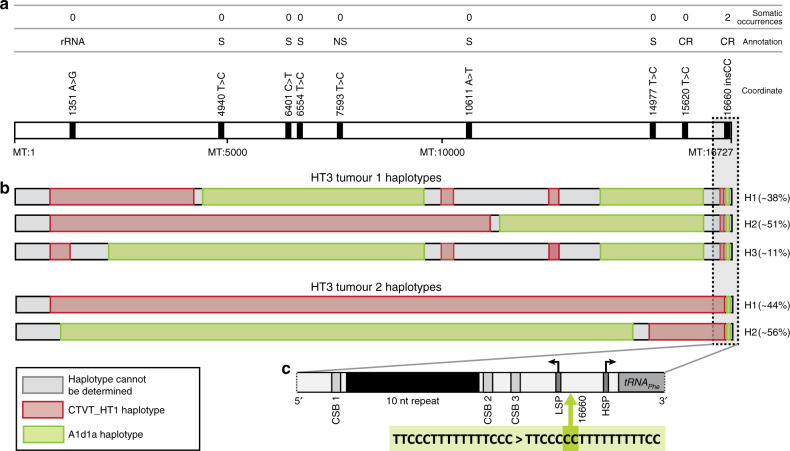
Fig. 2. Genetic features of the A1d1a haplotype.
a Genetic variants unique to the A1d1a haplotype (and in some cases shared with the related A1d1 haplotype, Supplementary Data 5) relative to 16 other dog haplotype groups. Number of somatic occurrences on other non-A1d1a CTVT mtDNA backgrounds is indicated above each variant. Variants within protein-coding genes are annotated as synonymous (S) or non-synonymous (NS), and other variants are annotated as occurring within ribosomal RNA (rRNA) or the control region (CR). MtDNA (MT) genome coordinates are indicated. b MtDNA haplotypes detected using long-read sequencing in the two tumours (labelled tumour 1 and tumour 2) belonging to the HT3 group, in which A1d1a and CTVT_HT1 have undergone recombination, with a heteroplasmic mixture of recombination products present in each tumour. The region fixed in all haplotypes in both tumours is indicated with a dotted box. The estimated frequency of each recombinant haplotype (H) within the two tumours’ CTVT cell mtDNA population is shown. c 16660insCC sequence context and position relative to control region features. Conserved sequence blocks (CSB) 1–3 are marked, together with the light strand promoter (LSP), heavy strand promoter (HSP) and a ten-nucleotide (nt) repeat block. 16660insCC co-occurs in A1d1a with 16672C>T, a polymorphism present on several canine haplotypes.
Fig. 3
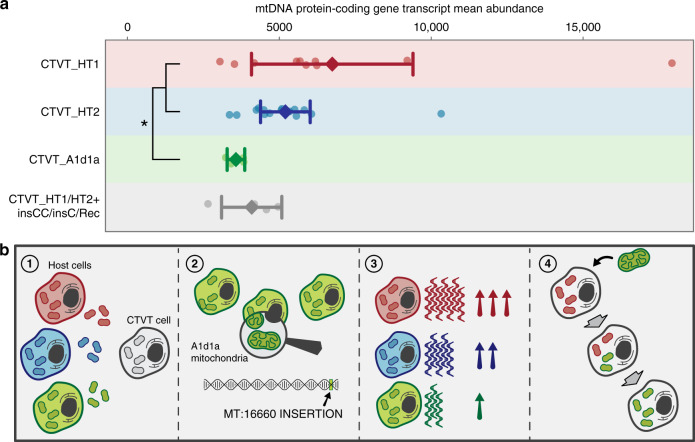
Fig. 3. MtDNA gene transcript abundance and model.
a Mean abundance of mtDNA protein-coding gene RNA in CTVT_HT1, CTVT_HT2, CTVT_A1d1a and CTVT_HT1/HT2+insCC/insC/Rec CTVTs (n = 33). In the group of CTVT_HT1/HT2+insCC/insC/Rec CTVTs (represented in grey), two carry 16660insCC and one carries 16660insC as a somatic mutation on CTVT_HT1 or CTVT_HT2 haplotype backgrounds, and one carries 16660insCC on a CTVT_HT1/A1d1a recombinant background. Dots represent mean abundances of mtDNA protein-coding gene transcripts in each of the CTVTs from each group, diamonds indicate mean mtDNA protein-coding gene abundances for each group and bars indicate 95% confidence intervals of the mean. Asterisk (*), p = 0.015 (two-sided Mann–Whitney test; Methods). Supplementary Data 6B provides batch-corrected transcript abundance data. b A model explaining repeated CTVT capture of the A1d1a haplotype. (1) All canine mtDNA haplotypes have equal opportunity for CTVT horizontal transfer, relative to population haplotype frequency. (2) A1d1a mtDNA haplotype carries an insertion in the control region, 16660insCC, which is not present in other haplotypes, and which may have regulatory functions. (3) MtDNA protein-coding transcript abundance is decreased in tumours with the A1d1a mtDNA haplotype relative to the two most common CTVT mtDNA haplotypes. (4) After A1d1a mtDNA horizontal transfer, A1d1a becomes homoplasmic through a selfish replicative advantage.

References

    1. Klucnika A, Ma H. A battle for transmission: the cooperative and selfish animal mitochondrial genomes. Open Biol. 2019;9:180267. - PMC - PubMed
    1. Ma H, O’Farrell PH. Selfish drive can trump function when animal mitochondrial genomes compete. Nat. Genet. 2016;48:798–802. - PMC - PubMed
    1. Haig D. Intracellular evolution of mitochondrial DNA (mtDNA) and the tragedy of the cytoplasmic commons. Bioessays. 2016;38:549–555. - PubMed
    1. Burt, A. & Trivers, R. Genes in Conflict: The Biology of Selfish Genetic Elements. (Harvard University Press, 2008).
    1. Gitschlag BL, et al. Homeostatic responses regulate selfish mitochondrial genome dynamics in C. elegans. Cell Metab. 2016;24:91–103. - PMC - PubMed

Publication types

Substances