


Refractive index gas sensor based on the Tamm state in a one-dimensional photonic crystal: Theoretical optimisation
- PMID: 32546751
- PMCID: PMC7297992
- DOI: 10.1038/s41598-020-66427-6
Refractive index gas sensor based on the Tamm state in a one-dimensional photonic crystal: Theoretical optimisation
Abstract
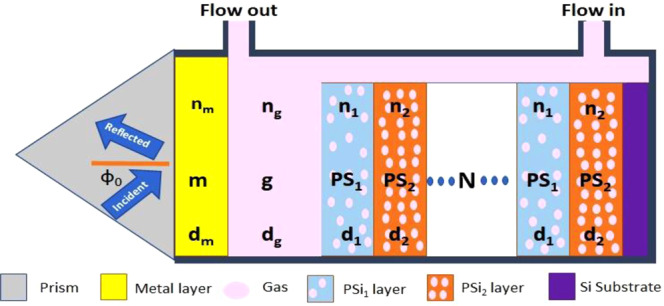
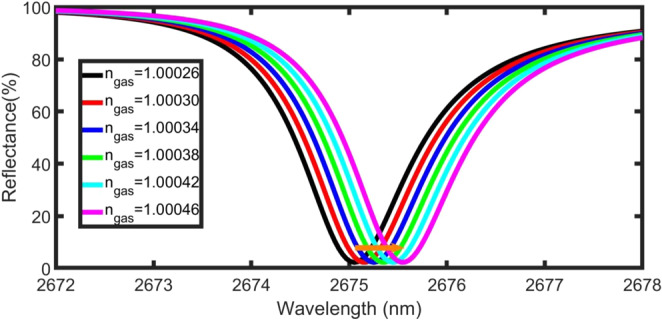
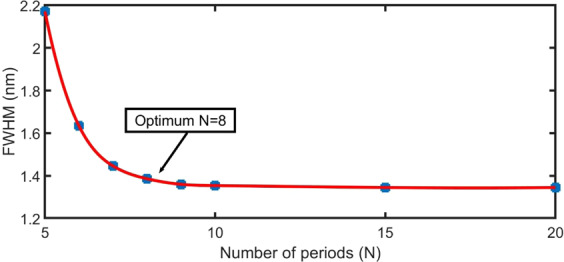
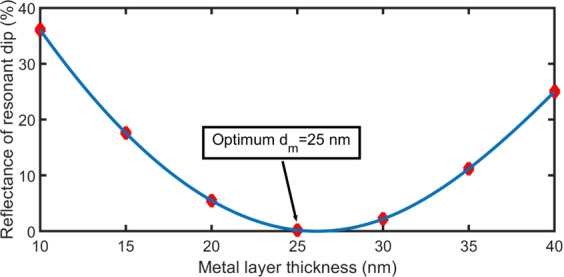
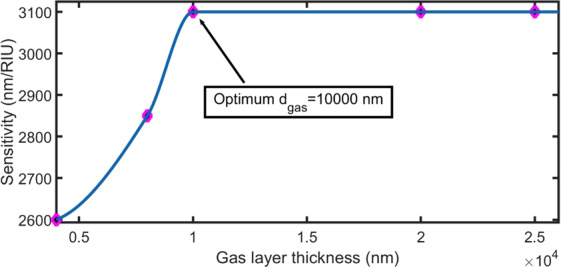
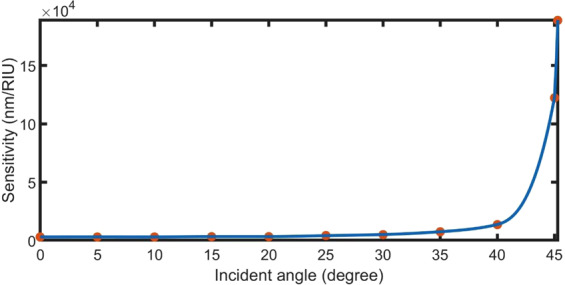
Gas sensors are important in many fields such as environmental monitoring, agricultural production, public safety, and medical diagnostics. Herein, Tamm plasmon resonance in a photonic bandgap is used to develop an optical gas sensor with high performance. The structure of the proposed sensor comprises a gas cavity sandwiched between a one-dimensional porous silicon photonic crystal and an Ag layer deposited on a prism. The optimised structure of the proposed sensor achieves ultra-high sensitivity (S = 1.9×10⁵ nm/RIU) and a low detection limit (DL = 1.4×10⁻⁷ RIU) compared to the existing gas sensor. The brilliant sensing performance and simple design of the proposed structure make our device highly suitable for use as a sensor in a variety of biomedical and industrial applications.
Conflict of interest statement
The authors declare no competing interests.
Figures
References
-
- Kanazawa E, et al. Metal oxide semiconductor N2O sensor for medical use. Sensors and Actuators B: Chemical. 2001;77:72–77.
-
- Zhang Q, Wang P, Li J, Gao X. Diagnosis of diabetes by image detection of breath using gas-sensitive laps. Biosensors and Bioelectronics. 2000;15:249–256. - PubMed
-
- Turner C, Walton C, Hoashi S, Evans M. Breath acetone concentration decreases with blood glucose concentration in type I diabetes mellitus patients during hypoglycaemic clamps. Journal of Breath Research. 2009;3:046004. - PubMed
-
- Islam MI, et al. Design of single mode spiral photonic crystal fiber for gas sensing applications. Sensing and Bio-Sensing. Research. 2017;13:55–62.
LinkOut - more resources
Full Text Sources
