


School-related physical activity interventions and mental health among children: a systematic review and meta-analysis
- PMID: 32548792
- PMCID: PMC7297899
- DOI: 10.1186/s40798-020-00254-x
School-related physical activity interventions and mental health among children: a systematic review and meta-analysis
Abstract
Background: Low levels of physical activity, sedentary behaviour and mental health problems are issues that have received considerable attention in the last decade. The aim of this systematic review and meta-analysis was to investigate effects of interventions targeting school-related physical activity or sedentary behaviour on mental health in children and adolescents and to identify the features of effective interventions.
Methods: Scientific articles published between January 2009 and October 2019 fulfilling the following criteria were included: general populations of children and adolescents between age 4 and 19, all types of school-related efforts to promote physical activity or reduce sedentary behaviour. Study selection, data extraction and quality assessment were done by at least two authors independently of each other. Data were analysed with a random effects meta-analysis and by narrative moderator analyses.
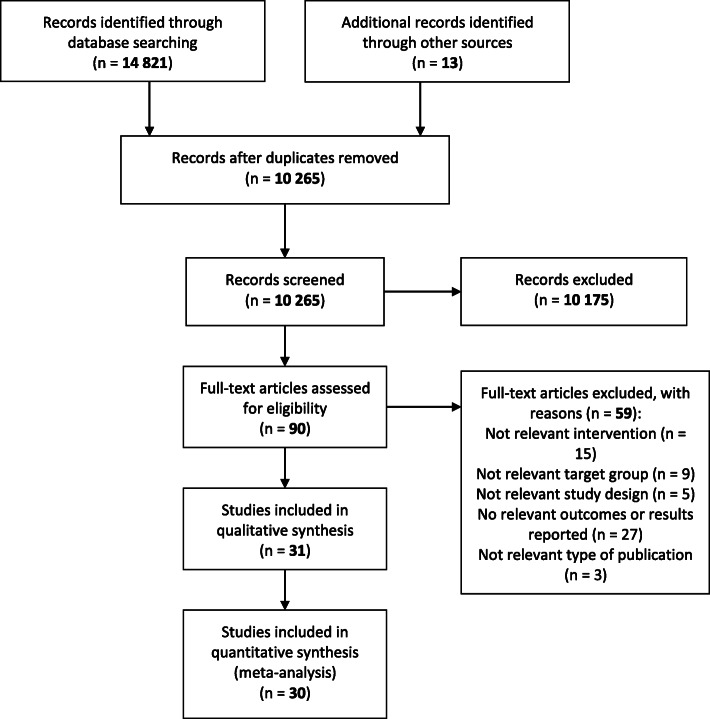
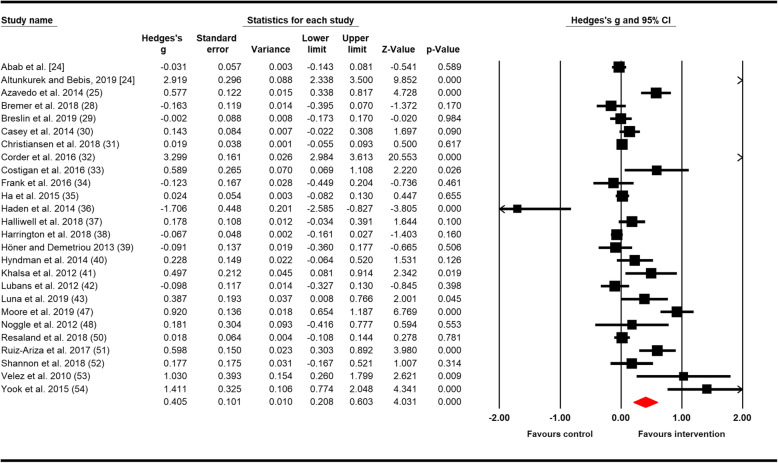
Results: The literature search resulted in 10265 unique articles. Thirty-one articles, describing 30 interventions, were finally included. Eleven relevant outcomes were identified: health-related quality of life, well-being, self-esteem and self-worth, resilience, positive effect, positive mental health, anxiety, depression, emotional problems, negative effect and internalising mental health problems. There was a significant beneficial effect of school-related physical activity interventions on resilience (Hedges' g = 0.748, 95% CI = 0.326; 1.170, p = 0.001), positive mental health (Hedges' g = 0.405, 95% CI = 0.208; 0.603, p = < 0.001), well-being (Hedges' g = 0.877, 95% CI = 0.356; 1.398, p = < 0.001) and anxiety (Hedges' g = 0.347, 95% CI = 0.072; 0.623, p = 0.013). Heterogeneity was moderate to high (I2 = 59-98%) between studies for all outcomes except positive effect, where heterogeneity was low (I2 = 2%). The narrative moderator analyses of outcomes based on 10 or more studies showed that age of the children moderated the effect of the intervention on internalising mental health problems. Interventions in younger children showed a significantly negative or no effect on internalising mental health problems while those in older children showed a significant positive or no effect. Moreover, studies with a high implementation reach showed a significant negative or no effect while those with a low level of implementation showed no or a positive effect. No signs of effect moderation were found for self-esteem, well-being or positive mental health. Risk of publication bias was evident for several outcomes, but adjustment did not change the results.
Conclusions: School-related physical activity interventions may reduce anxiety, increase resilience, improve well-being and increase positive mental health in children and adolescents. Considering the positive effects of physical activity on health in general, these findings may reinforce school-based initiatives to increase physical activity. However, the studies show considerable heterogeneity. The results should therefore be interpreted with caution. Future studies should report on implementation factors and more clearly describe the activities of the control group and whether the activity is added to or replacing ordinary physical education lessons in order to aid interpretation of results.
Trial registration: PROSPERO, CRD42018086757.
Keywords: Children; Mental health; Meta-analysis; Physical activity; School-related; Systematic review.
Conflict of interest statement
The authors, Susanne Andermo, Mats Hallgren, Thi-Thuy-Dung Nguyen, Sofie Jonsson, Solveig Petersen Marita Friberg, Anja Romqvist, Brendon Stubbs, Liselotte Schäfer Elinder, Solveig Petersen, Marita Friberg, and Liselotte Elinder, declare that they have no competing interests.
Figures
References
-
- Institute for Health Metrics and Evaluation. Global Burden of Disease University of Washington 2017. https://vizhub.healthdata.org/gbd-compare/. 2019.
-
- Public Health Agency of Sweden. Skolbarns hälsovanor i Sverige 2017/18: grundrapport (Health behaviour in school-aged children in Sweden 2017/18: basic report). Stockholm; 2019.
-
- The National Board of Health and Welfare. Utvecklingen av psykisk ohälsa bland barn och unga vuxna -Till och med 2016 (Development of mental ill-health among children and youth until 2016). Stockholm: The National Board of Health and Welfare; 2017.
-
- Public Health Agency of Sweden. Varför har den psykiska ohälsan ökat bland barn och unga i Sverige? Utvecklingen under perioden 1985-2014 (Why has mental ill-health increased among children and youth in Sweden? Development during the period 1985-2014). Stockholm: Public Health Agency of Sweden; 2018.
Publication types
Grants and funding
LinkOut - more resources
Full Text Sources
Medical
