


Phase Ib Study of Enzalutamide with or Without Sorafenib in Patients with Advanced Hepatocellular Carcinoma
- PMID: 32548867
- PMCID: PMC8186405
- DOI: 10.1634/theoncologist.2020-0521
Phase Ib Study of Enzalutamide with or Without Sorafenib in Patients with Advanced Hepatocellular Carcinoma
Abstract
Lessons learned: Androgen receptor as assessed by immunohistochemistry is expressed in a high proportion of patients with hepatocellular carcinoma (HCC). Enzalutamide at 160 mg orally daily is safe and tolerable in patients with advanced HCC but has no single-agent antitumor activity. Enzalutamide, a CYP3A4 inducer, at a standard dose of 160 mg reduces the exposure of sorafenib, a CYP3A4 substrate. Enzalutamide and sorafenib is safe and tolerable in patients with advanced HCC, but the addition of enzalutamide to sorafenib did not enhance the antitumor activity of sorafenib.
Background: Androgen receptor (AR) interference is deleterious to hepatocellular carcinoma (HCC) in preclinical models.
Methods: This is a multicenter, phase Ib study of enzalutamide ± sorafenib in patients with advanced HCC. In part 1, a 3 + 3 dose de-escalation design with expansion established the recommended phase II dose (RP2D) of enzalutamide in patients in whom sorafenib treatment had failed. In part 2, a 3 + 3 dose escalation with expansion established the safety of enzalutamide with sorafenib in treatment-naive patients with HCC. Secondary objectives included objective response rate (ORR), progression-free survival (PFS), overall survival (OS), pharmacokinetics (PK), and determination of AR expression by immunohistochemistry. A 7-day run-in with sorafenib alone in part 2 allowed assessment of the impact of enzalutamide on sorafenib pharmacokinetics.
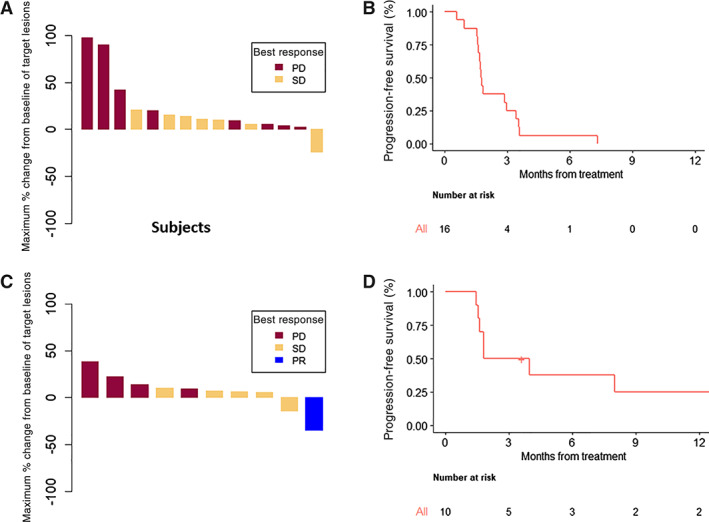
Results: In part 1, 16 patients received enzalutamide 160 mg daily. No dose-limiting toxicity (DLT) occurred; 1 patient required dose reduction. Responses were not observed; median PFS and OS were 1.8 (95% confidence interval [CI]: 1.6-3.6) and 7 (95% CI: 3.6 to not reached [NR]) months, respectively. In part 2, patients received sorafenib 400 mg daily (4) or twice a day (8) both with enzalutamide at the recommended phase II dose-no DLTs were observed. ORR was 10% (95% CI: 0.3-44.5), and median PFS and OS were 2.9 (95% CI: 1.6 to NR) and 6.7 (95% CI: 4.6 to NR) months, respectively. Enzalutamide reduced sorafenib exposure by 60%. Tumor AR expression did not associate with outcome.
Conclusion: Enzalutamide is ineffective in HCC; further development is not supported by this study.
© AlphaMed Press; the data published online to support this summary are the property of the authors.
Figures
References
-
- Nicholson B, Gulding K, Conaway M et al. Combination antiangiogenic and androgen deprivation therapy for prostate cancer: A promising therapeutic approach. Clin Cancer Res 2004;10:8728–8734. - PubMed
Publication types
MeSH terms
Substances
Grants and funding
LinkOut - more resources
Full Text Sources
Medical
Research Materials
