


Both short and long distance migrants use energy-minimizing migration strategies in North American herring gulls
- PMID: 32549986
- PMCID: PMC7294659
- DOI: 10.1186/s40462-020-00207-9
Both short and long distance migrants use energy-minimizing migration strategies in North American herring gulls
Abstract
Background: Recent studies have proposed that birds migrating short distances migrate at an overall slower pace, minimizing energy expenditure, while birds migrating long distances minimize time spent on migration to cope with seasonal changes in environmental conditions.
Methods: We evaluated variability in the migration strategies of Herring Gulls (Larus argentatus), a generalist species with flexible foraging and flight behaviour. We tracked one population of long distance migrants and three populations of short distance migrants, and compared the directness of their migration routes, their overall migration speed, their travel speed, and their use of stopovers.
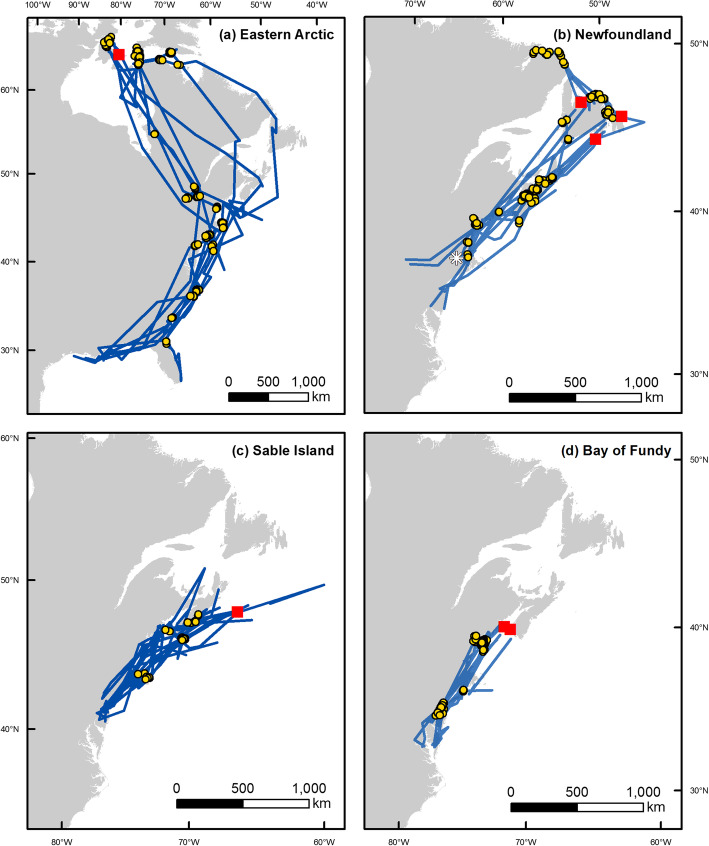
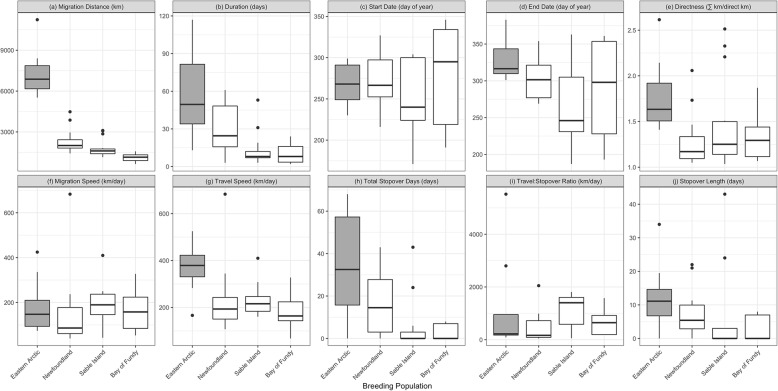
Results: Our research revealed that Herring Gulls breeding in the eastern Arctic migrate long distances to spend the winter in the Gulf of Mexico, traveling more than four times farther than gulls from Atlantic Canada during autumn migration. While all populations used indirect routes, the long distance migrants were the least direct. We found that regardless of the distance the population traveled, Herring Gulls migrated at a slower overall migration speed than predicted by Optimal Migration Theory, but the long distance migrants had higher speeds on travel days. While long distance migrants used more stopover days overall, relative to the distance travelled all four populations used a similar number of stopover days.
Conclusions: When taken in context with other studies, we expect that the migration strategies of flexible generalist species like Herring Gulls may be more influenced by habitat and food resources than migration distance.
Keywords: Animal movement; Bird migration; Ecology; Generalist; Migration strategy; Migratory behaviour; Stopover; Telemetry; Tracking.
© The Author(s) 2020.
Conflict of interest statement
Competing interestsThe authors declare that they have no competing interests.
Figures
References
-
- Bell CP. Process in the evolution of bird migration and pattern in avian ecogeography. J Avian Biol. 2000;31:258–256.
-
- Alerstam T, Hedenström A, Åkesson S. Long-distance migration: evolution and determinants. Oikos. 2003;103:247–260.
-
- Alerstam T, Lindström A. Optimal bird migration: the relative importance of time, energy, and safety. In: Gwinner E, editor. Bird Migr exophysiology. Berlin: Springer-Verlag; 1990. pp. 331–351.
LinkOut - more resources
Full Text Sources
