


Designing a tool to support patient and public involvement in research projects: the Involvement Matrix
- PMID: 32550002
- PMCID: PMC7296703
- DOI: 10.1186/s40900-020-00188-4
Designing a tool to support patient and public involvement in research projects: the Involvement Matrix
Abstract
Background: Interest in patient involvement in research is growing. Research should rather be 'with' or 'by' patients, and not only be 'about' or 'for' patients. Patients' active involvement in research is not self-evident and special efforts have to be made. If we make efforts towards patient involvement, it could contribute to even more relevant projects with an even greater impact. In this paper we describe the process of development of a tool to support patient involvement in research projects.
Methods: The tool development was done in a co-creation of experience experts (patients and their parents/relatives) together with researchers. We used a participatory method in an iterative process comprising three consecutive stages. First, the purpose for the tool was explored, using focus groups. Second, the main ingredients and conceptualization for the tool were determined, using a narrative review. Third, the so-called Involvement Matrix was formalized and finalized using various expert panels.
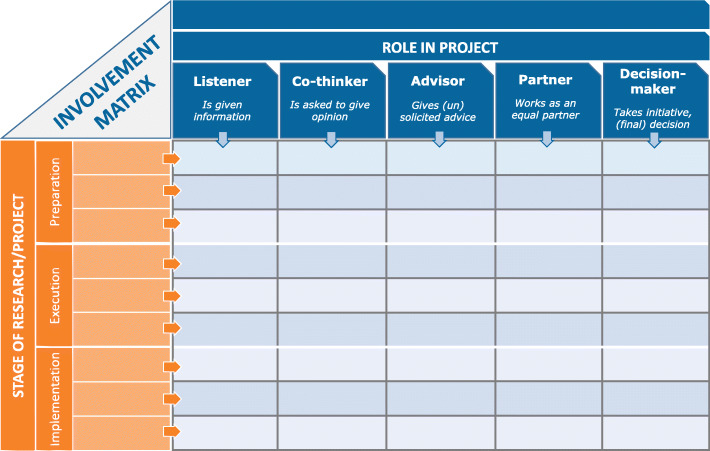
Results: A conversation tool was developed, through which researchers and patients could discuss and explain their roles of involvement in a research project. This tool was formalized and visualized as a 'matrix'. The so-called Involvement Matrix describes five roles (i.e., Listener, Co-thinker, Advisor, Partner, and Decision-maker) and three phases (i.e., Preparation, Execution, and Implementation) and includes a user's guide.
Conclusion: The Involvement Matrix can be used prospectively to discuss about possible roles of patients in different phases of projects, and retrospectively to discuss whether roles were carried out satisfactorily. Sharing experiences with the Involvement Matrix and evaluating its impact are the next steps in supporting patient involvement in research.
Keywords: Expectations; Patient involvement; Projects; Research; Roles.
© The Author(s) 2020.
Conflict of interest statement
Competing interestsThe authors declare that they have no competing interests.
Figures
References
LinkOut - more resources
Full Text Sources
Medical
