


Gut microbiome in primary sclerosing cholangitis: A review
- PMID: 32550753
- PMCID: PMC7284173
- DOI: 10.3748/wjg.v26.i21.2768
Gut microbiome in primary sclerosing cholangitis: A review
Abstract
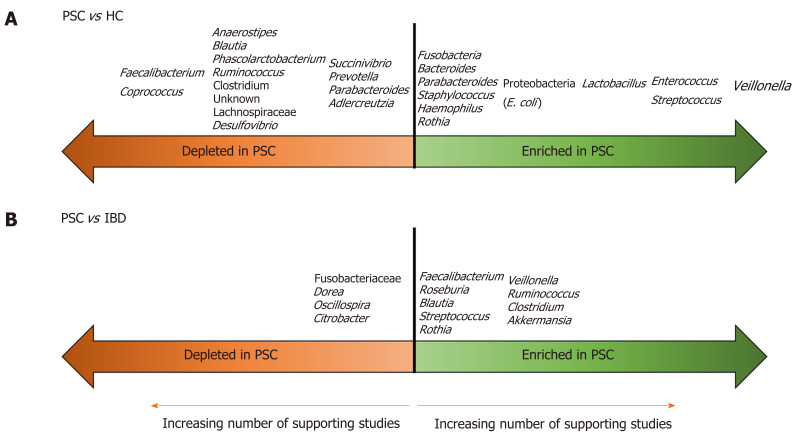
Primary sclerosing cholangitis (PSC) is a chronic cholestatic liver disease characterized by biliary inflammation and stricturing. Exploration of the pathogenesis of PSC in light of its association with inflammatory bowel disease (IBD) and the "gut-liver" axis is an emerging area of interest. A growing number of studies have begun to elucidate the role of the gut microbiota, its metabolites and its influence on host immune responses in the development of PSC and PSC-IBD. Studies of the fecal microbiota have highlighted enriched levels of certain species, including Veillonella, Streptococcus and Enterococcus, among others. A heightened immune response to enteric dysbiosis and bacterial translocation have also been implicated. For example, Klebsiella pneumoniae strains derived from gnotobiotic mice transplanted with PSC-IBD microbiota were found to induce pore formation in human intestinal epithelial cells and enhanced Th17 responses. Gut microbes have additionally been hypothesized to be implicated in PSC pathogenesis through their role in the synthesis of various metabolites, including bile acids (BAs), which function as signaling molecules with important gut and hepatic effects. An expanded knowledge of the gut microbiome as it relates to PSC offers critical insight into the development of microbe-altering therapeutic interventions, such as antibiotics, nutritional interventions and fecal microbial transplantation. Some of these have already shown some preliminary evidence of benefit. Despite exciting progress in the field, much work remains to be done; areas that are particularly lacking include functional characterization of the microbiome and examination of pediatric populations. In this review, we summarize studies that have investigated the microbiome in PSC and PSC-IBD as well as putative mechanisms, including the potential role of metabolites, such as BAs. We then briefly review the evidence for interventions with microbe-altering properties for treating PSC.
Keywords: Bile acids; Colitis; Inflammatory bowel disease; Microbiome; Microbiota; Primary sclerosing cholangitis.
©The Author(s) 2020. Published by Baishideng Publishing Group Inc. All rights reserved.
Conflict of interest statement
Conflict-of-interest statement: Dr. Kamath BM reports - Consultant Shire, Albireo and Mirum since they make ASBT inhibitors. All other authors no disclosures to report.
Figures
References
-
- Dyson JK, Beuers U, Jones DEJ, Lohse AW, Hudson M. Primary sclerosing cholangitis. Lancet. 2018;391:2547–2559. - PubMed
-
- Deneau M, Jensen MK, Holmen J, Williams MS, Book LS, Guthery SL. Primary sclerosing cholangitis, autoimmune hepatitis, and overlap in utah children: Epidemiology and natural history. Hepatology. 2013;58:1392–1400. - PubMed
-
- Deneau MR, El-Matary W, Valentino PL, Abdou R, Alqoaer K, Amin M, Amir AZ, Auth M, Bazerbachi F, Broderick A, Chan A, Cotter J, Doan S, El-Youssef M, Ferrari F, Furuya KN, Gottrand M, Gottrand F, Gupta N, Homan M, Kamath BM, Kim KM, Kolho KL, Konidari A, Koot B, Iorio R, Ledder O, Mack C, Martinez M, Miloh T, Mohan P, O'Cathain N, Papadopoulou A, Ricciuto A, Saubermann L, Sathya P, Shteyer E, Smolka V, Tanaka A, Varier R, Venkat V, Vitola B, Vos MB, Woynarowski M, Yap J, Jensen MK. The natural history of primary sclerosing cholangitis in 781 children: A multicenter, international collaboration. Hepatology. 2017;66:518–527. - PubMed
-
- Lunder AK, Hov JR, Borthne A, Gleditsch J, Johannesen G, Tveit K, Viktil E, Henriksen M, Hovde Ø, Huppertz-Hauss G, Høie O, Høivik ML, Monstad I, Solberg IC, Jahnsen J, Karlsen TH, Moum B, Vatn M, Negård A. Prevalence of Sclerosing Cholangitis Detected by Magnetic Resonance Cholangiography in Patients With Long-term Inflammatory Bowel Disease. Gastroenterology. 2016;151:660–669.e4. - PubMed
Publication types
MeSH terms
Substances
LinkOut - more resources
Full Text Sources
Medical
