


Review
doi: 10.1177/2047487320932695.
Epub 2020 Jun 17.
COVID-19 and risk of pulmonary fibrosis: the importance of planning ahead
Affiliations
- PMID: 32551971
- PMCID: PMC7717346
- DOI: 10.1177/2047487320932695
Item in Clipboard
Review
COVID-19 and risk of pulmonary fibrosis: the importance of planning ahead
Eur J Prev Cardiol.
2020 Sep.
No abstract available
Figures
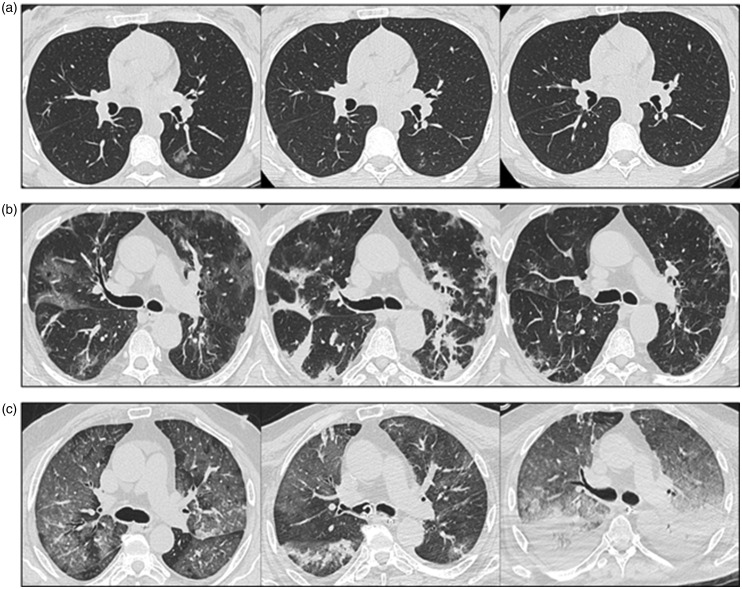
Serial high-resolution computed tomography (HRCT) images of three patients with a confirmed infection by SARS-CoV-2, showing different possible evolutions of lung involvement. (a) Mild COVID-19 lung involvement in a 39-year-old woman, scarcely symptomatic and home-treated with hydroxychloroquine. HRCT at day 1 showed a small subpleural mono-lateral ground-glass opacity (GGO) at the superior segment of the left inferior lobe (1), which was significantly reduced at day 7 (2), and almost completely resolved after two weeks (3). (b) Severe COVID-19 pneumonia in a 67-year-old man, hospitalized and treated with tocilizumab and ventilatory support with favourable evolution. HRCT at day 1 showed multiple patchy bilateral subpleural and peripheral areas of GGO associated with limited interlobular septal thickening (1). At day 5, there was a significant progression of the disease with air-space consolidations (2). After three weeks, HRCT showed significant reduction of the extension and severity of the consolidations with residual GGO and peribronchovascular thickening (3). (c) Severe COVID-19 pneumonia in a 74-year-old man, hospitalized with poor outcome. HRCT at day 1 showed bilateral extensive GGO with diffuse distribution associated with reticulations in a ‘crazy-paving pattern’, particularly at the lower lobes (1). At day 9, there was a reduction of the GGO with progressive evolution in peripheral consolidations (2). Finally, HRCT at day 18 showed diffuse bilateral GGO and marked increase of the consolidative posterior distribution in a full-blown acute distress respiratory syndrome (3).
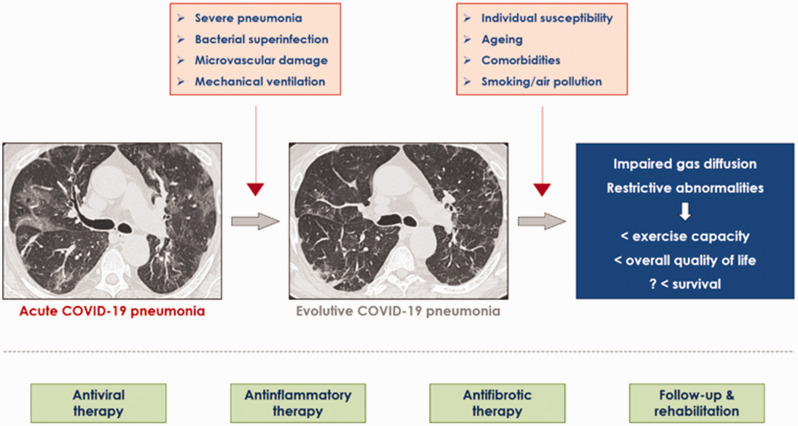
Possible progression of COVID-19 pneumonia to lung fibrosis, and preventive strategies. The high-resolution computed tomography (HRCT) images in the first two panels show a case of severe COVID-19 pneumonia recovered after three weeks in a 67-year-old man. Although clinically stable and near to discharge, the persistent residual interstitial involvement at HRCT (second panel) could be an early sign of long-term fibrosis.
