


Neuroinflammatory mechanisms of post-traumatic epilepsy
- PMID: 32552898
- PMCID: PMC7301453
- DOI: 10.1186/s12974-020-01854-w
Neuroinflammatory mechanisms of post-traumatic epilepsy
Abstract
Background: Traumatic brain injury (TBI) occurs in as many as 64-74 million people worldwide each year and often results in one or more post-traumatic syndromes, including depression, cognitive, emotional, and behavioral deficits. TBI can also increase seizure susceptibility, as well as increase the incidence of epilepsy, a phenomenon known as post-traumatic epilepsy (PTE). Injury type and severity appear to partially predict PTE susceptibility. However, a complete mechanistic understanding of risk factors for PTE is incomplete.
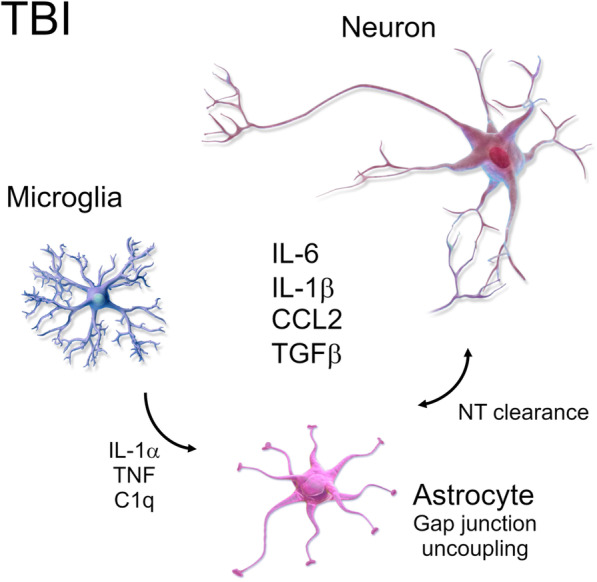
Main body: From the earliest days of modern neuroscience, to the present day, accumulating evidence supports a significant role for neuroinflammation in the post-traumatic epileptogenic progression. Notably, substantial evidence indicates a role for astrocytes, microglia, chemokines, and cytokines in PTE progression. Although each of these mechanistic components is discussed in separate sections, it is highly likely that it is the totality of cellular and neuroinflammatory interactions that ultimately contribute to the epileptogenic progression following TBI.
Conclusion: This comprehensive review focuses on the neuroinflammatory milieu and explores putative mechanisms involved in the epileptogenic progression from TBI to increased seizure-susceptibility and the development of PTE.
Keywords: Astrocytes; Chemokines; Cytokines; Epileptogenesis; Inflammation; Microglia; TBI; Traumatic brain injury.
Conflict of interest statement
The authors declare that they have no competing interests.
Figures
References
-
- Dewan MC, Rattani A, Gupta S, Baticulon RE, Hung YC, Punchak M, Agrawal A, Adeleye AO, Shrime MG, Rubiano AM, Rosenfeld JV, Park KB. Estimating the global incidence of traumatic brain injury. J Neurosurg. 2018:1-18. Epub 2018/04/28. doi: 10.3171/2017.10.JNS17352. PubMed PMID: 29701556. - PubMed
-
- Frey LC. Epidemiology of posttraumatic epilepsy: a critical review. Epilepsia. 2003;44 Suppl 10:11-17. PubMed PMID: 14511389. - PubMed
-
- Tubi MA, Lutkenhoff E, Blanco MB, McArthur D, Villablanca P, Ellingson B, Diaz-Arrastia R, Van Ness P, Real C, Shrestha V, Engel J, Jr., Vespa PM. Early seizures and temporal lobe trauma predict post-traumatic epilepsy: a longitudinal study. Neurobiol Dis. 2019;123:115-21. Epub 2018/06/04. doi: 10.1016/j.nbd.2018.05.014. PubMed PMID: 29859872; PMCID: PMC6274611. - PMC - PubMed
-
- DeGrauw X, Thurman D, Xu L, Kancherla V, DeGrauw T. Epidemiology of traumatic brain injury-associated epilepsy and early use of anti-epilepsy drugs: an analysis of insurance claims data, 2004-2014. Epilepsy Res. 2018;146:41-9. Epub 2018/08/03. doi: 10.1016/j.eplepsyres.2018.07.012. PubMed PMID: 30071385; PMCID: PMC6547364. - PMC - PubMed
Publication types
MeSH terms
Substances
Grants and funding
LinkOut - more resources
Full Text Sources
Medical
