. 2020 Jun 18;13(1):80.
doi: 10.1186/s13045-020-00912-3.

Combination therapy of BCR-ABL-positive B cell acute lymphoblastic leukemia by tyrosine kinase inhibitor dasatinib and c-JUN N-terminal kinase inhibition

Affiliations

Combination therapy of BCR-ABL-positive B cell acute lymphoblastic leukemia by tyrosine kinase inhibitor dasatinib and c-JUN N-terminal kinase inhibition

Xinhua Xiao et al. J Hematol Oncol. .

Abstract

Background: The Philadelphia chromosome (Ph), which leads to the creation and expression of the fusion gene product BCR-ABL, underlines the pathogenesis of chronic myelogenous leukemia (CML) and a fraction of adult and pediatric acute B-lymphoblastic leukemia (B-ALL). The BCR-ABL tyrosine kinase inhibitors (TKIs) have shown a remarkable clinical activity in patients with CML, but their efficacy in treating Ph+ B-ALL is limited. Identifying additional therapeutic targets is important for the effective treatment of Ph+ B-ALL.

Methods: Activation of the JNK signaling pathway in human and mouse BCR-ABL+ B-ALL cells with or without dasatinib treatment was analyzed by Western blotting. JNK was inhibited either by RNA interference or chemical inhibitors, such as JNK-IN-8. The effect of JNK inhibition with or without BCR-ABL TKI dasatinib on BCR-ABL+ B-ALL cells was analyzed by the CellTiter-Glo® Luminescent Cell Viability Assay. The in vivo effects of JNK-IN-8 and dasatinib alone or in combination were tested using a BCR-ABL induced B-ALL mouse model.

Results: We found that the c-JUN N-terminal kinase (JNK) signaling pathway is abnormally activated in both human and mouse BCR-ABL+ B-ALL cells, but the BCR-ABL TKI does not inhibit JNK activation in these cells. Inhibition of JNK, either by RNAi-mediated downregulation or by JNK inhibitors, could significantly reduce viability of Ph+ B-ALL cells. JNK inhibition by RNAi-mediated downregulation or JNK inhibitors also showed a synergistic effect with the BCR-ABL TKI, dasatinib, in killing Ph+ B-ALL cells in vitro. Furthermore, a potent JNK inhibitor, JNK-IN-8, in combination with dasatinib markedly improved the survival of mice with BCR-ABL induced B-ALL, as compared to the treatment with dasatinib alone.

Conclusions: Our findings indicate that simultaneously targeting both BCR-ABL and JNK kinase might serve as a promising therapeutic strategy for Ph+ B-ALL.

Keywords: Combination target therapy; Dasatinib; JNK; Ph+ B-ALL.


Conflict of interest statement

The authors declare that they have no competing interests.

Figures
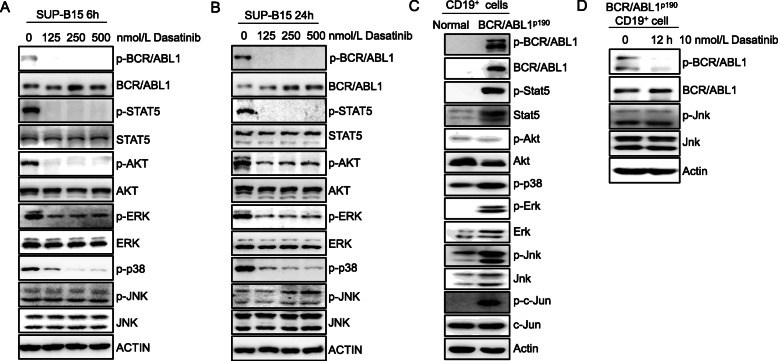
Fig. 1
Fig. 1
JNK kinases remain abnormally activated upon the treatment of dasatinib in Ph+ B-ALL. a Human Ph+ B-ALL cell line SUP-B15 cells were treated with dasatinib at various concentrations for 6 hours (h) and subsequently examined by western blot using indicated antibodies against key effectors in BCR-ABL and MAPK signaling pathways: phosphorylated (p) and total BCR/ABL, Stat5, AKT, ERK, p38 and JNK, respectively. Actin was used as a loading control. b SUP-B15 cells were treated with dasatinib at various concentrations as indicated for 24 h and subsequently examined by western blot using indicated antibodies against phosphorylated and total BCR/ABL, Stat5, AKT, ERK, p38, and JNK, respectively. Actin was used as a loading control. c Western blot analysis of lysates of CD19+ B lymphocytes isolated from bone marrows of normal and BCR/ABLp190 bone marrow transduction and transplantation mice using antibodies described in (a) plus western blot analysis using antibodies against phosphorylated and total c-JUN. d CD19+ B lymphocytes from BCR/ABLp190 bone marrow transduction and transplantation mice were treated with 10 nmol/L dasatinib or vehicle for 12 h, followed by western blot analysis with antibodies against phosphorylated and total BCR-ABL and JNK
Fig. 2
Fig. 2
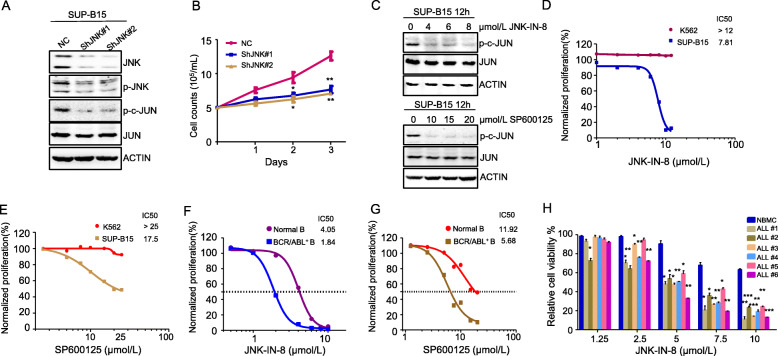
JNK inhibition reduces viability of Ph+ B-ALL cells. a Levels of phosphorylated and total JNK and c-JUN in SUP-B15 cells transduced with lentivirus vectors containing control shRNA (ShNC), shRNA targeting JNK (ShJNK#1), or ShJNK#2 were detected by western blot analysis with antibodies indicated. Actin was used as a loading control. b Proliferation of SUP-B15 cells expressing control and JNK shRNA were plotted by counting viable cells over a period of 3 days. c SUP-B15 cells were treated with JNK inhibitor JNK-IN-8 or SP600125 for 12 h, followed by western blot analysis using antibodies against phosphorylated and total c-JUN. d, e Viability of SUP-B15 and a CML blast crisis cell line K562 cells treated with various concentrations of JNK-IN-8 (d) or SP600125 (e) for 48 h was measured by the CellTiter Glo assay. Normalized cell proliferation was presented and compound’s IC50 value calculated. f, g Viability of CD19+ B lymphocytes isolated from normal and BCR/ABLp190 bone marrow transduction and transplantation mice treated with various concentrations of JNK-IN-8 (f) or SP600125 (g) for 48 h was measured by the CellTiter Glo assay. Normalized cell proliferation was presented and compound’s IC50 value calculated. h The nucleated bone marrow cells (NBMC) from a healthy donor and primary BM cells isolated from 6 patients with Ph+ B-ALL were treated with different concentrations of JNK-IN-8 for 48 h. Cell viability was measured by the CellTiter Glo assay. Data are presented as mean ± SD, and P values were calculated using Student’s t test. *P < 0.05, **P < 0.01, and ***P < 0.001
Fig. 3
Fig. 3
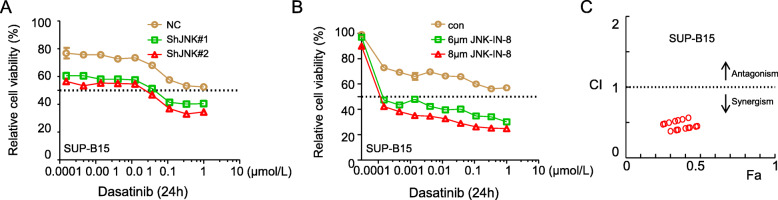
JNK inhibition cooperates with dasatinib in killing Ph+ B-ALL cells. a SUP-B15 cells expressing ShNC, ShJNK#1, or ShJNK#2 were treated with different concentrations of dasatinb for 24 h. Viability of these cells was then measured by the CellTiter Glo assay. b SUP-B15 cells were treated with indicated concentrations of dasatinib combined with or without JNK-IN-8 (6 μmol/L and 8 μmol/L) for 24 h. Viability of these cells was measured by the CellTiter Glo assay. c “Combination index” (CI) values were calculated at each concentration of JNK-IN-8 based on data in b and plotted, Fractional inhibition abbreviated as Fa. Data are presented as mean ± SD
Fig. 4
Fig. 4
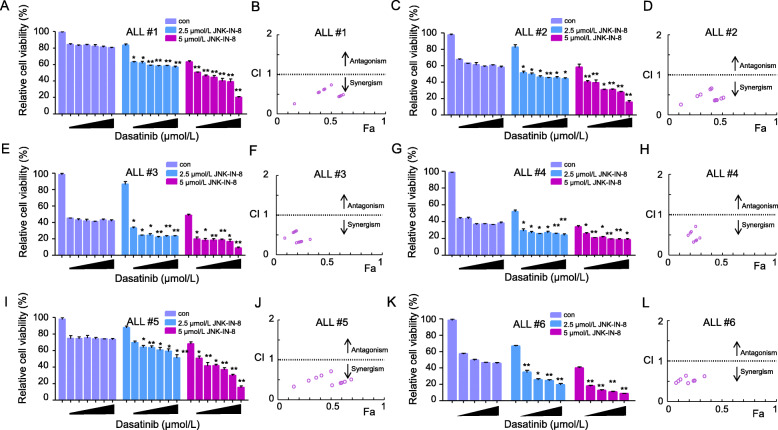
JNK-IN-8 cooperates with dasatinib in killing primary Ph+ B-ALL cells. a, c, e, g, i, and k Primary bone marrow cells isolated from 6 Ph+ B-ALL patients were treated with dasatinib (at the concentrations of 0, 0.125, 0.25, 0.5, 1, and 2 μmol/L), JNK-IN-8 (2.5, 5 μmol/L ) or both in combination for 48 h. Cell viability was measured by the CellTiter Glo assay. Data are presented as mean ± SD; P values were calculated by the comparison between the combination group and JNK-IN-8 or dasatinib alone group. *P < 0.05, **P < 0.01. b, d, f, h, j, and l CI values were calculated based on data from a, c, e, g, i, and k, respectively, and plotted. Fractional inhibition abbreviated as Fa
Fig. 5
Fig. 5
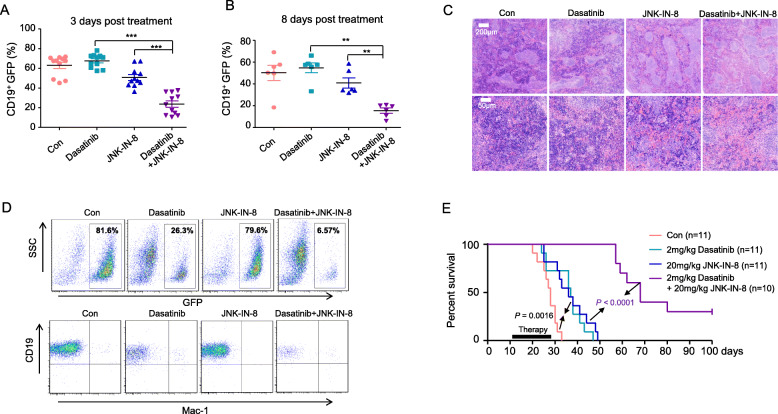
The combination treatment with JNK-IN-8 and dasatinib significantly prolongs the life of BCR/ABL+ B-ALL mice. a Percentage of GFP-positive CD19+ B lymphocytes in peripheral blood (PB) from BCR/ABLp190 bone marrow transduction and transplantation mice treated with vehicle, dasatinib (2 mg/kg), JNK-IN-8 (20 mg/kg) alone, or both in combination QD, respectively, for 3 days. b Percentage of GFP-positive CD19+ B lymphocytes in PB from BCR/ABLp190 bone marrow transduction and transplantation mice treated with compounds as described in a for 8 days. c Hematoxylin and eosin staining of spleens from BCR/ABLp190 bone marrow transduction and transplantation mice treated with compounds as described in a for 10 days. Scale bars in the upper and lower panel are 200 μm and 50 μm, respectively. d Flow cytometry analysis of bone marrow cells from mice as described in C. e The Kaplan-Meier survival curves of BCR/ABLp190 bone marrow transduction and transplantation mice continuously administrated with vehicle, dasatinib (2 mg/kg), JNK-IN-8 (20 mg/kg) alone, or both drugs in combination QD for 18 days. P values were calculated by log-rank test and shown

References

    1. Teachey DT, Pui CH. Comparative features and outcomes between paediatric T-cell and B-cell acute lymphoblastic leukaemia. Lancet Oncol. 2019;20:e142–e154. doi: 10.1016/S1470-2045(19)30031-2. - DOI - PMC - PubMed
    1. Deininger MW, Goldman JM, Melo JV. The molecular biology of chronic myeloid leukemia. Blood. 2000;96:3343–3356. doi: 10.1182/blood.V96.10.3343. - DOI - PubMed
    1. Druker BJ, Guilhot F, O'Brien SG, Gathmann I, Kantarjian H, Gattermann N, Deininger MW, Silver RT, Goldman JM, Stone RM, et al. Five-year follow-up of patients receiving imatinib for chronic myeloid leukemia. N Engl J Med. 2006;355:2408–2417. doi: 10.1056/NEJMoa062867. - DOI - PubMed
    1. Arico M, Schrappe M, Hunger SP, Carroll WL, Conter V, Galimberti S, Manabe A, Saha V, Baruchel A, Vettenranta K, et al. Clinical outcome of children with newly diagnosed Philadelphia chromosome-positive acute lymphoblastic leukemia treated between 1995 and 2005. J Clin Oncol. 2010;28:4755–4761. doi: 10.1200/JCO.2010.30.1325. - DOI - PMC - PubMed
    1. Talpaz M, Shah NP, Kantarjian H, Donato N, Nicoll J, Paquette R, Cortes J, O’Brien S, Nicaise C, Bleickardt E, et al. Dasatinib in imatinib-resistant Philadelphia chromosome-positive leukemias. N Engl J Med. 2006;354:2531–2541. doi: 10.1056/NEJMoa055229. - DOI - PubMed

Publication types

MeSH terms