


Postoperative Pain after Treatment Using the GentleWave System: A Randomized Controlled Trial
- PMID: 32553417
- PMCID: PMC7387160
- DOI: 10.1016/j.joen.2020.04.004
Postoperative Pain after Treatment Using the GentleWave System: A Randomized Controlled Trial
Abstract
Introduction: Cleaning and shaping are necessary to allow for the delivery of irrigants and medicaments to the apical third of the canal. Standard treatment irrigation generally uses a conventional needle and some frequency of sonic activation. The GentleWave System (GWS; Sonendo, Inc, Laguna Hills, CA) combines irrigant delivery with multisonic activation. This randomized clinical trial aimed to determine if the GWS significantly decreases the incidence and intensity of postoperative pain.
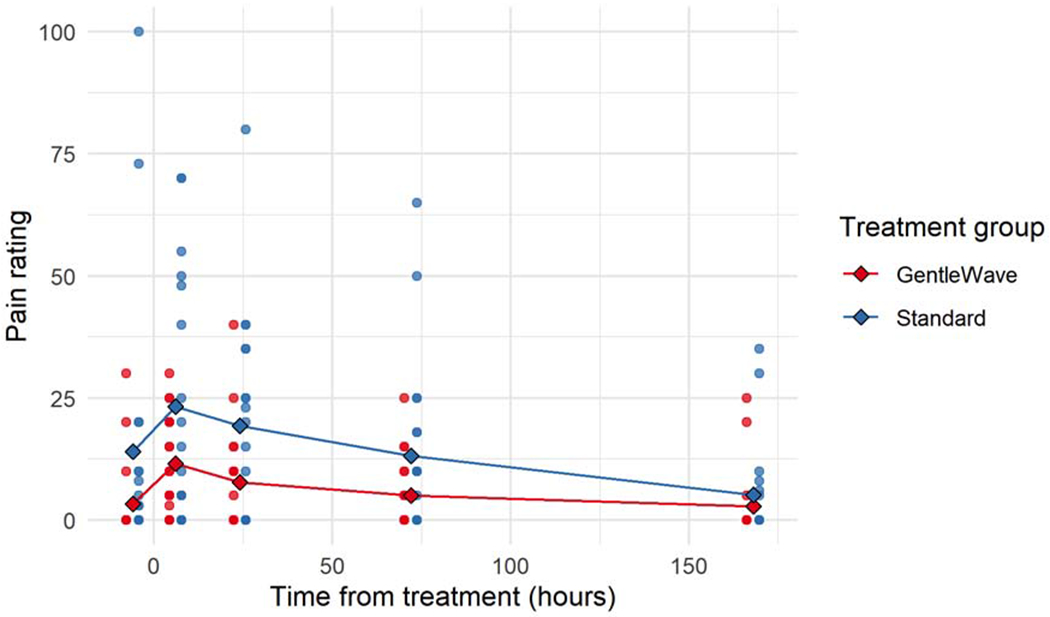
Methods: Patients used a numeric rating scale to record their pain level at the 6-hour time point before treatment. All participants were randomly divided into 2 groups and were blind to the treatment they received. The standard (control) group received endodontic treatment with conventional side-vented needle irrigation and ultrasonic activation. The second group received treatment with the GWS. Following treatment, patients used a numeric rating scale to record their pain level at 6, 24, 72, and 168 hours.
Results: In the standard treatment group, 72.2% of patients experienced at least 1 occurrence of postoperative pain, whereas in the GWS group, 83.3% of patients experienced at least 1 occurrence of postoperative pain. The highest pain intensity level for both treatments occurred at the 6-hour posttreatment time point. All pain decreased with time after the 6-hour posttreatment time point (P < 1.237e-7).
Conclusions: There was no significant difference in the incidence or intensity of postoperative pain after either treatment group. However, both groups reported a statistically significant decrease in pain with time.
Keywords: Endodontics; GentleWave; incidence; intensity, irrigation; postoperative pain.
Copyright © 2020 American Association of Endodontists. Published by Elsevier Inc. All rights reserved.
Figures
References
-
- Peters OA, Peters CI, Basrani B. Cleaning and shaping the root canal system In: Hargreaves KM, Berman LH, eds. Cohen’s Pathways of the pulp. 11thed. St. Louis: Mosby, Inc., 2016:209–279.
-
- Wang R, Shen Y, Ma J, Huang D, Zhou X, Gao Y, Haapasalo M. Evaluation of the effect of needle position on irritant flow in the C-shaped root canal using a computational fluid dynamics model. J Endod 2015; 41: 931–936 - PubMed
-
- Vandrangi P, Basrani B. Multisonic ultracleaning in molars with the GentleWave system. Oral Health. 2015;72–86
-
- Siqueira JF, Barnett F. Interappointment pain: mechanisms, diagnosis, and treatment. Endod Topics. 2004; 7: 93–109
Publication types
MeSH terms
Substances
Grants and funding
LinkOut - more resources
Full Text Sources
Medical
