. 2020 Aug 24;58(9):e00275-20.
doi: 10.1128/JCM.00275-20. Print 2020 Aug 24.

Clinical and Genomic Epidemiology of Carbapenem-Nonsusceptible Citrobacter spp. at a Tertiary Health Care Center over 2 Decades

Affiliations

Clinical and Genomic Epidemiology of Carbapenem-Nonsusceptible Citrobacter spp. at a Tertiary Health Care Center over 2 Decades

Ahmed Babiker et al. J Clin Microbiol. .

Abstract

Carbapenem-nonsusceptible Citrobacter spp. (CNSC) are increasingly recognized as health care-associated pathogens. Information regarding their clinical epidemiology, genetic diversity, and mechanisms of carbapenem resistance is lacking. We examined microbiology records of adult patients at the University of Pittsburgh Medical Center (UMPC) Presbyterian Hospital (PUH) from 2000 to 2018 for CNSC, as defined by ertapenem nonsusceptibility. Over this time frame, the proportion of CNSC increased from 4% to 10% (P = 0.03), as did daily defined carbapenem doses/1,000 patient days (6.52 to 34.5; R2 = 0.831; P < 0.001), which correlated with the observed increase in CNSC (lag = 0 years; R2 = 0.660). Twenty CNSC isolates from 19 patients at PUH and other UPMC hospitals were available for further analysis, including whole-genome short-read sequencing and additional antimicrobial susceptibility testing. Of the 19 patients, nearly all acquired CNSC in the health care setting and over half had polymicrobial cultures containing at least one other organism. Among the 20 CNSC isolates, Citrobacter freundii was the predominant species identified (60%). CNSC genomes were compared with genomes of carbapenem-susceptible Citrobacter spp. from UPMC and with other publicly available CNSC genomes. Isolates carrying genes encoding carbapenemases (blaKPC-2,blaKPC-3, and blaNDM-1) were also long-read sequenced, and their carbapenemase-encoding plasmid sequences were compared with one another and with publicly available sequences. Phylogenetic analysis of 102 UPMC Citrobacter genomes showed that CNSC from our setting did not cluster together. Similarly, a global phylogeny of 64 CNSC genomes showed a diverse population structure. Our findings suggest that both local and global CNSC populations are genetically diverse and that CNSC harbor carbapenemase-encoding plasmids found in other Enterobacterales.

Keywords: Citrobacter; carbapenem; carbapenemase; multidrug resistance.


Figures

FIG 1
FIG 1
Carbapenem consumption and proportion of carbapenem-nonsusceptible Citrobacter spp. (CNSC), 2000 to 2018. Carbapenem daily defined doses (DDDs) per 1,000 patient days (yellow bars) and the proportion of Citrobacter species isolates that were carbapenem nonsusceptible (solid blue line) were quantified for each year between 2000 and 2018 at UPMC-PUH. Testing of 2,817 total Citrobacter species isolates revealed that 78 unique patients had CNSC (defined as ertapenem nonsusceptible). The dotted blue line shows a linear regression for increased CNSC proportion over time (R2 = 0.257; P = 0.03). Carbapenem DDDs per 1,000 patient days also increased over time (R2 = 0.831; P < 0.001) and correlated with the increase in CNSC (lag = 0 years; R2 = 0.660).
FIG 2
FIG 2
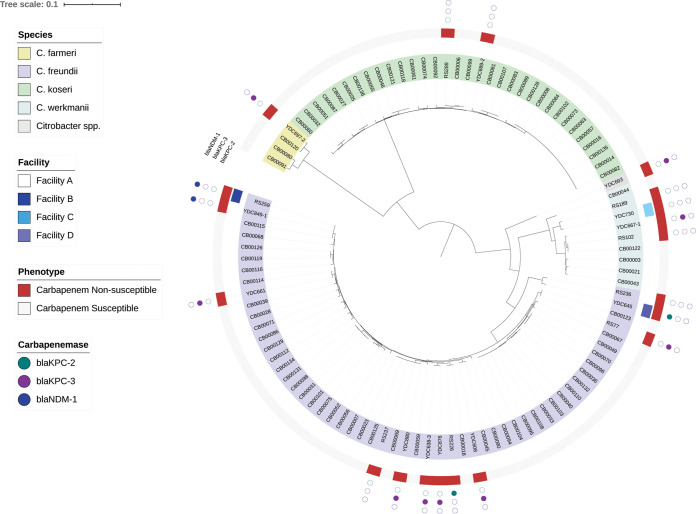
Local phylogeny of carbapenem-susceptible and -nonsusceptible Citrobacter spp. from UPMC. A phylogenetic tree of 102 local Citrobacter sp. genomes (82 carbapenem-susceptible and 20 carbapenem-nonsusceptible isolates) was generated based on an alignment of 1,606 core genes using RAxML (28). The tree was visualized and annotated using Interactive Tree of Life (iTOL) (29). The tree is annotated based on species, facility source, carbapenem susceptibility phenotype, and carbapenemase genes identified, if any, in the genome of each isolate.
FIG 3
FIG 3
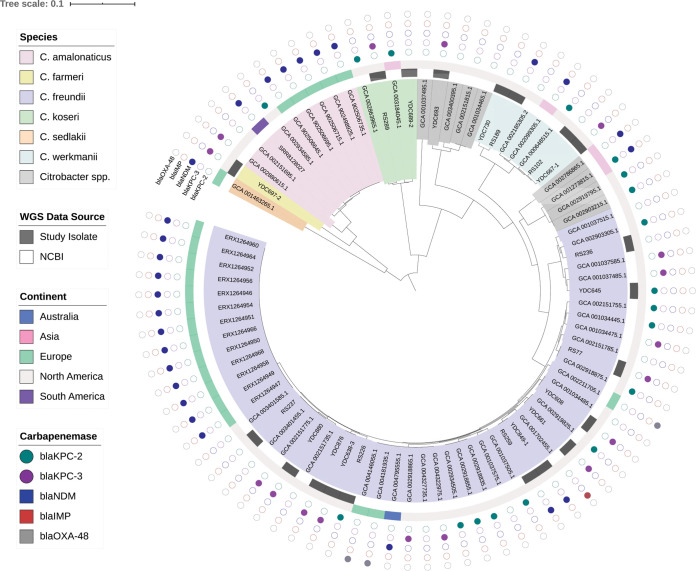
Global phylogeny of available CNSC genomes. A phylogenetic tree of 84 CNSC genomes (20 from this study and 64 from the NCBI) was generated based on an alignment of 1,842 core genes using RAxML (28). The tree was visualized and annotated using Interactive Tree of Life (iTOL) (29). The tree is annotated based on species, whole-genome sequencing data source, continent of isolation, and carbapenemase genes identified, if any, in the genome of each isolate.
FIG 4
FIG 4
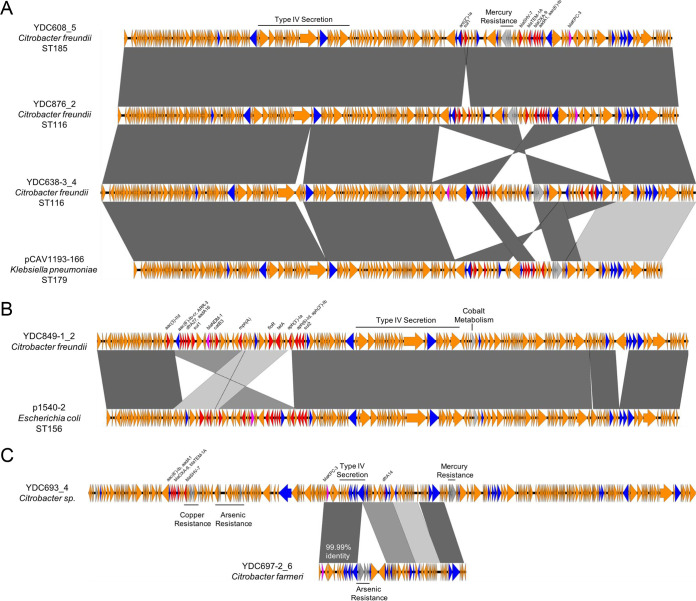
Carbapenemase-encoding plasmid diversity among and between CNSC genomes. CNSC genome contigs were compared to each other and to sequences deposited in the National Center for Biotechnology Information (NCBI). Sequences were aligned to one another with EasyFig. Sequence names are in the format “isolate_contig” based on hybrid assembly or correspond to the sequence name from NCBI. Bacterial species and sequence type are listed, where available. Open reading frames are colored by function (blue, mobilization; pink, carbapenemase; red, other antibiotic resistance; gray, metal interacting; orange, other/hypothetical). Antibiotic resistance genes, metal-interacting operons, and type IV secretion system components are labeled. Gray blocks between sequences indicate regions of >5 kb with >98% nucleotide identity, with darker shading indicating higher identity. Nucleotide identity between the blaKPC-3-encoding Tn4401-like regions of YDC693_4 and YDC697-2_6 (from two isolates of different Citrobacter species from the same patient) is noted with white text in panel C.

References

    1. Lozano R, et al. 2012. Global and regional mortality from 235 causes of death for 20 age groups in 1990 and 2010: a systematic analysis for the Global Burden of Disease Study 2010. Lancet 380:2095–2128. doi: 10.1016/S0140-6736(12)61728-0. - DOI - PMC - PubMed
    1. Kadri SS, Lai YL, Ricotta EE, Strich JR, Babiker A, Rhee C, Klompas M, Dekker JP, Powers JH III, Danner RL, Adjemian J. 2019. External validation of difficult-to-treat resistance prevalence and mortality risk in Gram-negative bloodstream infection using electronic health record data from 140 US hospitals. Open Forum Infect Dis 6:ofz110. doi: 10.1093/ofid/ofz110. - DOI - PMC - PubMed
    1. Bartsch SM, McKinnell JA, Mueller LE, Miller LG, Gohil SK, Huang SS, Lee BY. 2017. Potential economic burden of carbapenem-resistant Enterobacteriaceae (CRE) in the United States. Clin Microbiol Infect 23:48.E9–48.E16. doi: 10.1016/j.cmi.2016.09.003. - DOI - PMC - PubMed
    1. WHO. 2017. Global priority list of antibiotic-resistant bacteria to guide research, discover, and development of new antibiotics. World Health Organization, Geneva, Switzerland.
    1. CDC. 2019. Antibiotic resistance threats in the United States. U.S. Department of Health and Human Services, CDC, Atlanta, GA.

Publication types

LinkOut - more resources