Editorial
doi: 10.1183/13993003.01608-2020.
Print 2020 Jul.
Thrombosis and COVID-19 pneumonia: the clot thickens!
Affiliations
- PMID: 32554532
- PMCID: PMC7301830
- DOI: 10.1183/13993003.01608-2020
Item in Clipboard
Editorial
Thrombosis and COVID-19 pneumonia: the clot thickens!
Eur Respir J.
.
Abstract
Pulmonary thrombosis appears to be common in COVID-19 pneumonia and takes two forms, proximal pulmonary emboli and/or distal thrombosis. The possible mechanisms and clinical implications are discussed.
Conflict of interest statement
Conflict of interest: L.C. Price reports personal fees from Actelion and Johnson and Johnson, outside the submitted work. Conflict of interest: C. McCabe has nothing to disclose. Conflict of interest: B. Garfield has nothing to disclose. Conflict of interest: S.J. Wort reports grants and personal fees from Actelion Pharmaceuticals and Bayer, personal fees from MSD and GSK, outside the submitted work.
Figures
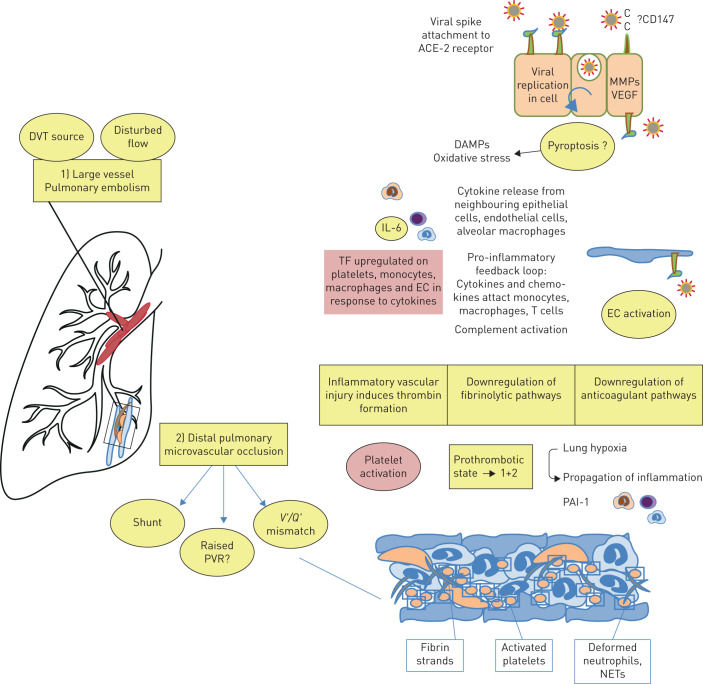
Hypothesis of the origin of coronavirus disease 2019 (COVID-19)-associated pulmonary emboli and lung microcirculatory thrombotic disease: interaction of inflammation and coagulation. When severe acute respiratory syndrome coronavirus 2 (SARS-CoV-2) infects cells expressing the surface receptors angiotensin-converting enzyme 2 (ACE-2), active replication and release of the virus may cause the host cell to undergo pyroptosis (pro-inflammatory apoptosis) and release damage-associated molecular patterns (DAMPs), activating oxidant stress, and generating pro-inflammatory cytokine and chemokine release from nearby epithelial cells, endothelial cells and alveolar macrophages. These proteins in turn attract inflammatory cells to the site of infection, promoting a pro-inflammatory feedback loop. Tissue factor, usually hidden on the subendothelium, is upregulated on platelets, leukocytes and endothelial cells (ECs) during inflammation, leading to activation of both the extrinsic and intrinsic coagulation pathways to make thrombin. Complement activation is also relevant. Thrombin binds to protease-activated receptors (e.g. PAR-1) to promote the formation of fibrin from fibrinogen, the activation of platelets and subsequent clot stabilisation, also propagating further inflammation. Natural anticoagulants and fibrinolytics may also be reduced in COVID-19/SARS-CoV-2 infection. Occluded small pulmonary blood vessels are likely to contain fibrin, platelets and coagulation factors, as well as neutrophils that become trapped in neutrophil extracellular traps (NETs) as they pass through the lung. Ongoing inflammation provides a positive feedback loop. Additional procoagulant stimuli include lung hypoxia, for example via upregulation of plasminogen activator inhibitor-1 (PAI-1) through suppression of fibrinolysis. In this prothrombotic pneumonitis or acute respiratory distress syndrome, whether similar mechanisms promote both microthrombosis as well as larger vessel pulmonary embolic disease is not known.
Comment on
-
Venous thromboembolism in SARS-CoV-2 patients: only a problem in ventilated ICU patients, or is there more to it?Eur Respir J. 2020 Jul 30;56(1):2001201. doi: 10.1183/13993003.01201-2020. Print 2020 Jul. Eur Respir J. 2020. PMID: 32398294 Free PMC article.
-
Pulmonary embolism in patients with COVID-19 pneumonia.Eur Respir J. 2020 Jul 30;56(1):2001365. doi: 10.1183/13993003.01365-2020. Print 2020 Jul. Eur Respir J. 2020. PMID: 32398297 Free PMC article.
References
-
- Leonard-Lorant I, Delabranche X, Severac F, et al. Acute pulmonary embolism in COVID-19 patients on CT angiography and relationship to D-dimer levels. Radiology 2020; in press [https://doi.org/10.1148/radiol.2020201561]. doi: 10.1148/radiol.2020201561 - DOI - PMC - PubMed
Publication types
MeSH terms
LinkOut - more resources
Full Text Sources
Other Literature Sources
Medical
Miscellaneous