


Levels of Periplasmic Nitrate Reductase during Denitrification are Lower in Bradyrhizobium japonicum than in Bradyrhizobium diazoefficiens
- PMID: 32554940
- PMCID: PMC7511789
- DOI: 10.1264/jsme2.ME19129
Levels of Periplasmic Nitrate Reductase during Denitrification are Lower in Bradyrhizobium japonicum than in Bradyrhizobium diazoefficiens
Abstract
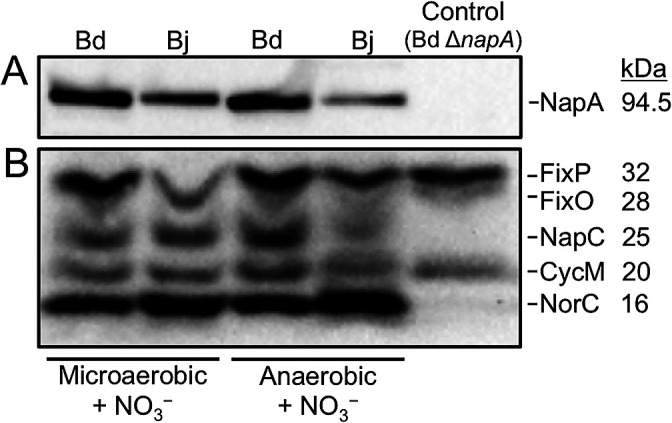
Soybean plants host endosymbiotic dinitrogen (N2)-fixing bacteria from the genus Bradyrhizobium. Under oxygen-limiting conditions, Bradyrhizobium diazoefficiens and Bradyrhizobium japonicum perform denitrification by sequentially reducing nitrate (NO3-) to nitrous oxide (N2O) or N2. The anaerobic reduction of NO3- to N2O was previously shown to be lower in B. japonicum than in B. diazoefficiens due to impaired periplasmic nitrate reductase (Nap) activity in B. japonicum. We herein demonstrated that impaired Nap activity in B. japonicum was due to low Nap protein levels, which may be related to a decline in the production of FixP and FixO proteins by the cbb3-type oxidase.
Keywords: Bradyrhizobium; cbb3 oxidase; competitive growth; denitrification; periplasmic nitrate reductase.
Figures
References
-
- Aida T., Hata S., and Kusunoki H. (1986) Temporary low oxygen conditions for the formation of nitrate reductase and nitrous oxide reductase by denitrifying Pseudomonas sp. G59. Can J Microbiol 32: 543–547. - PubMed
-
- Bergaust L., Bakken L.R., and Frostegård Å. (2011) Denitrification regulatory phenotype, a new term for the characterization of denitrifying bacteria. Biochem Soc Trans 39: 207–212. - PubMed
-
- Bueno B., Robles E.F., Torres M.J., Krell T., Bedmar E.J., Delgado M.J., and Mesa S. (2017) Disparate response to microoxia and nitrogen oxides of the Bradyrhizobium japonicum napEDABC, nirK and norCBQD denitrification genes. Nitric Oxide 6: 1–13. - PubMed
MeSH terms
Substances
Supplementary concepts
LinkOut - more resources
Full Text Sources
Molecular Biology Databases
Research Materials
