A 2-free-end flexor carpi radialis tendon graft for treating a complex index finger extensor tendon injury
- PMID: 32555110
- PMCID: PMC7944807
- DOI: 10.23750/abm.v91i4-S.9475
A 2-free-end flexor carpi radialis tendon graft for treating a complex index finger extensor tendon injury
Abstract
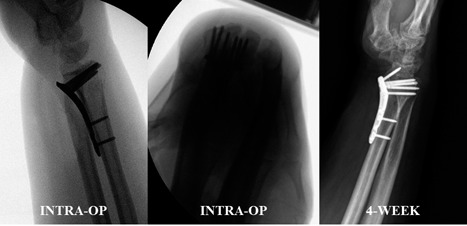
Background: Volar plating has increasingly become the most used technique for the treatment of unstable distal radius fractures due to the low soft-tissue disturbance and its biomechanical reliability, which allows the early mobilization of the wrist. One of the main goals of the volar locking compression plates design is to avoid those soft tissue complications historically associated to the dorsal plating. However, extensor tendon complications can not be completely excluded.
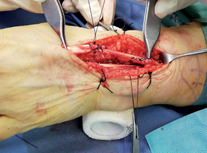
Method: The authors report the case of a patient with a complete rupture of the index finger extensor tendons after volar plate fixation of the distal radius. Due to the presence of a severe tendons retraction with a 4-centimeter gap and the neighbouring soft tissues damage, it was decided to fill the gap with a 2-free-end autograft harvested from the Flexor Carpi Radialis (FCR) tendon, using the volar surgical approach performed to remove the plate.
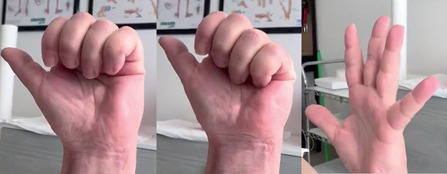
Results: At the 2-month follow-up, the patient showed the complete recovery of the flexion-extension movements.
Conclusions: Even though the 2-free-end FCR tendon graft is not commonly reported for the reconstruction of extensor tendons defects, we assume it deserves to be considered as an adequate technique whenever the neighbouring tendons are critically compromised.
Conflict of interest statement
Each author declares that he or she has no commercial associations (e.g. consultancies, stock ownership, equity interest, patent/licensing arrangement etc.) that might pose a conflict of interest in connection with the submitted article
Figures

References
-
- Court-Brown C. M, Caesar B. “Epidemiology of adult fractures: A review,”. Injury. 2006;37:691–697. - PubMed
-
- Arora R, Lutz M, Hennerbichler A, Krappinger D, Espen D, Gabl M. “Complications following internal fixation of unstable distal radius fracture with a palmar locking-plate,”. J. Orthop. Trauma. 2007;21:316–322. - PubMed
-
- Berglund L. M, Messer T. M. “Complications of volar plate fixation for managing distal radius fractures,”. Journal of the American Academy of Orthopaedic Surgeons. 2009;17:369–77. - PubMed
-
- Totoki Y, Yoshii Y, Kusakabe T, Akita K, Ishii T. “Screw Length Optimization of a Volar Locking Plate Using Three Dimensional Preoperative Planning in Distal Radius Fractures,”. J. hand Surg. Asian-Pacific Vol. 2018;23:520–527. - PubMed
Publication types
MeSH terms
LinkOut - more resources
Full Text Sources
Medical
Miscellaneous