. 2020 Jun 17;10(1):9861.
doi: 10.1038/s41598-020-66923-9.

Single Circulating Fetal Trophoblastic Cells Eligible for Non Invasive Prenatal Diagnosis: the Exception Rather than the Rule

Affiliations

Single Circulating Fetal Trophoblastic Cells Eligible for Non Invasive Prenatal Diagnosis: the Exception Rather than the Rule

Laure Cayrefourcq et al. Sci Rep. .

Abstract

Non-Invasive Prenatal Diagnosis (NIPD), based on the analysis of circulating cell-free fetal DNA (cff-DNA), is successfully implemented for an increasing number of monogenic diseases. However, technical issues related to cff-DNA characteristics remain, and not all mutations can be screened with this method, particularly triplet expansion mutations that frequently concern prenatal diagnosis requests. The objective of this study was to develop an approach to isolate and analyze Circulating Trophoblastic Fetal Cells (CFTCs) for NIPD of monogenic diseases caused by triplet repeat expansion or point mutations. We developed a method for CFTC isolation based on DEPArray sorting and used Huntington's disease as the clinical model for CFTC-based NIPD. Then, we investigated whether CFTC isolation and Whole Genome Amplification (WGA) could be used for NIPD in couples at risk of transmitting different monogenic diseases. Our data show that the allele drop-out rate was 3-fold higher in CFTCs than in maternal cells processed in the same way. Moreover, we give new insights into CFTCs by compiling data obtained by extensive molecular testing by microsatellite multiplex PCR genotyping and by WGA followed by mini-exome sequencing. CFTCs appear to be often characterized by a random state of genomic degradation.


Conflict of interest statement

The authors declare no competing interests.

Figures
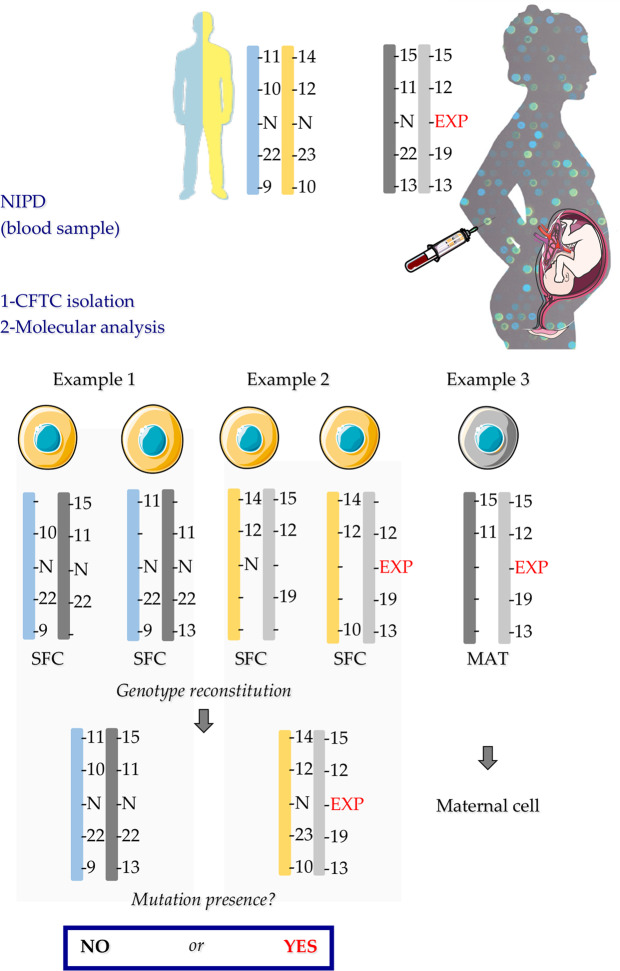
Figure 1
Figure 1
Genotype result interpretation. In example 1 and 2, the presence of the paternal-specific alleles 10 and 14 allows concluding that these two single cells are fetal cells. Example 3 illustrates the identification of a maternal cell on the basis of its genotype. EXP: expansion of triplet repeats; MAT: maternal cell; N: normal triplet repeat size; NIPD: non-invasive prenatal diagnosis; SFC: Single Fetal Cell.
Figure 2
Figure 2
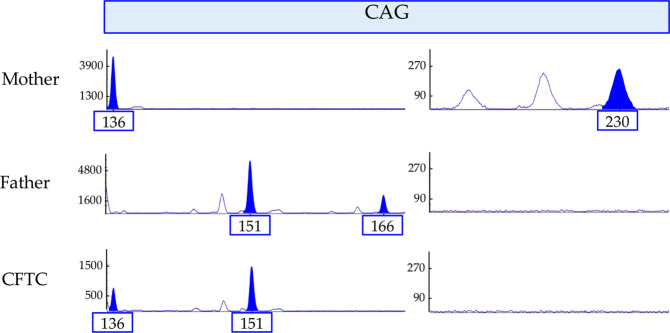
NIPD result for Family D. At the CAG repeat locus region, the mother carries one normal allele (136) and one expanded allele (230) that corresponds to a 44 repeats expansion mutation. The father carries two normal alleles (151 and 166). The fetus inherited the maternal normal 136 allele and the paternal normal 151 allele.
Figure 3
Figure 3
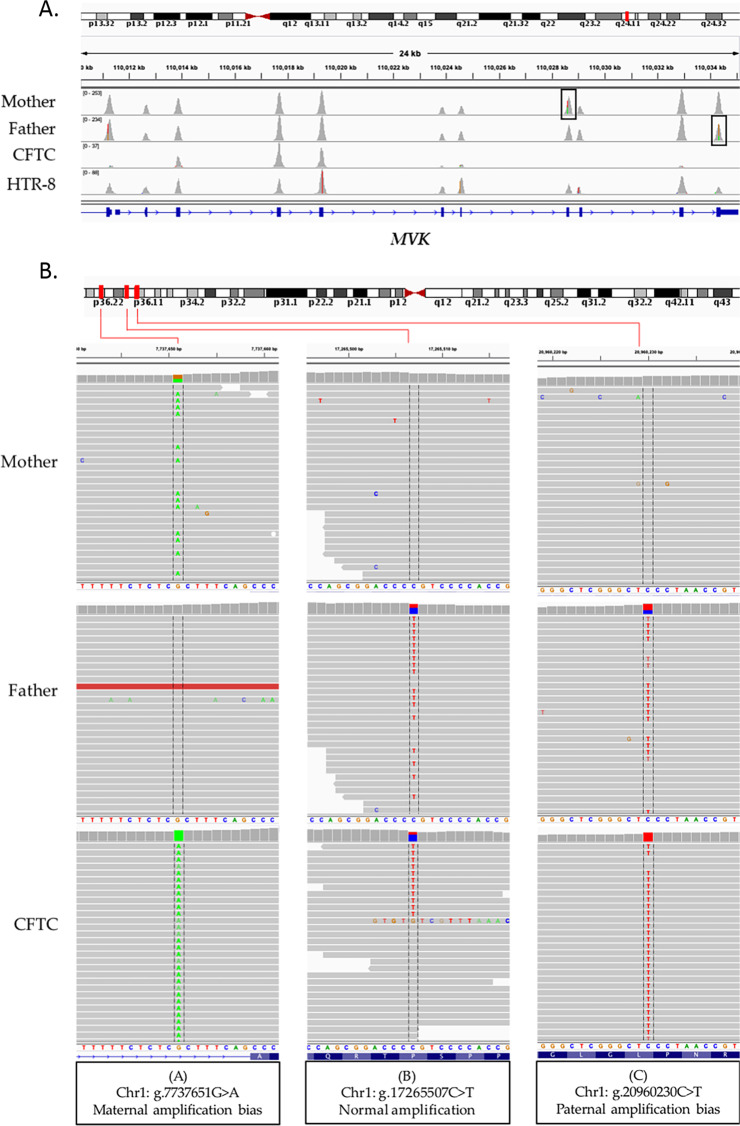
(A) IGV visualization of the sequence coverage in the MVK gene on chromosome 12 in the couple at risk of transmitting mevalonic aciduria to their fetus (Family J) and in a single HTR-8/SVneo cell from a different sequencing run. The maternal and paternal mutations targeted in this analysis are located in exon 8 and 11 (highlighted by black frames), respectively. (B) Amplification bias characterization in a single CFTC (Family J). IGV visualization of sequence alignments in three regions of chromosome 1 showing: (A) Abnormal amplification of a maternal allele (the maternal heterozygous variant is homozygous in the CFTC), (B) Normal amplification (both wild type and paternal variant are found in CFTC), and (C) Abnormal amplification of a paternal allele.

References

    1. Drury, S., Hill, M. & Chitty, L. S. Cell-Free Fetal DNA Testing for Prenatal Diagnosis. In Advances in Clinical Chemistry 76, 1–35 (Elsevier Inc., 2016). - PubMed
    1. Hui L. Noninvasive Approaches to Prenatal Diagnosis: Historical Perspective and Future Directions. Methods Mol. Biol. 2019;1885:45–58. doi: 10.1007/978-1-4939-8889-1_3. - DOI - PubMed
    1. Mellis R, Chandler N, Chitty LS. Next-generation sequencing and the impact on prenatal diagnosis. Expert Rev. Mol. Diagn. 2018;18:689–699. doi: 10.1080/14737159.2018.1493924. - DOI - PubMed
    1. Mujezinovic F, Alfirevic Z. Procedure-Related Complications of Amniocentesis and Chorionic Villous. Obstet. Gynecol. 2007;110:687–694. doi: 10.1097/01.AOG.0000278820.54029.e3. - DOI - PubMed
    1. Hayward J, Chitty LS. Beyond screening for chromosomal abnormalities: Advances in non-invasive diagnosis of single gene disorders and fetal exome sequencing. Semin. Fetal Neonatal Med. 2018;23:94–101. doi: 10.1016/j.siny.2017.12.002. - DOI - PubMed

Publication types