Impact of a respiratory ICU rotation on resident knowledge and confidence in managing mechanical ventilation
- PMID: 32556030
- PMCID: PMC7572270
- DOI: 10.36416/1806-3756/e20190108
Impact of a respiratory ICU rotation on resident knowledge and confidence in managing mechanical ventilation
Abstract
Objective: To develop and apply a competency-based test to assess learning among internal medicine residents during a respiratory ICU rotation at a university hospital.
Methods: We developed a test comprising 19 multiple-choice questions regarding knowledge of mechanical ventilation (MV) and 4 self-assessment questions regarding the degree of confidence in the management of MV. The test was applied on the first and last day of a 30-day respiratory ICU rotation (pre-rotation and post-rotation, respectively). During the rotation, the residents had lectures, underwent simulator training, and shadowed physicians on daily bedside rounds focused on teaching MV management.
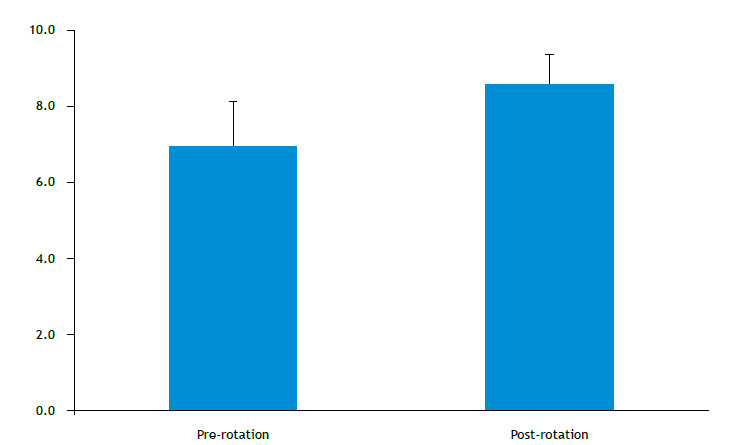
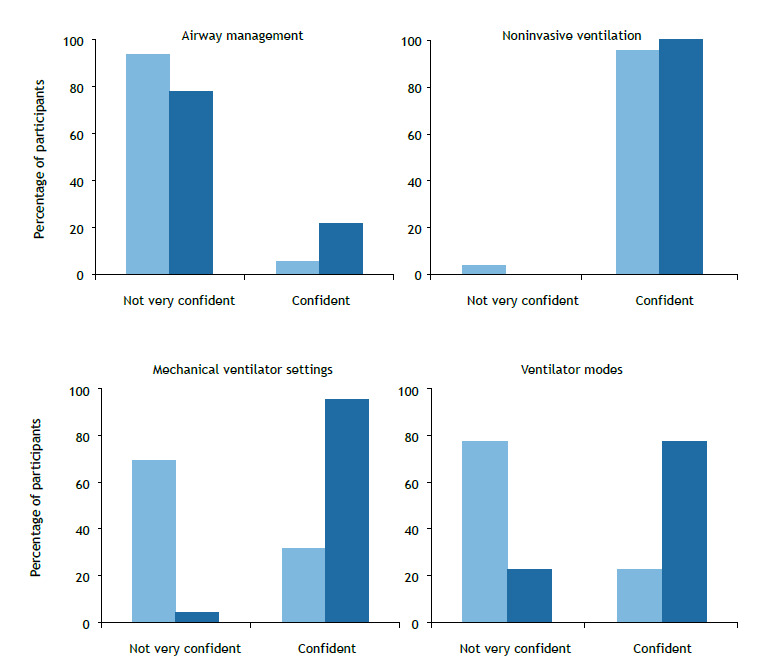
Results: Fifty residents completed the test at both time points. The mean score increased from 6.9 ± 1.2 (pre-rotation) to 8.6 ± 0.8 (post-rotation; p < 0.001). On questions regarding the approach to hypoxemia, the recognition of patient-ventilator asynchrony, and the recognition of risk factors for extubation failure, the post-rotation scores were significantly higher than the pre-rotation scores. Confidence in airway management increased from 6% before the rotation to 22% after the rotation (p = 0.02), whereas confidence in making the initial MV settings increased from 31% to 96% (p < 0.001) and confidence in adjusting the ventilator modes increased from 23% to 77% (p < 0.001).
Conclusions: We developed a competency-based test to assess knowledge of MV among residents before and after an rotation in a respiratory ICU. Resident performance increased significantly after the rotation, as did their confidence in caring for patients on MV.
Objetivo:: Desenvolver e aplicar um teste baseado em competências para avaliar o aprendizado de residentes de clínica médica em estágio na UTI respiratória de um hospital universitário.
Métodos:: Desenvolvemos um teste com 19 questões de múltipla escolha sobre conhecimento em ventilação mecânica (VM) e 4 questões de autoavaliação sobre o nível de confiança no manejo da VM. Os testes foram aplicados no primeiro (pré-estágio) e no último dia (pós-estágio) do estágio de 30 dias na UTI respiratória. Durante o estágio, os residentes tiveram aulas teóricas, treinamento com simulador e visitas diárias à beira do leito focadas no ensino de VM.
Resultados:: Cinquenta residentes completaram o teste nos dois momentos. A média de pontuação (0-10 pontos) aumentou de 6,9 ± 1,2 no pré-estágio para 8,6 ± 0,8 no pós-estágio (p < 0,001). Observamos um aumento significativo no pós-estágio comparado com o pré-estágio em questões sobre abordagem da hipoxemia, reconhecimento da assincronia paciente-ventilador e reconhecimento de fatores de risco para falha de extubação. A confiança na abordagem de vias aéreas aumentou de 6% para 22% ao final do estágio (p = 0,02). A confiança no ajuste inicial da VM subiu de 31% para 96% (p < 0,001), e a confiança no ajuste dos modos ventilatórios aumentou de 23% para 77% (p < 0,001).
Conclusões:: Desenvolvemos um teste baseado em competências para avaliar o conhecimento sobre VM entre residentes antes e depois de um estágio em UTI respiratória. O desempenho dos residentes ao final do estágio aumentou significativamente, assim como sua confiança para cuidar de pacientes sob VM.
Figures
References
-
- Tomicic V, Espinoza M, Andresen M, Molina J, Calvo M, Ugarte H. Characteristics and factors associated with mortality in patients receiving mechanical ventilation first Chilean multicenter study [Article in Spanish]. Rev Med. Chil. 2008;136(8):959–967. doi: 10.4067/S0034-98872008000800001. - DOI - PubMed
MeSH terms
LinkOut - more resources
Full Text Sources