Review
. 2021 Jan 21;27(5):1533-1555.
doi: 10.1002/chem.202002059. Epub 2020 Nov 10.

Generation and Reactivity of C(1)-Ammonium Enolates by Using Isothiourea Catalysis

Affiliations
Review

Generation and Reactivity of C(1)-Ammonium Enolates by Using Isothiourea Catalysis

Calum McLaughlin et al. Chemistry. .

Abstract

C(1)-Ammonium enolates are powerful, catalytically generated synthetic intermediates applied in the enantioselective α-functionalisation of carboxylic acid derivatives. This minireview describes the recent developments in the generation and application of C(1)-ammonium enolates from various precursors (carboxylic acids, anhydrides, acyl imidazoles, aryl esters, α-diazoketones, alkyl halides) using isothiourea Lewis base organocatalysts. Their synthetic utility in intra- and intermolecular enantioselective C-C and C-X bond forming processes on reaction with various electrophiles will be showcased utilising two distinct catalyst turnover approaches.

Keywords: C(1)-ammonium enolates; aryloxides; catalyst turnover; formal cycloaddition; isothioureas.


Conflict of interest statement

The authors declare no conflict of interest.

Figures
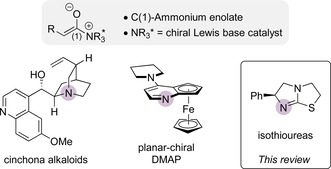
Figure 1
Figure 1
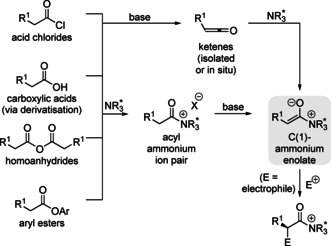
C(1)‐Ammonium enolates.
Scheme 1
Scheme 1
Overview of C(1)‐ammonium enolate generation.
Scheme 2
Scheme 2
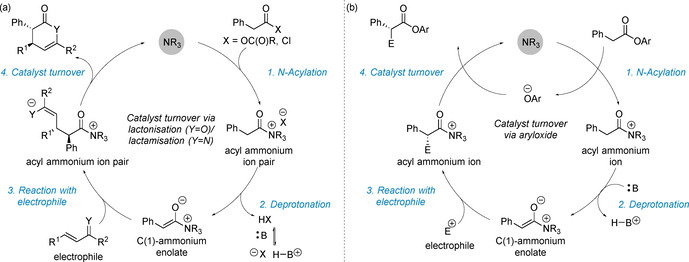
Catalyst turnover in C(1)‐ammonium enolate catalysis (a) via lactonisation (X=O)/lactamisation (X=N) and (b) via aryloxide.
Figure 2
Figure 2
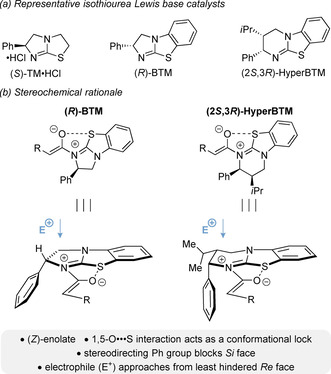
Isothiourea Lewis base organocatalysts.
Scheme 3
Scheme 3
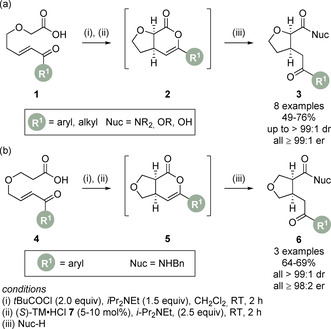
Michael addition/lactonisation for the synthesis of (a) syn‐2,3‐tetrahydrofurans and (b) syn 3,4‐tetrahydrofurans. (S)‐TMHCl.
Scheme 4
Scheme 4
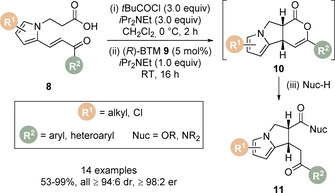
Michael addition/lactonisation for the synthesis of pyrrolizines.
Scheme 5
Scheme 5
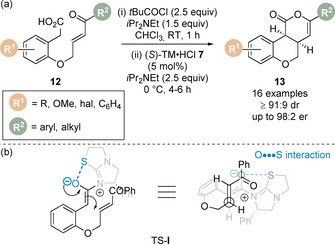
(a) 6‐exo‐trig Michael addition/lactonisation for the enantioselective synthesis of cis‐chromenones, and (b) stereochemical rationale.
Scheme 6
Scheme 6
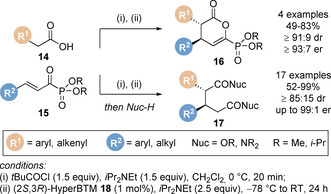
Michael addition/lactonisation using α‐keto‐β,γ‐unsaturated phosphonate Michael acceptors.
Scheme 7
Scheme 7
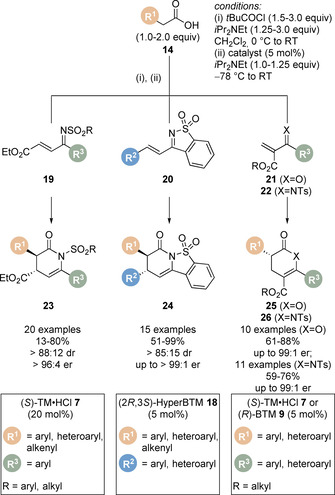
Michael addition/lactonisation or lactamisation using various Michael acceptors (when X=O: from homoanhydride).
Scheme 8
Scheme 8
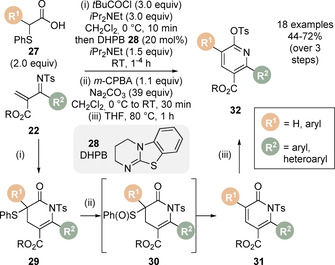
Isothiourea‐catalysed Michael addition/lactamisation, oxidation‐elimination sequence for the synthesis of 2,3,5,6‐tetrasubstituted pyridines. DHPB=dihydropyrimidobenzothiazole, m‐CPBA=meta‐chloroperoxybenzoic acid.
Scheme 9
Scheme 9
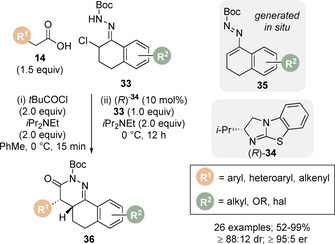
Isothiourea‐catalysed Michael addition/lactamisation of in situ generated azoalkenes. Boc=tert‐butlyoxycarbonyl.
Scheme 10
Scheme 10
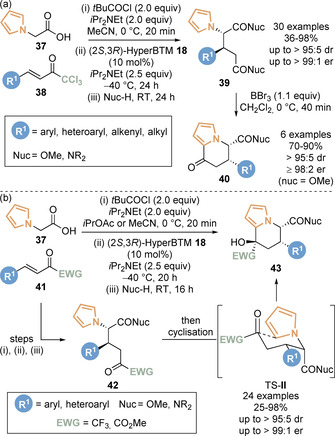
Isothiourea‐catalysed functionalisation of 2‐pyrrole acetic acid.
Scheme 11
Scheme 11
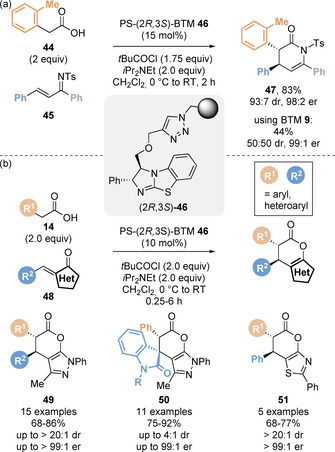
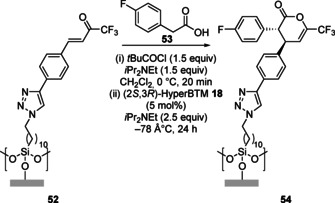
Enantioselective Michael addition/lactonisation catalysed by an immobilised isothiourea.
Scheme 12
Scheme 12
Direct Michael addition/lactonisation on a silicon oxide surface.
Scheme 13
Scheme 13
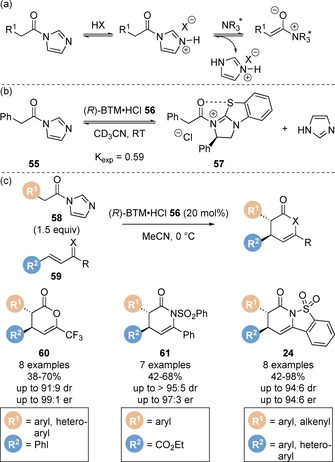
(a) The imidazolium effect for C(1)‐ammonium enolate generation, (b) initial equilibrium studies and (c) formal [4+2] cycloadditions.
Scheme 14
Scheme 14
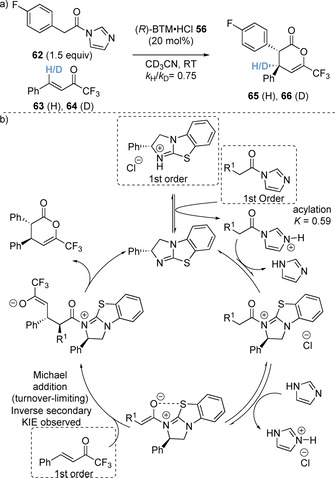
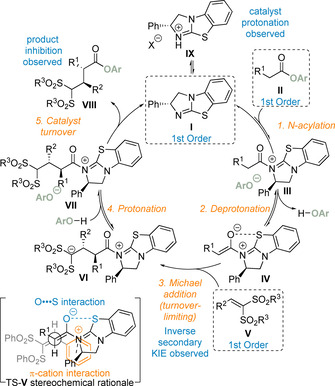
(a) Observed inverse secondary kinetic isotope effect (KIE) and (b) proposed mechanism using N‐acyl imidazoles.
Scheme 15
Scheme 15
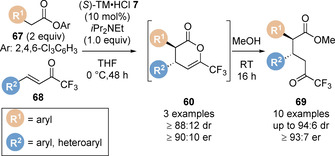
Michael addition/lactonisation using 2,4,6‐trichlorophenyl esters.
Scheme 16
Scheme 16
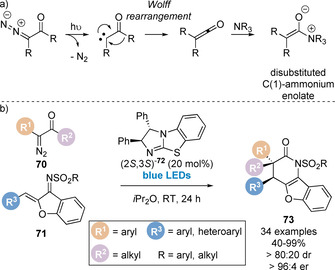
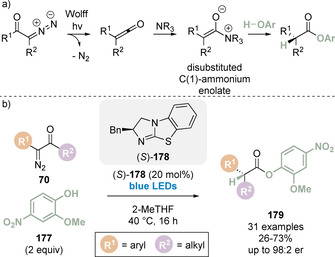
(a) Generation of C(1)‐ammonium enolates from α‐diazoketones and (b) application in Michael addition/lactamisation.
Scheme 17
Scheme 17
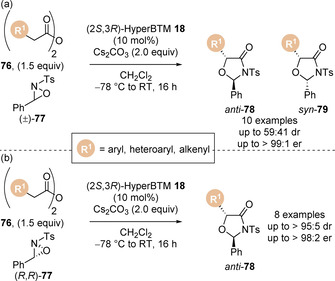
Isothiourea‐catalysed formal [3+2] cycloadditions with (a) racemic oxaziridines and (b) enantioenriched oxaziridines. Ts=tosyl.
Scheme 18
Scheme 18
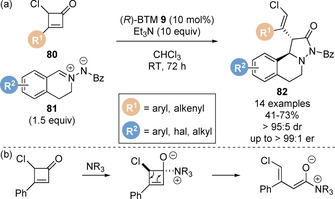
Isothiourea‐catalysed formal [3+2] cycloadditions of C(1)‐ammonium enolates generated from mono‐chloro‐substituted cyclobutenones. Bz=benzoyl.
Scheme 19
Scheme 19
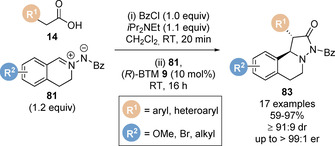
Isothiourea‐catalysed formal [3+2] cycloadditions of C(1)‐ammonium enolates generated from carboxylic acids.
Scheme 20
Scheme 20
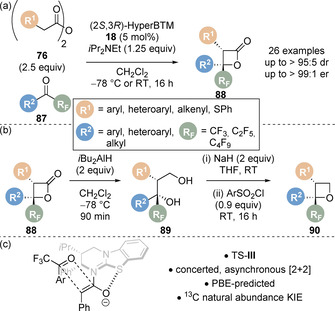
(a) Isothiourea‐catalysed synthesis of perfluoroalkyl‐substituted β‐lactones, (b) product derivatisation and (c) proposed transition state.
Scheme 21
Scheme 21
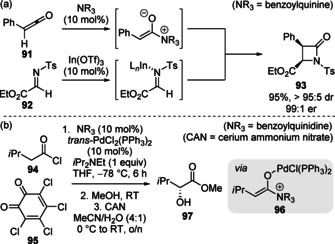
(a) Enantioselective synthesis of β‐lactams and (b) enantioselective α‐hydroxylation, enabled by dual tertiary amine/metal catalysis.
Scheme 22
Scheme 22
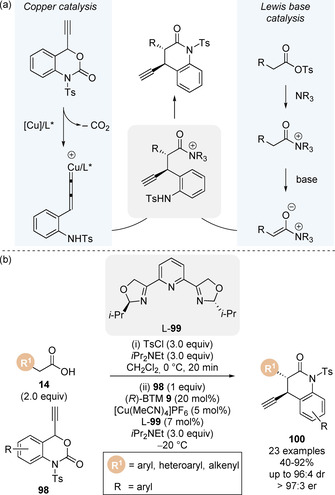
Dual copper/isothiourea‐catalysed decarboxylative formal [4+2] cycloaddition for the synthesis of 3,4‐dihydroquinolin‐2‐one derivatives.
Scheme 23
Scheme 23
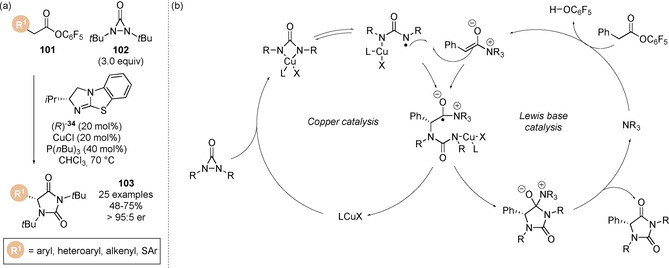
Cooperative copper/isothiourea‐catalysed α‐amination of esters using diaziridinone.
Scheme 24
Scheme 24
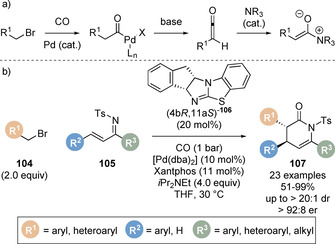
(a) Generation of C(1)‐ammonium enolates via palladium‐catalysed carbonylation and (b) application in a combined carbonylation/cycloaddition cascade.
Scheme 25
Scheme 25
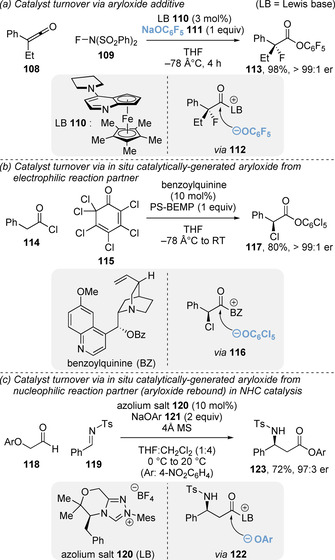
Catalyst turnover via (a) aryloxide additive, (b) aryloxide generated from electrophilic reaction partner, and (c) aryloxide generated from nucleophilic reaction partner. Mes=mesityl.
Scheme 26
Scheme 26
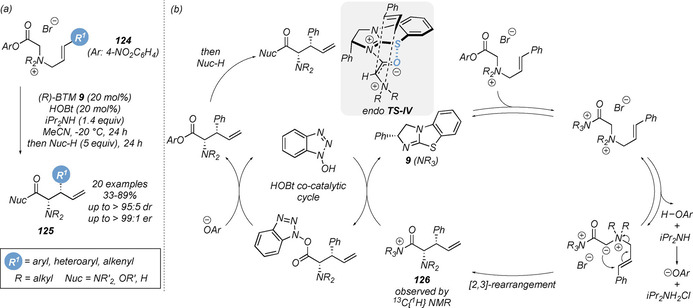
(a) Isothiourea‐catalysed asymmetric [2,3]‐sigmatropic rearrangement of allylic ammonium ylides and (b) the proposed mechanism.
Scheme 27
Scheme 27
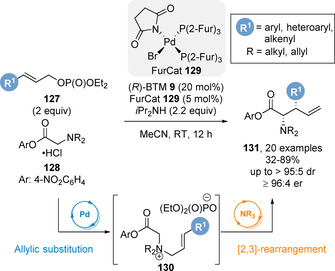
Synthesis of syn α‐amino acid derivatives via tandem palladium/isothiourea relay catalysis.
Scheme 28
Scheme 28
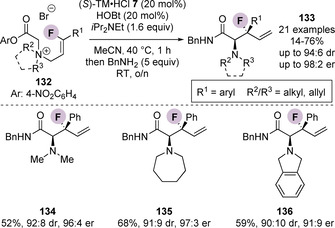
Enantioselective synthesis of β‐fluoro‐β‐aryl‐α‐aminopenten‐amides via [2,3]‐rearrangement of ammonium salts bearing a (Z)‐3‐fluoro‐3‐arylprop‐2‐ene group. Bn=benzyl.
Scheme 29
Scheme 29
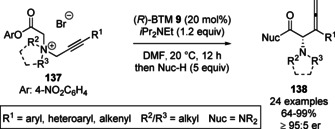
Asymmetric [2,3]‐rearrangement of propargylic ammonium salts.
Scheme 30
Scheme 30
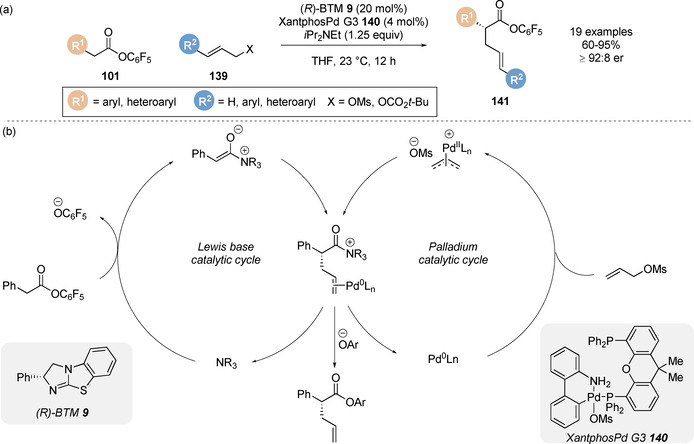
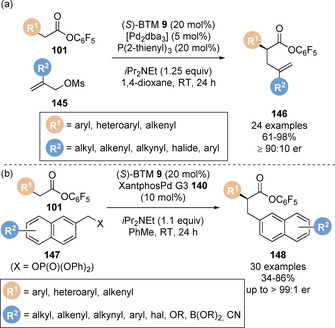
(a) Coorperative palladium/isothiourea catalysis for the enantioselective α‐allylation of pentafluorophenyl esters and (b) proposed mechanism.
Scheme 31
Scheme 31
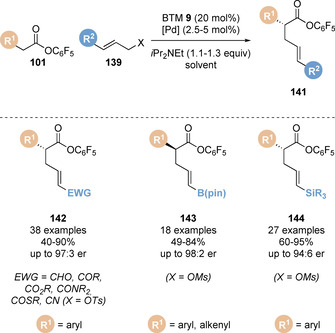
Palladium/isothiourea‐catalysed enantioselective α‐allylation using electron‐deficient, B(pin)‐substituted and silicon‐substituted allylic partners.
Scheme 32
Scheme 32
Dual palladium/isothiourea‐catalysed (a) enantioselective α‐allylation using 2‐substituted allyl electrophiles and (b) enantioselective α‐benzylation.
Scheme 33
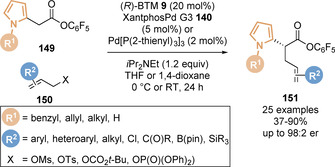
Scheme 33
Dual palladium/isothiourea‐catalysed enantioselective α‐allylation of 2‐pyrrole substituted pentafluorophenyl esters.
Scheme 34
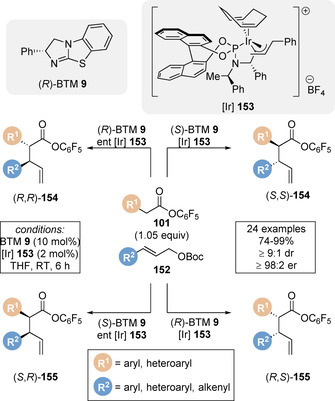
Scheme 34
Dual iridium/isothiourea‐catalysed stereodivergent α‐allylation of pentafluorophenyl esters.
Scheme 35
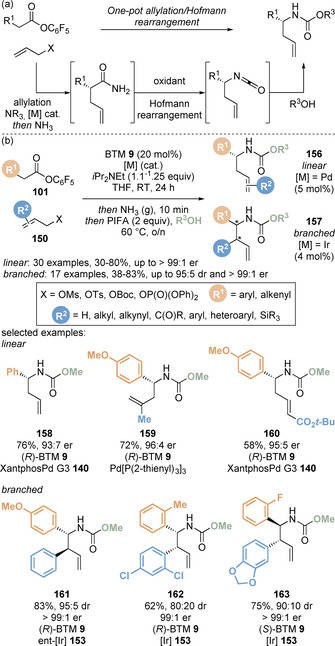
Scheme 35
Enantioselective synthesis of homoallylic amines via a one‐pot allylation/Hofmann rearrangement sequence.
Scheme 36
Scheme 36
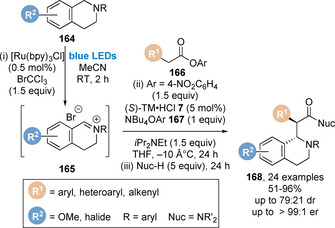
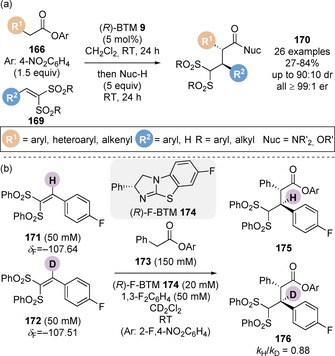
Enantioselective addition of C(1)‐ammonium enolates, generated from para‐nitrophenyl esters to iminium ion electrophiles.
Scheme 37
Scheme 37
(a) Base‐free enantioselective C(1)‐ammonium enolate catalysis and (b) observed inverse secondary kinetic isotope effect.
Scheme 38
Scheme 38
Proposed mechanism of base‐free enantioselective C(1)‐ammonium enolate catalysis featuring a multifunctional aryloxide.
Scheme 39
Scheme 39
Enantioselective protonation of a disubstituted C(1)‐ammonium enolate generated from α‐dizaoketones.

References

    1. Denmark S. E., Beutner G. L., Angew. Chem. Int. Ed. 2008, 47, 1560–1638; - PubMed
    2. Angew. Chem. 2008, 120, 1584–1663.
    1. None
    1. Erkkilä A., Majander I., Pihko P. M., Chem. Rev. 2007, 107, 5416–5470; - PubMed
    1. Mukherjee S., Yang J. W., Hoffmann S., List B., Chem. Rev. 2007, 107, 5471–5569; - PubMed
    1. Mečiarová M., Tivoský P., Šebesta R., New J. Chem. 2016, 40, 4855–4864.

MeSH terms

LinkOut - more resources