


The communicative importance of agent-backgrounding: Evidence from homesign and Nicaraguan Sign Language
- PMID: 32559513
- PMCID: PMC12289345
- DOI: 10.1016/j.cognition.2020.104332
The communicative importance of agent-backgrounding: Evidence from homesign and Nicaraguan Sign Language
Abstract
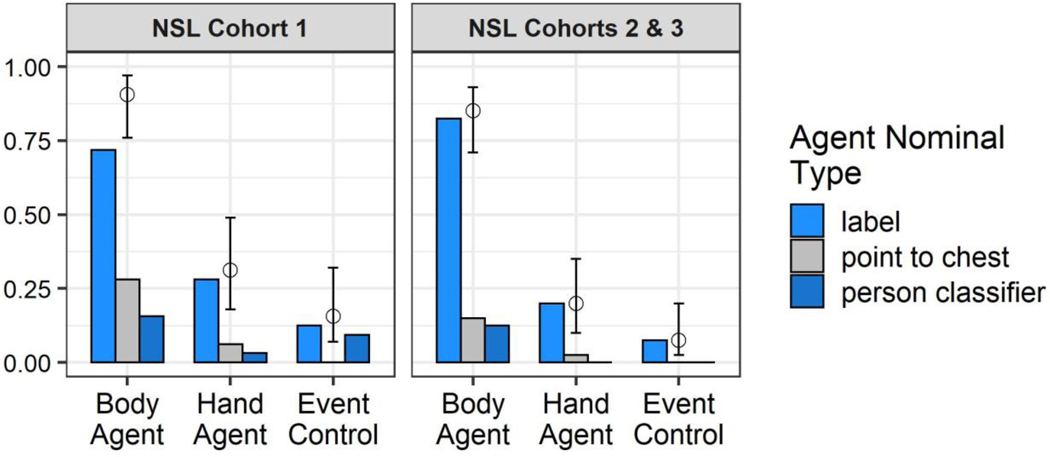
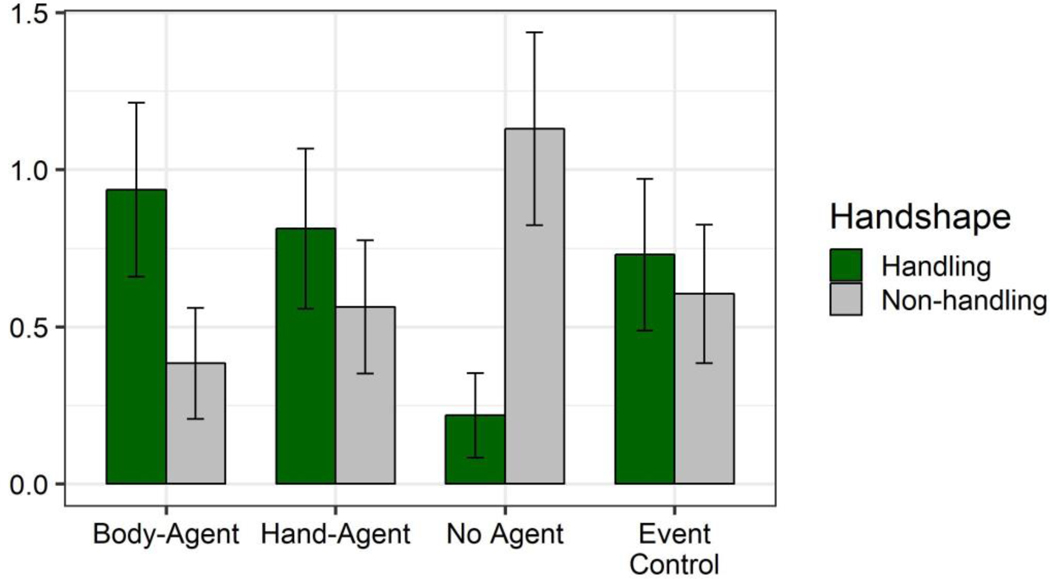
Some concepts are more essential for human communication than others. In this paper, we investigate whether the concept of agent-backgrounding is sufficiently important for communication that linguistic structures for encoding this concept are present in young sign languages. Agent-backgrounding constructions serve to reduce the prominence of the agent - the English passive sentence a book was knocked over is an example. Although these constructions are widely attested cross-linguistically, there is little prior research on the emergence of such devices in new languages. Here we studied how agent-backgrounding constructions emerge in Nicaraguan Sign Language (NSL) and adult homesign systems. We found that NSL signers have innovated both lexical and morphological devices for expressing agent-backgrounding, indicating that conveying a flexible perspective on events has deep communicative value. At the same time, agent-backgrounding devices did not emerge at the same time as agentive devices. This result suggests that agent-backgrounding does not have the same core cognitive status as agency. The emergence of agent-backgrounding morphology appears to depend on receiving a linguistic system as input in which linguistic devices for expressing agency are already well-established.
Keywords: Agency; Gesture; Language emergence; Semantics; Sign languages; Typology.
Copyright © 2020 Elsevier B.V. All rights reserved.
Figures





References
-
- Abner N, Flaherty M, Stangl K, Coppola M, Brentari D, & Goldin-Meadow S. (2019). The noun-verb distinction in established and emergent sign systems. Language, 95(2), 230–267.
-
- Abraham W, & Leisiö L. (Eds.). (2006). Passivization and typology : form and function. Amsterdam ; Philadelphia: J. Benjamins Pub. Co.
-
- Aikhenvald AY (2006). Serial verb constructions in typological perspective. In Aikhenvald A. & Dixon RMW (Eds.), Serial verb constructions: A cross-linguistic typology (pp. 1–68). Oxford, UK: Oxford University Press.
-
- Armon-Lotem S, Haman E, Jensen de Lopez K, Smoczynska M, Yatsushiro K, Szczerbinski M, . . . van der Lely H. (2016). A Large-Scale Crosslinguistic Investigation of the Acquisition of Passive. Language Acquisition, null-null. doi: 10.1080/10489223.2015.1047095 - DOI
-
- Bahan B, Kegl J, Lee RG, MacLaughlin D, & Neidle C. (2000). The licensing of null arguments in American Sign Language. Linguistic Inquiry, 31(1), 1–27.
Publication types
MeSH terms
Grants and funding
LinkOut - more resources
Full Text Sources
