


Meta-Analysis of Microbial Communities in Hot Springs: Recurrent Taxa and Complex Shaping Factors beyond pH and Temperature
- PMID: 32560103
- PMCID: PMC7356817
- DOI: 10.3390/microorganisms8060906
Meta-Analysis of Microbial Communities in Hot Springs: Recurrent Taxa and Complex Shaping Factors beyond pH and Temperature
Abstract
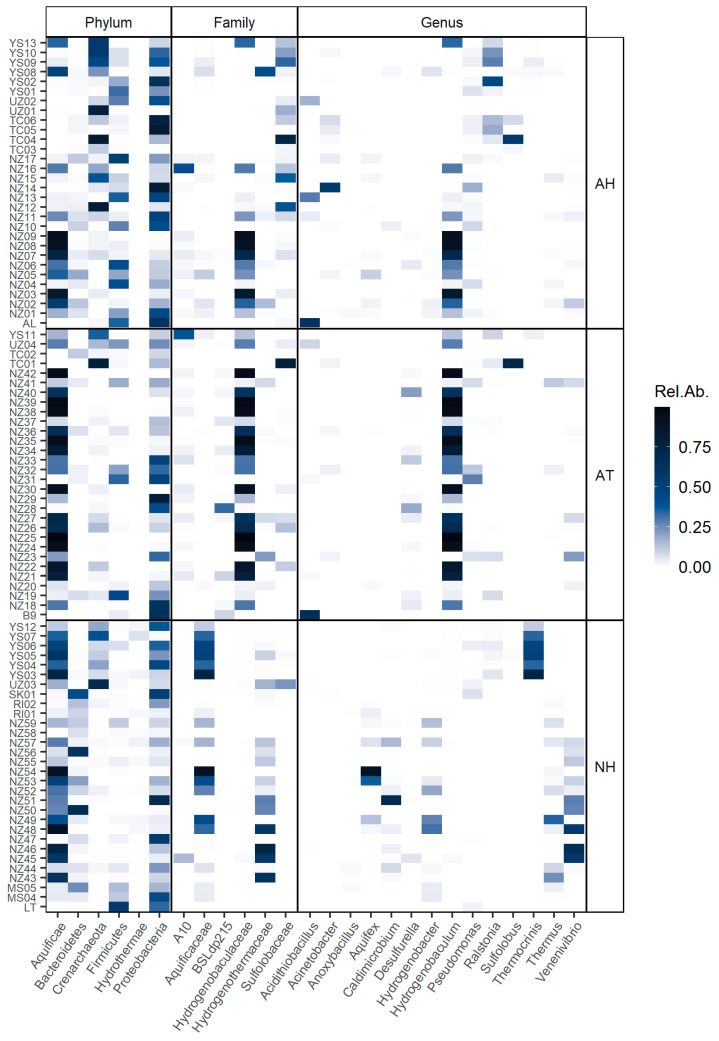
The study of microbial communities from extreme environments is a fascinating topic. With every study, biologists and ecologists reveal interesting facts and questions that dispel the old belief that these are inhospitable environments. In this work, we assess the microbial diversity of three hot springs from Neuquén, Argentina, using high-throughput amplicon sequencing. We predicted a distinct metabolic profile in the acidic and the circumneutral samples, with the first ones being dominated by chemolithotrophs and the second ones by chemoheterotrophs. Then, we collected data of the microbial communities of hot springs around the world in an effort to comprehend the roles of pH and temperature as shaping factors. Interestingly, there was a covariation between both parameters and the phylogenetic distance between communities; however, neither of them could explain much of the microbial profile in an ordination model. Moreover, there was no correlation between alpha diversity and these parameters. Therefore, the microbial communities' profile seemed to have complex shaping factors beyond pH and temperature. Lastly, we looked for taxa associated with different environmental conditions. Several such taxa were found. For example, Hydrogenobaculum was frequently present in acidic springs, as was the Sulfolobaceae family; on the other hand, Candidatus Hydrothermae phylum was strongly associated with circumneutral conditions. Interestingly, some singularities related to sites featuring certain taxa were also observed.
Keywords: Caviahue-Copahue; Domuyo; amplicon sequencing; extreme environments; extremophiles; hot springs; microbial communities.
Conflict of interest statement
The authors declare no conflict of interest.
Figures
References
-
- Hamamura N., Macur R.E., Korf S., Ackerman G., Taylor W.P., Kozubal M., Reysenbach A.L., Inskeep W.P. Linking microbial oxidation of arsenic with detection and phylogenetic analysis of arsenite oxidase genes in diverse geothermal environments. Environ. Microbiol. 2009;11:421–431. doi: 10.1111/j.1462-2920.2008.01781.x. - DOI - PubMed
-
- Belilla J., Moreira D., Jardillier L., Reboul G., Benzerara K., López-García J.M., Bertolino P., López-Archilla A.I., López-García P. Hyperdiverse archaea near life limits at the polyextreme geothermal Dallol area. Nat. Ecol. Evol. 2019;3:1552–1561. doi: 10.1038/s41559-019-1005-0. - DOI - PMC - PubMed
-
- Skirnisdottir S., Hreggvidsson G.O., Hjörleifsdottir S., Marteinsson V.T., Petursdottir S.K., Holst O., Kristjansson J.K. Influence of sulfide and temperature on species composition and community structure of hot spring microbial mats. Appl. Environ. Microbiol. 2000;66:2835–2841. doi: 10.1128/AEM.66.7.2835-2841.2000. - DOI - PMC - PubMed
Grants and funding
LinkOut - more resources
Full Text Sources
