Future Climate Significantly Alters Fungal Plant Pathogen Dynamics during the Early Phase of Wheat Litter Decomposition
- PMID: 32560135
- PMCID: PMC7356542
- DOI: 10.3390/microorganisms8060908
Future Climate Significantly Alters Fungal Plant Pathogen Dynamics during the Early Phase of Wheat Litter Decomposition
Abstract
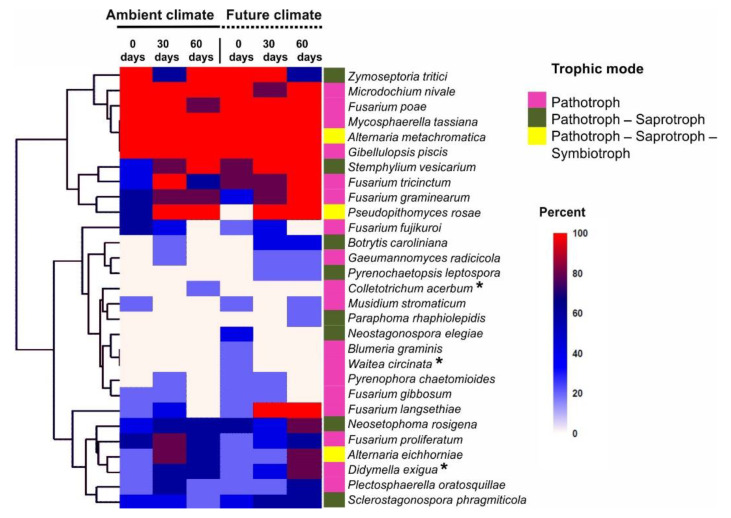
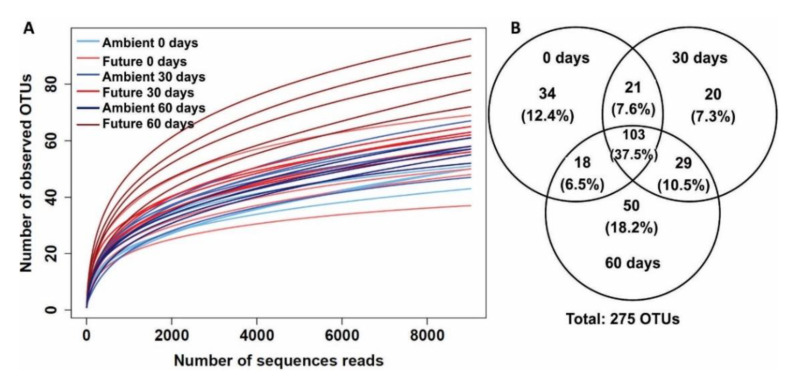
Returning wheat residues to the soil is a common practice in modern agricultural systems and is considered to be a sustainable practice. However, the negative contribution of these residues in the form of "residue-borne pathogens" is recognized. Here, we aimed to investigate the structure and ecological functions of fungal communities colonizing wheat residues during the early phase of decomposition in a conventional farming system. The experiment was conducted under both ambient conditions and a future climate scenario expected in 50-70 years from now. Using MiSeq Illumina sequencing of the fungal internal transcribed spacer 2 (ITS2), we found that plant pathogenic fungi dominated (~87% of the total sequences) within the wheat residue mycobiome. Destructive wheat fungal pathogens such as Fusarium graminearum, Fusarium tricinctum, and Zymoseptoria tritci were detected under ambient and future climates. Moreover, future climate enhanced the appearance of new plant pathogenic fungi in the plant residues. Our results based on the bromodeoxyuridine (BrdU) immunocapture technique demonstrated that almost all detected pathogens are active at the early stage of decomposition under both climate scenarios. In addition, future climate significantly changed both the richness patterns and the community dynamics of the total, plant pathogenic and saprotrophic fungi in wheat residues as compared with the current ambient climate. We conclude that the return of wheat residues can increase the pathogen load, and therefore have negative consequences for wheat production in the future.
Keywords: GCEF; MiSeq Illumina sequencing; climate change; fungal ITS2; litter decomposition; mycobiome; wheat straw decomposition.
Conflict of interest statement
The authors declare no conflict of interest.
Figures
Similar articles
-
Life in the Wheat Litter: Effects of Future Climate on Microbiome and Function During the Early Phase of Decomposition.Microb Ecol. 2022 Jul;84(1):90-105. doi: 10.1007/s00248-021-01840-6. Epub 2021 Sep 6. Microb Ecol. 2022. PMID: 34487212 Free PMC article.
-
Future climate conditions accelerate wheat straw decomposition alongside altered microbial community composition, assembly patterns, and interaction networks.ISME J. 2023 Feb;17(2):238-251. doi: 10.1038/s41396-022-01336-2. Epub 2022 Nov 9. ISME J. 2023. PMID: 36352255 Free PMC article.
-
Wheat Straw Return Influences Nitrogen-Cycling and Pathogen Associated Soil Microbiota in a Wheat-Soybean Rotation System.Front Microbiol. 2019 Aug 8;10:1811. doi: 10.3389/fmicb.2019.01811. eCollection 2019. Front Microbiol. 2019. PMID: 31440226 Free PMC article.
-
Experimental Climate Change Modifies Degradative Succession in Boreal Peatland Fungal Communities.Microb Ecol. 2017 Apr;73(3):521-531. doi: 10.1007/s00248-016-0875-9. Epub 2016 Oct 15. Microb Ecol. 2017. PMID: 27744477
-
Decoupling the direct and indirect effects of climate on plant litter decomposition: Accounting for stress-induced modifications in plant chemistry.Glob Chang Biol. 2018 Apr;24(4):1428-1451. doi: 10.1111/gcb.13923. Epub 2018 Jan 28. Glob Chang Biol. 2018. PMID: 28986956 Review.
Cited by
-
Life in the Wheat Litter: Effects of Future Climate on Microbiome and Function During the Early Phase of Decomposition.Microb Ecol. 2022 Jul;84(1):90-105. doi: 10.1007/s00248-021-01840-6. Epub 2021 Sep 6. Microb Ecol. 2022. PMID: 34487212 Free PMC article.
-
Extreme summers impact cropland and grassland soil microbiomes.ISME J. 2023 Oct;17(10):1589-1600. doi: 10.1038/s41396-023-01470-5. Epub 2023 Jul 7. ISME J. 2023. PMID: 37419993 Free PMC article.
-
Dark side of a bio-based and biodegradable plastic? Assessment of pathogenic microbes associated with poly(butylene succinate-co-adipate) under ambient and future climates using next-generation sequencing.Front Plant Sci. 2022 Oct 13;13:966363. doi: 10.3389/fpls.2022.966363. eCollection 2022. Front Plant Sci. 2022. PMID: 36311114 Free PMC article.
-
Deciphering Trifolium pratense L. holobiont reveals a microbiome resilient to future climate changes.Microbiologyopen. 2021 Aug;10(4):e1217. doi: 10.1002/mbo3.1217. Microbiologyopen. 2021. PMID: 34459547 Free PMC article.
-
Conventional tobacco products harbor unique and heterogenous microbiomes.Environ Res. 2023 Mar 1;220:115205. doi: 10.1016/j.envres.2022.115205. Epub 2022 Dec 30. Environ Res. 2023. PMID: 36592812 Free PMC article.
References
-
- Klocke N.L., Currie R.S., Aiken R.M. Soil water evaporation and crop residues. Trans. ASABE. 2009;52:103–110. doi: 10.13031/2013.25951. - DOI
LinkOut - more resources
Full Text Sources