. 2020 Jul;69(7):1311-1335.
doi: 10.2337/dbi19-0022.

T-Cell Epitopes and Neo-epitopes in Type 1 Diabetes: A Comprehensive Update and Reappraisal

Affiliations

T-Cell Epitopes and Neo-epitopes in Type 1 Diabetes: A Comprehensive Update and Reappraisal

Eddie A James et al. Diabetes. 2020 Jul.

Abstract

The autoimmune disease type 1 diabetes is characterized by effector T-cell responses to pancreatic β-cell-derived peptides presented by HLA class I and class II molecules, leading ultimately to β-cell demise and insulin insufficiency. Although a given HLA molecule presents a vast array of peptides, only those recognized by T cells are designated as epitopes. Given their intimate link to etiology, the discovery and characterization of T-cell epitopes is a critical aspect of type 1 diabetes research. Understanding epitope recognition is also crucial for the pursuit of antigen-specific immunotherapies and implementation of strategies for T-cell monitoring. For these reasons, a cataloging and appraisal of the T-cell epitopes targeted in type 1 diabetes was completed over a decade ago, providing an important resource for both the research and the clinical communities. Here we present a much needed update and reappraisal of this earlier work and include online supplementary material where we cross-index each epitope with its primary references and Immune Epitope Database (IEDB) identifier. Our analysis includes a grading scale to score the degree of evidence available for each epitope, which conveys our perspective on several useful criteria for epitope evaluation. While providing an efficient summary of the arguably impressive current state of knowledge, this work also brings to light several deficiencies. These include the need for improved epitope validation, as few epitopes score highly by the criteria employed, and the dearth of investigations of the epitopes recognized in the context of several understudied type 1 diabetes-associated HLA molecules.


Figures

Figure 1
Figure 1
Year-by-year and cumulative summary of the articles and epitopes examined in this work. AC: HLA class I–restricted epitopes. DF: HLA class II–restricted epitopes. A: The articles represented in Table 1 were categorized by year of publication and the corresponding cumulative article numbers are depicted in A. For articles having both an e-publication date and a print date in PubMed, the earlier date was used to assign the year of publication. See Supplementary Table 1 for the PMID numbers for all of the 65 articles included in A. B and C: The number of new HLA class I–restricted epitopes reported in each of the indicated years is depicted in B, with the corresponding cumulative epitope numbers shown in C, for a total of 140 epitopes reported by the end of 2018. D: The articles represented in Table 2 were categorized by year of publication and the corresponding cumulative article numbers are depicted in D. See Supplementary Table 2 for the PMID numbers for all of the 100 articles included in D. E and F: The number of new HLA class II–restricted epitopes reported in each of the indicated years is depicted in E, with the corresponding cumulative epitope numbers shown in F, for a total of 418 epitopes reported by the end of 2018. Note that the cutoff for inclusion in our analysis was a publication date up to 9 July 2019. Given the partial nature of the data for 2019, the corresponding articles and epitopes are not included in Figure 1.
Figure 2
Figure 2
T-cell epitope grading rubric. Our epitope scoring criteria include the source of T cells used to define the epitope (human islets/pLNs, human blood/spleen, or HLA-Tg mice), evidence of natural processing/presentation, and the isolation of T cells with confirmed recognition of the corresponding epitope. The figure depicts the minimal criteria that must be met for an epitope to be assigned the corresponding evidence grade, ranging from A+ to D−. Evidence of natural processing/presentation of an epitope may include peptide elution from MHC and identification by mass spectrometry, response to antigen protein or antigen-expressing cells, protein/DNA immunization response in HLA-Tg mice, or in vitro proteasome digestion yielding the correct C-terminus. The T-cell isolation criterion can be fulfilled with the availability of an epitope-reactive T-cell clone, line, or hybridoma or T-cell receptor–transduced T-cell line (of human or mouse origin).
Figure 3
Figure 3
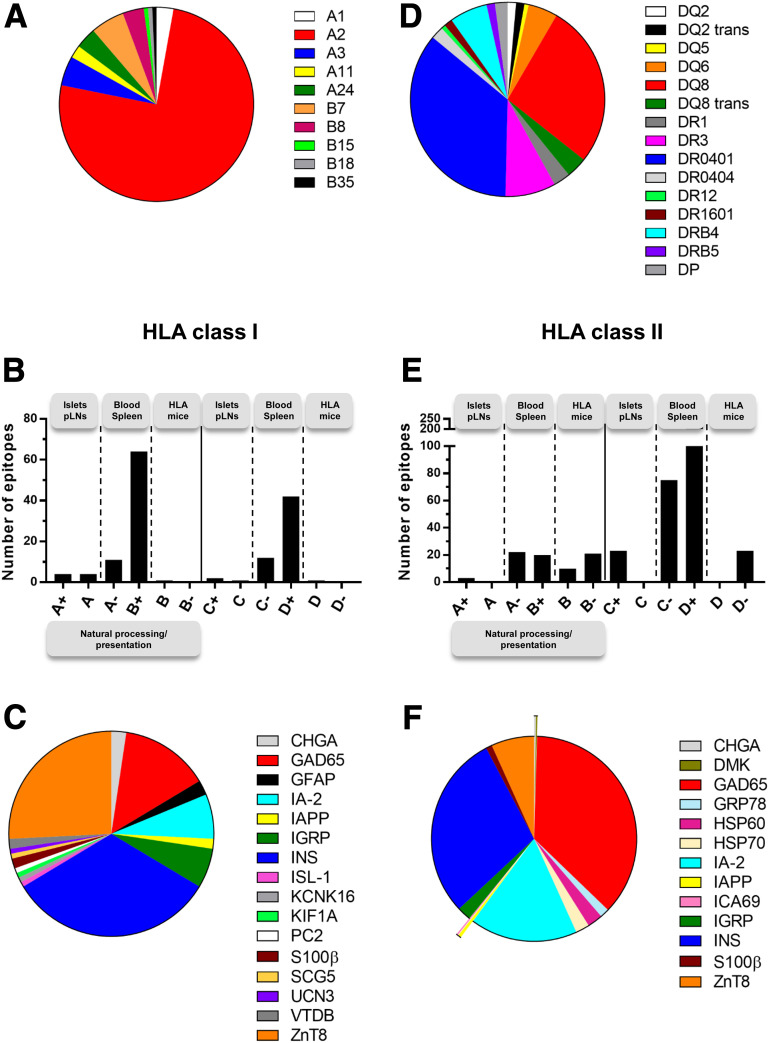
HLA restriction and grade and antigen distributions for CD8+ and CD4+ T-cell epitopes of β-cell antigens. AC: HLA class I–restricted epitopes. DF: HLA class II–restricted epitopes. A and D: The HLA restrictions for the 142 CD8+ T-cell epitopes in Table 1 and the 143 CD4+ T-cell epitopes in Supplementary Table 4 are depicted as pie graphs in A and D, respectively. B and E: The grade distributions of the CD8+ T-cell epitopes in Table 1 and the 418 CD4+ T-cell epitopes in Table 2 are shown in B and E, respectively. Gray boxes summarize the grading criteria (see Fig. 2). C and F: The antigen sources of the CD8+ T-cell epitopes in Table 1 and the CD4+ T-cell epitopes in Table 2 are depicted as pie graphs in C and F, respectively. Epitopes arising from nonconventional antigens (bottom portions of Tables 1 and 2) are not included. For the eight antigens that are sources of both CD8+ and CD4+ T-cell epitopes (i.e., CHGA, GAD65, IA-2, IAPP, IGRP, INS, S100β, and ZnT8), the same color code is used in C and F.

References

    1. Pugliese A. Autoreactive T cells in type 1 diabetes. J Clin Invest 2017;127:2881–2891 - PMC - PubMed
    1. Di Lorenzo TP, Peakman M, Roep BO. Translational mini-review series on type 1 diabetes: systematic analysis of T cell epitopes in autoimmune diabetes. Clin Exp Immunol 2007;148:1–16 - PMC - PubMed
    1. James EA, Pietropaolo M, Mamula MJ. Immune recognition of β-cells: neoepitopes as key players in the loss of tolerance. Diabetes 2018;67:1035–1042 - PMC - PubMed
    1. Kaddis JS, Pugliese A, Atkinson MA. A run on the biobank: what have we learned about type 1 diabetes from the nPOD tissue repository? Curr Opin Endocrinol Diabetes Obes 2015;22:290–295 - PubMed
    1. Vita R, Mahajan S, Overton JA, et al. . The Immune Epitope Database (IEDB): 2018 update. Nucleic Acids Res 2019;47:D339–D343 - PMC - PubMed

Publication types

MeSH terms