. 2020 Jun 19;11(1):3150.
doi: 10.1038/s41467-020-16819-z.

A missense mutation in the MLKL brace region promotes lethal neonatal inflammation and hematopoietic dysfunction

Joanne M Hildebrand #  1   2 Maria Kauppi #  3   4 Ian J Majewski  3   4 Zikou Liu  3   4 Allison J Cox  5 Sanae Miyake  6 Emma J Petrie  3   4 Michael A Silk  7   8 Zhixiu Li  9 Maria C Tanzer  3   4   10 Gabriela Brumatti  3   4 Samuel N Young  3   4 Cathrine Hall  3   4 Sarah E Garnish  3   4 Jason Corbin  3   4 Michael D Stutz  3   4   11 Ladina Di Rago  3   4 Pradnya Gangatirkar  3   4 Emma C Josefsson  3   4 Kristin Rigbye  3   4   12 Holly Anderton  3   4 James A Rickard  3   4   13 Anne Tripaydonis  3   4   13 Julie Sheridan  3   4 Thomas S Scerri  3   4 Victoria E Jackson  3   4 Peter E Czabotar  3   4 Jian-Guo Zhang  3   4 Leila Varghese  3   4   14 Cody C Allison  3   4 Marc Pellegrini  3   4 Gillian M Tannahill  3   4   15 Esme C Hatchell  3   4 Tracy A Willson  3   4 Dina Stockwell  3   4 Carolyn A de Graaf  3   4 Janelle Collinge  3   4 Adrienne Hilton  3 Natasha Silke  3   4 Sukhdeep K Spall  3   4 Diep Chau  3   4   16 Vicki Athanasopoulos  17   18 Donald Metcalf  3   4 Ronald M Laxer  19 Alexander G Bassuk  5   20 Benjamin W Darbro  5 Maria A Fiatarone Singh  21 Nicole Vlahovich  22 David Hughes  22 Maria Kozlovskaia  22   23 David B Ascher  7   8 Klaus Warnatz  24   25 Nils Venhoff  24 Jens Thiel  24 Christine Biben  3   4 Stefan Blum  26 John Reveille  27 Michael S Hildebrand  28   29 Carola G Vinuesa  17   18 Pamela McCombe  30 Matthew A Brown  9   31 Benjamin T Kile  3   4   32 Catriona McLean  33 Melanie Bahlo  3   4 Seth L Masters  3   4 Hiroyasu Nakano  6 Polly J Ferguson  5 James M Murphy  3   4 Warren S Alexander  34   35 John Silke  36   37
Affiliations

A missense mutation in the MLKL brace region promotes lethal neonatal inflammation and hematopoietic dysfunction

Joanne M Hildebrand et al. Nat Commun. .

Abstract

MLKL is the essential effector of necroptosis, a form of programmed lytic cell death. We have isolated a mouse strain with a single missense mutation, MlklD139V, that alters the two-helix 'brace' that connects the killer four-helix bundle and regulatory pseudokinase domains. This confers constitutive, RIPK3 independent killing activity to MLKL. Homozygous mutant mice develop lethal postnatal inflammation of the salivary glands and mediastinum. The normal embryonic development of MlklD139V homozygotes until birth, and the absence of any overt phenotype in heterozygotes provides important in vivo precedent for the capacity of cells to clear activated MLKL. These observations offer an important insight into the potential disease-modulating roles of three common human MLKL polymorphisms that encode amino acid substitutions within or adjacent to the brace region. Compound heterozygosity of these variants is found at up to 12-fold the expected frequency in patients that suffer from a pediatric autoinflammatory disease, chronic recurrent multifocal osteomyelitis (CRMO).


Conflict of interest statement

J.M.H., S.N.Y., P.E.C., J.M.M., and J.S. contribute to a project developing necroptosis inhibitors in collaboration with Anaxis Pty Ltd. The remaining authors declare no competing interests.

Figures
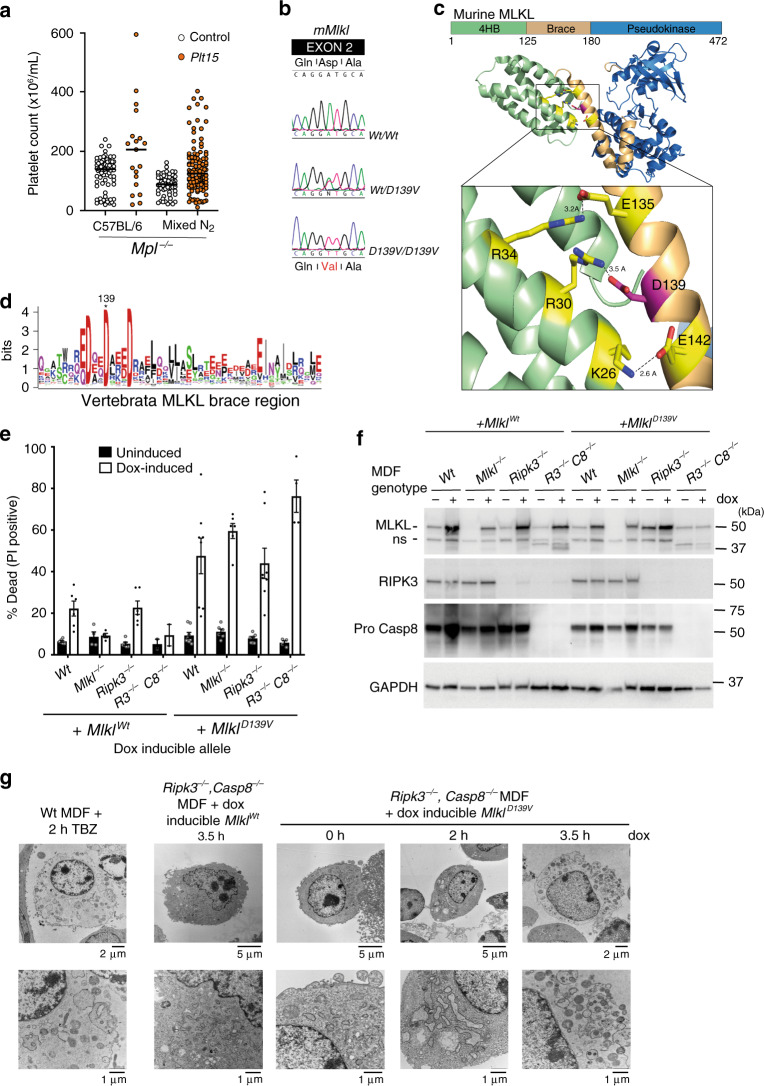
Fig. 1
Fig. 1. Murine MLKLD139V is a constitutively active form of MLKL.
a Platelet counts from Mpl−/− mice (open circles, n = 80, 60) and offspring from matings between Plt15 mice and Mpl−/− mice (closed orange circles, n = 19, 113) on a C57BL/6 or mixed C57BL/6:129/Sv background used for linkage analysis (Mixed N2). b A missense mutation (D139V) in the second exon of Mlkl was identified in Plt15 mutant mice. DNA sequence shown for wild type (top), a heterozygous mutant (middle), and a homozygous mutant (bottom). c Aspartate 139 contributes to an ‘electrostatic zipper’ joining brace helix 1 and the 4HB α2 helix of mouse MLKL (PDB code 4BTF). d Sequence logo of MLKL brace domain generated from multiple sequence alignment of all Vertebrata MLKL sequences (257) available on OrthoDB. e Mouse dermal fibroblasts (MDFs) of indicated genotypes were stably transduced with MlklWt and MlklD139V and expression induced with doxycycline (dox, white bars) or not induced (black bars) for 21 h. PI-positive cells were quantified by flow cytometry. Means ± SEM are plotted for n = 4–8 experiments (a combination of biological repeats and independent experiments) for each genotype with the exception of R3−/−C8−/− + MlklWt (n = 2, ±range). f Western blot analysis of whole cell lysates taken 6 h post doxycycline induction. g Transmission electron micrographs of MDFs stimulated as indicated. Images selected for (f) and (g) are representative of 2–3 independent analyses with similar results. TBZ; TNF + Birinapant + Z-VAD-fmk.
Fig. 2
Fig. 2. Homozygous MlklD139V neonates exhibit dispersed upper body inflammation.
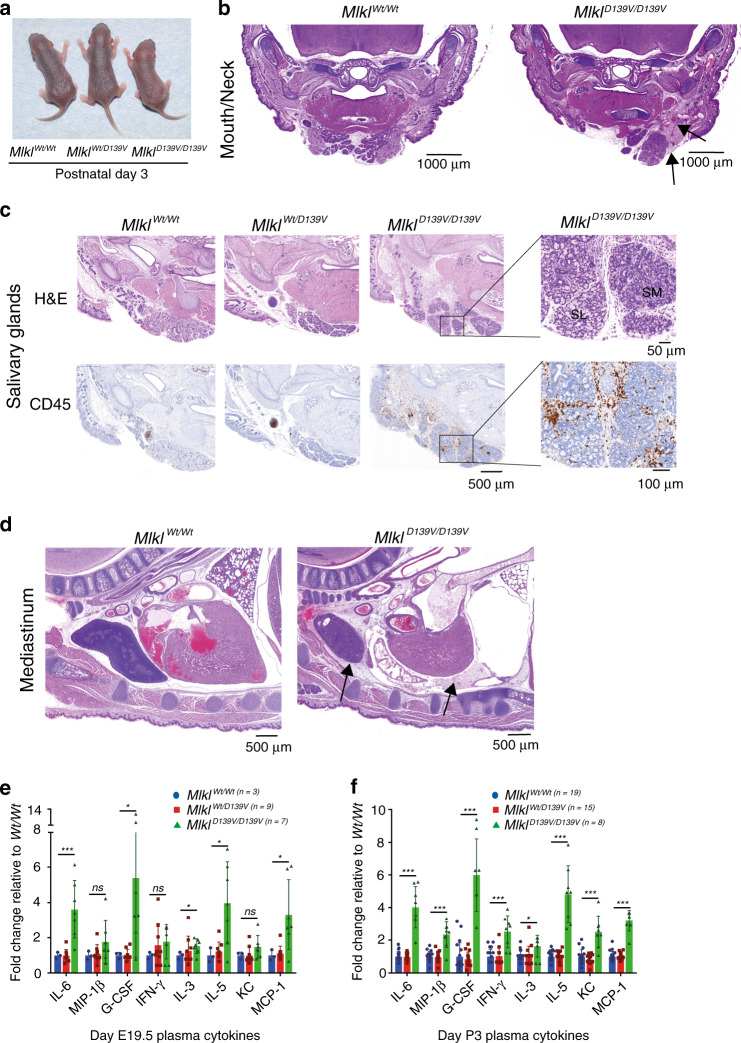
a Macroscopic appearance of MlklWt/Wt, MlklWt/D139V and MlklD139V/D139V mice at postnatal day 3. b Coronal section of mouth and neck region of postnatal day 2 litter mates stained with hematoxylin and eosin (H&E). Dilated blood vessels and edema are indicated by arrows. c Serial mandible sections from postnatal day 3 litter mates stained with H&E and anti-CD45. Inset black boxes are magnified in right panel. SL, sublingual gland. SM, submandibular gland. Images representative of n = 3–4 P3 pups per genotype. d H&E stained sections from mediastinum of postnatal day 2 litter mates. Thymic cortical thinning and pericardial infiltration are indicated by arrows. For full anatomical annotations for (b) and (d) see Supplementary Fig. 2h. (b) and (d) representative of n = 5–6 P2 pups examined with similar characteristics. Scale bars for (bd) range from 50 to 1000 μm as indicated. Multiplex measurement of plasma cytokine levels at E19.5 (e) and postnatal day 3 (f). Each symbol represents one independent pup sampled; MlklWt/Wt – blue circles, MlklWt/D139V- red squares, MlklD139V/D139V- green triangles, with bar height and error bars representing mean ± SD respectively for n = 3–to 19 pups as indicated. *p ≤ 0.05, **p ≤ 0.01, ***p ≤ 0.005 calculated using an unpaired, two-tailed t-test.
Fig. 3
Fig. 3. Alterations in hematopoietic cells and defective emergency hematopoiesis in MlklD139V mice.
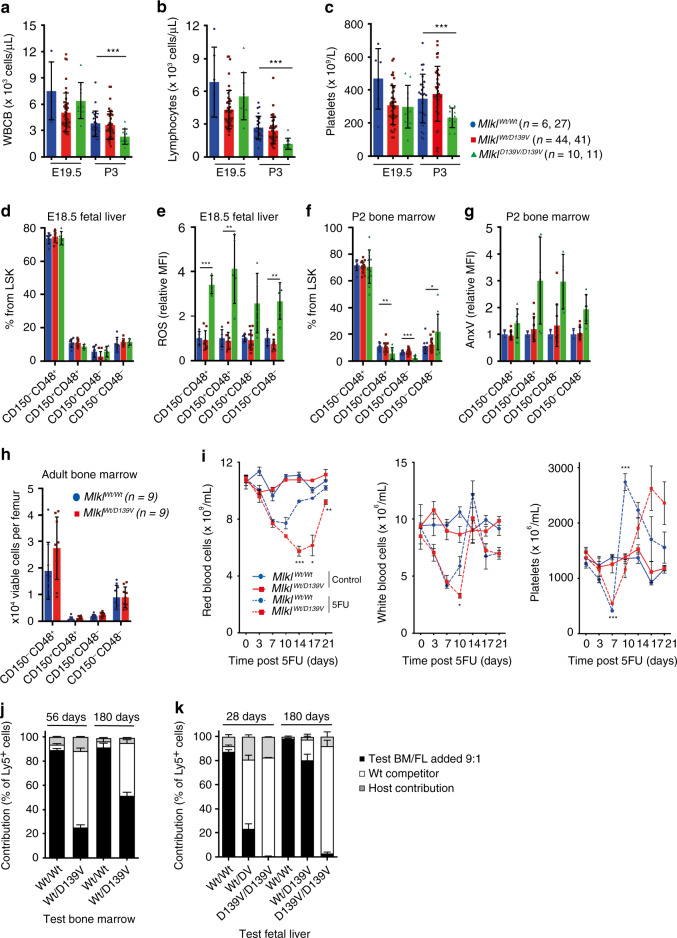
ac Absolute white blood cell (WBCB), lymphocyte and platelet numbers in peripheral blood of E19.5 and P3 pups, n = 6, 27, 44, 41, 10, and 11 as indicated. d Proportions of HSC (Lineage-Sca-1+c-kit+ (LSK) CD150+ CD48), MPP (LSK CD150 CD48), HPC-1 (LSK CD150 CD48+) and HPC-2 (LSK CD150+ CD48+), n = 5 per genotype and (e) relative levels of ROS (n = 4, 9, 5) (f) P2 bone marrow LSK populations (n = 9, 18, and 11) and (g) relative AnnexinV binding (n = 2, 11, 7). (h) HSC subtypes in adult bone marrow, n = 9 per genotype. ah Each symbol represents one independent animal; MlklWt/Wt – blue circles, MlklWt/D139V- red squares, MlklD139V/D139V- green triangles, with bar height and error bars representing mean ± SD respectively, or range when n = 2. Red and white blood cells and platelets in MlklWt/Wt (blue circles) and MlklWt/D139V (red squares) mice after treatment with 150 mg per kg 5FU or saline. Means ± SEM from one experiment in which three mice were sampled at each time point for each treatment group, similar results were obtained in an independent cohort. j Bone marrow from MlklWt/Wt or MlklWt/D139V mice on CD45Ly5.2 background was mixed with wild-type CD45Ly5.1 competitor bone marrow and transplanted into irradiated CD45Ly5.1/Ly5.2 recipients. Peripheral blood mononuclear cells (PBMCs) quantified after 56 and 180 days. Mean ± SEM are shown (3 donors per genotype, 3–5 recipients per donor). k Fetal liver cells (CD45Ly5.2; MlklWt/Wt, MlklWt/D139V or MlkD139V/D139V) were transplanted into lethally irradiated recipients (CD45Ly5.1/Ly5.2) together with competitor bone marrow (CD45Ly5.1). Contribution to PBMCs 28 days and 180 days after transplantation. Mean ± SEM are shown (2–10 donors per genotype, 2–6 recipients per donor). Host contribution (CD45Ly5.1/Ly5.2) is depicted in gray, competitor (CD45Ly5.1) in white, and test (CD45Ly5.2) in black for (j) and (k). *p ≤ 0.05, **p ≤ 0.01, ***p ≤ 0.005 calculated using an unpaired, two-tailed t-test.
Fig. 4
Fig. 4. MLKLD139V undergoes constitutive post-translation turn-over.
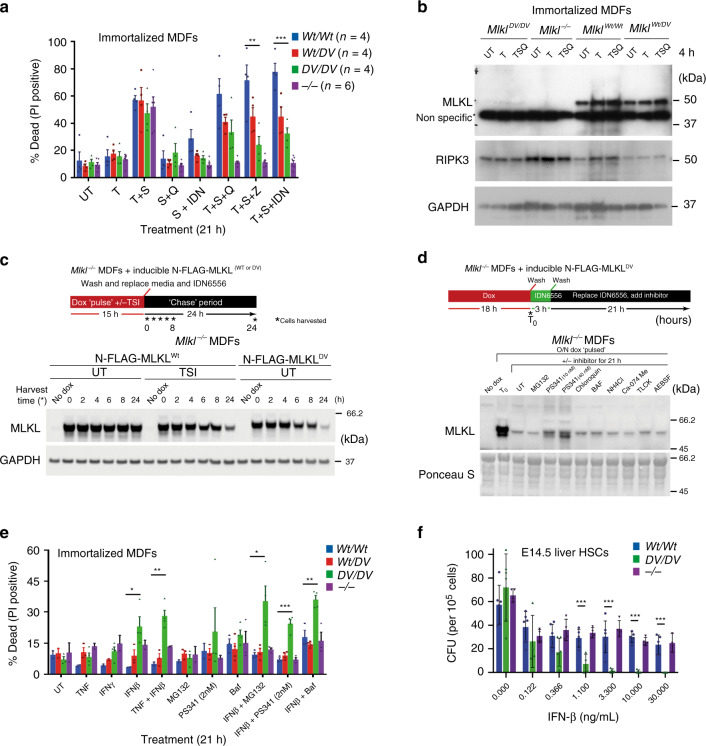
MDFs were isolated from MlklWt/Wt, MlklWt/D139V, MlkD139V/D139V or Mlkl−/− pups, immortalized and stimulated as indicated for 21 h for quantification of PI-positive cells using flow cytometry (n = 4, 4, 4, and 6) (a), or for 4 h for western blot analysis (b). Mlkl−/− MDFs were stably transduced with doxycycline-inducible FLAG-MLKLWT and FLAG-MLKLD139V constructs to examine MLKL protein stability after doxycycline withdrawal (c) and in the presence of indicated compounds (FLAG-MLKLD139V) (d). e Immortalized MDFs from (a) were stimulated as indicated for 21 h for quantification of PI-positive cells using flow cytometry (n = 2–3, 3–4, 4, 2–3). f E14.5 fetal liver cells from MlklWt/Wt, MlkD139V/D139V or Mlkl−/− embryos were plated in the presence of indicated dose of IFN-β and colonies enumerated after 7 days (n = 4–6). (a, e and f) represent mean ± SEM (A,E) or ±SD (f). be Representative images of at least three similar experiments. *p ≤ 0.05, **p ≤ 0.01, ***p ≤ 0.005 calculated using an unpaired, two-tailed t-test.
Fig. 5
Fig. 5. Three of the four highest frequency missense human MLKL SNPs encode non-conservative amino acid substitutions within or adjacent to the brace helix region.
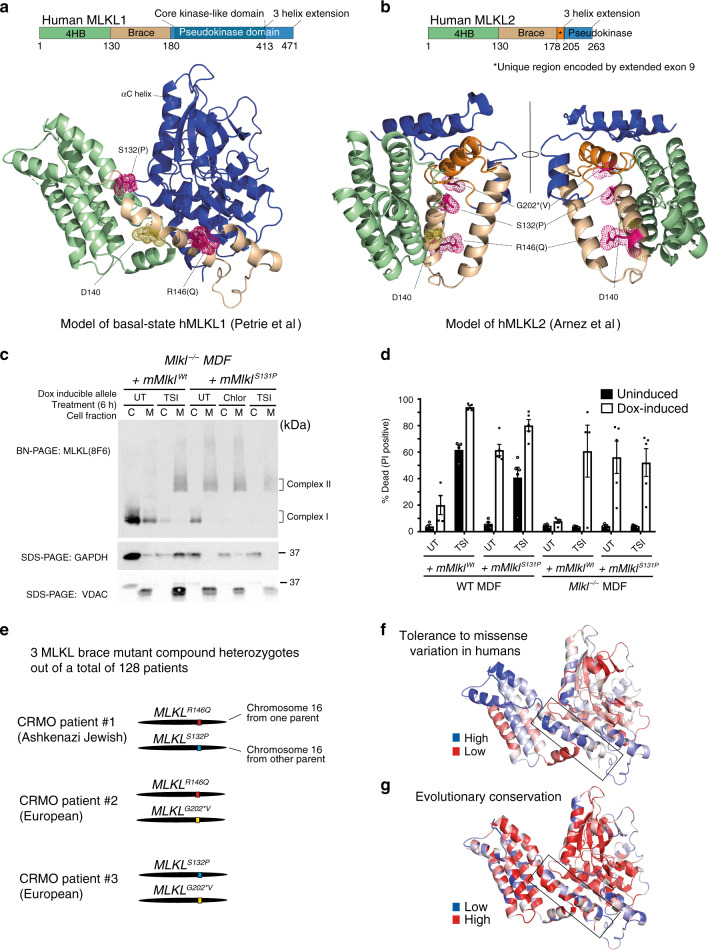
a S132 and R146 (magenta) are located on either side of D140 (yellow—equivalent to mouse D139) in the first human MLKL brace helix. Alternate amino acids encoded by human polymorphisms indicated in parentheses. b G202 is predicted to be on an α helix unique to MLKL2 isoform and to form an interface along with S132 and R146. The mouse equivalent of human rs35589326 (hMLKLS132P), mMLKLS131P, spontaneously forms membrane-associated high molecular weight complexes following Blue Native (BN) PAGE (c) and kills MDFs (d) in the absence of extrinsic necroptotic stimuli when expressed in mouse dermal fibroblasts for 6 (c) and 21 hrs respectively (d). C; cytoplasmic fraction, M; crude membrane fraction, TSI; TNF, Smac-mimetic and IDN6556, Chlor: Chloroquine. c Representative of two independent experiments with similar results. Error bars in (d) indicate the mean ± SEM of 4–5 independent experiments. e Schematic showing brace helix variant combinations identified as alleles in trans in three CRMO patients. f MTRs are mapped onto the structure of MLKL to show regions that have low tolerance to missense variation in the human population (red) and regions that have increased tolerance to missense variation (blue), normalized to the gene’s MTR distribution. g Multiple sequence alignment (MSA) conservation scores are mapped onto the structure of MLKL to show regions that are highly conserved through evolution (red) and regions that are less conserved through evolution (blue).

References

    1. Newton K, Manning G. Necroptosis and Inflammation. Annu. Rev. Biochem. 2016;85:743–763. - PubMed
    1. Sun L, et al. Mixed lineage kinase domain-like protein mediates necrosis signaling downstream of RIP3 kinase. Cell. 2012;148:213–227. - PubMed
    1. Zhao J, et al. Mixed lineage kinase domain-like is a key receptor interacting protein 3 downstream component of TNF-induced necrosis. Proc. Natl Acad. Sci. USA. 2012;109:5322–5327. - PMC - PubMed
    1. Murphy JM, et al. The pseudokinase MLKL mediates necroptosis via a molecular switch mechanism. Immunity. 2013;39:443–453. - PubMed
    1. Davies, K. A. et al. Distinct pseudokinase domain conformations underlie divergent activation mechanisms among vertebrate MLKL orthologues. Nat Commun.11, 10.1038/s41467-020-16823-3 (2020). - PMC - PubMed

Publication types

Supplementary concepts

LinkOut - more resources