. 2020 Jun 19;10(1):10003.
doi: 10.1038/s41598-020-66622-5.

Antibiotic effect and microbiome persistence vary along the European seabass gut

Affiliations

Antibiotic effect and microbiome persistence vary along the European seabass gut

Fotini Kokou et al. Sci Rep. .

Abstract

The constant increase in aquaculture production has led to extensive use of antibiotics as a means to prevent and treat diseases, with adverse implications on the environment, animal health and commensal microbes. Gut microbes are important for the host proper functioning, thus evaluating such impacts is highly crucial. Examining the antibiotic impact on gut segments with different physiological roles may provide insight into their effects on these microhabitats. Hence, we evaluated the effect of feed-administrated antibiotics on the composition and metabolic potential of the gut microbiome in the European seabass, an economically important aquaculture species. We used quantitative PCR to measure bacterial copy numbers, and amplicon sequencing of the 16S rRNA gene to describe the composition along the gut, after 7-days administration of two broad-range antibiotic mixtures at two concentrations. While positive correlation was found between antibiotic concentration and bacterial abundance, we showed a differential effect of antibiotics on the composition along the gut, highlighting distinct impacts on these microbial niches. Moreover, we found an increase in abundance of predicted pathways related to antibiotic-resistance. Overall, we show that a high portion of the European seabass gut microbiome persisted, despite the examined antibiotic intake, indicating high stability to perturbations.


Conflict of interest statement

The authors declare no competing interests.

Figures
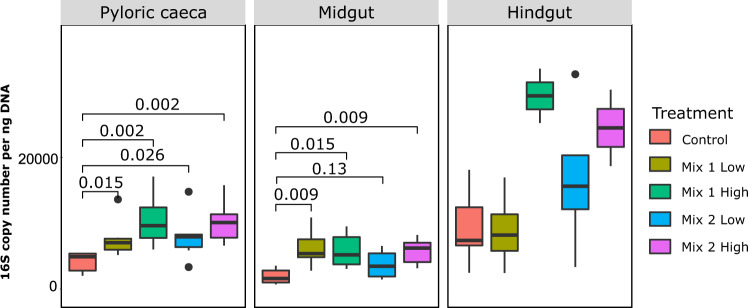
Figure 1
Figure 1
Number of 16S rRNA gene copy numbers measured with quantitative PCR within each gut compartment of fish fed with different diets (control and antibiotics). Significance was tested with Wilcoxon rank-sum two-sided test at P < 0.05.
Figure 2
Figure 2
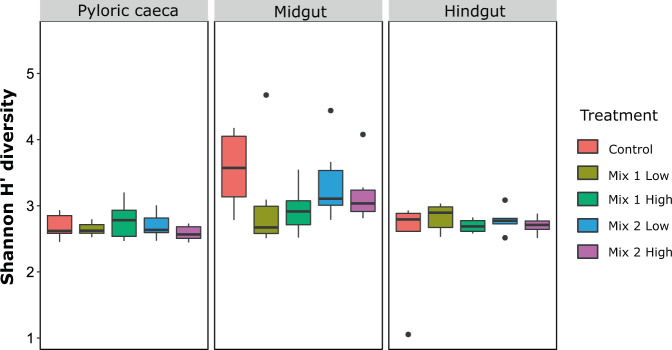
Shannon H’ diversity of the microbial communities of the different diets (control and antibiotics) in each gut part. Significance was tested with Wilcoxon rank-sum two way test at P < 0.05.
Figure 3
Figure 3
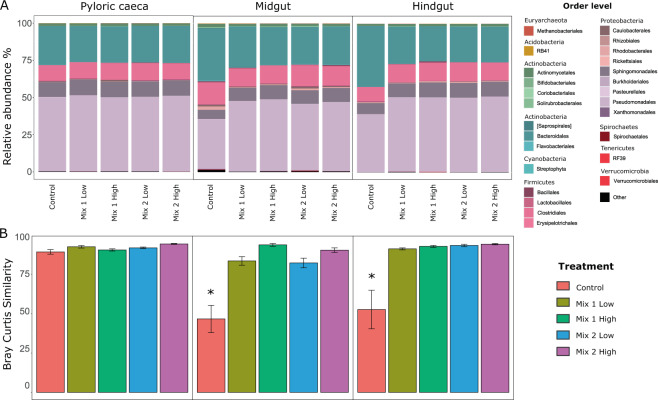
(A) Microbial composition at the order level across the gut and within each antibiotic-treated group. (B) Bray-Curtis within group similarity across the different gut parts and antibiotic treatments. Stars indicate significance at P < 0.05, after performing Wilcoxon rank-sum two-way test, between the treatments and the control.
Figure 4
Figure 4
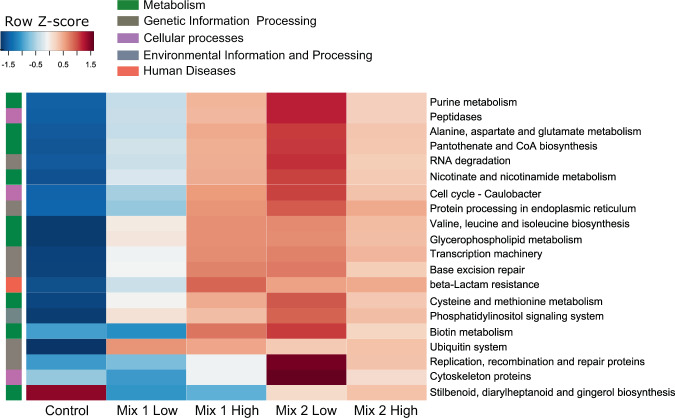
Pathway enrichment analysis using PICRUSt-predicted KEGG (Kyoto Encyclopaedia of Genes and Genomes) orthologs between the antibiotic-fed groups and the control in the midgut. Significance in pathway enrichment was tested using LEfSe analysis.
Figure 5
Figure 5
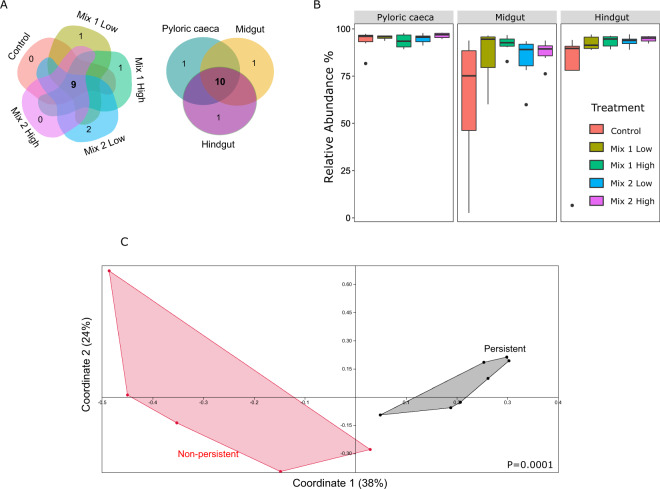
(A) The persistent microbiome is shared between treatments (left) and gut parts (right), as indicated by the Venn diagram. (B) The relative abundance of the persistent microbiome overall consisted of around 60% of the overall abundance, while it increased with antibiotic resistance, especially observed in the midgut and hindgut. (C) Principal Coordinate Analysis based on Jaccard metric on the antibiotic genes’ richness between the persistent and the affected (non-persistent) microbes. P-value (P = 0.0001) indicates significance based on Permanova (Jaccard metric).

References

    1. FAO. The State of World Fisheries and Aquaculture 2018 - Meeting the sustainable development goals. Rome. Licence: CC BY-NC-SA 3.0 IGO. (2018).
    1. Okocha RC, Olatoye IO, Adedeji OB. Food safety impacts of antimicrobial use and their residues in aquaculture. Public Health Reviews. 2018;39:21. doi: 10.1186/s40985-018-0099-2. - DOI - PMC - PubMed
    1. Cabello FC. Heavy use of prophylactic antibiotics in aquaculture: a growing problem for human and animal health and for the environment. Environmental microbiology. 2006;8:1137–1144. doi: 10.1111/j.1462-2920.2006.01054.x. - DOI - PubMed
    1. Cabello FC, et al. Antimicrobial use in aquaculture re-examined: its relevance to antimicrobial resistance and to animal and human health. Environmental Microbiology. 2013;15:1917–1942. doi: 10.1111/1462-2920.12134. - DOI - PubMed
    1. Defoirdt T, Sorgeloos P, Bossier P. Alternatives to antibiotics for the control of bacterial disease in aquaculture. Current opinion in microbiology. 2011;14:251–258. doi: 10.1016/j.mib.2011.03.004. - DOI - PubMed

Publication types

MeSH terms