Review
. 2020 Oct:64:13-20.
doi: 10.1016/j.gde.2020.05.015. Epub 2020 Jun 18.

Epigenetic regulation of mouse preimplantation embryo development

Affiliations
Review

Epigenetic regulation of mouse preimplantation embryo development

Xudong Fu et al. Curr Opin Genet Dev. 2020 Oct.

Abstract

After fertilization, mouse embryos go through preimplantation development to give rise to blastocyst. Two key molecular events, zygotic genome activation (ZGA) and the first cell lineage specification, are essential for the process. Recent advances in low-input epigenomics profiling techniques allow the analysis of these events at a molecular level, which revealed a critical role of epigenetic and chromatin reprogramming in ZGA and the first cell lineage specification. Additionally, the establishment of an in vitro embryonic stem cell (ESC) to two-cell embryo-like conversion system have also contributed to the molecular understanding of preimplantation development. In this review, we summarize recent advances in epigenetic regulation of mouse preimplantation development, point out the remaining questions, and propose strategies to tackle these questions.


Figures

Figure 1.
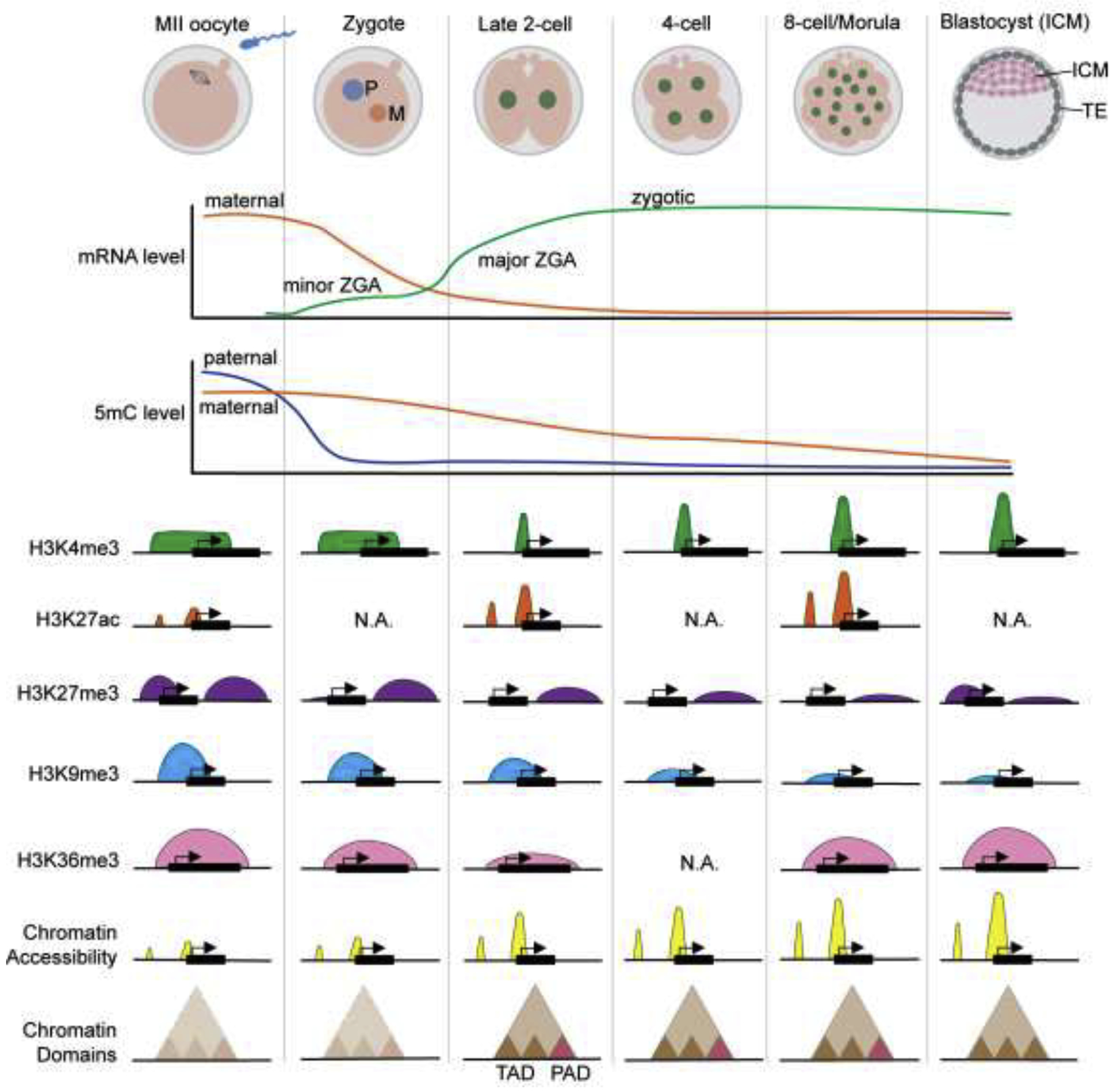
Figure 1.. Overview of the mRNA level, DNA methylation, and chromatin landscapes during mouse preimplantation development
After fertilization, maternal mRNA (orange line) are rapidly degraded while two waves of ZGA (both minor and major ZGA, green line) take place. Paternal genome 5-methylcytosine (5mC, blue line) is rapidly decreased in zygotes, while maternal 5mC level (orange line) is gradually decreased during preimplantation development. The broad H3K4me3 (green) domain in oocytes is removed at two-cell stage and replaced by the promoter H3K4me3 peaks. H3K27ac (orange) level is increased at two-cell stage. The H3K27me3 (purple) at promoter region is rapidly erased after fertilization, while the H3K27me3 at distal region is gradually decreased from two-cell stage. The H3K9me3 (blue) at promoter region is gradually decreased during preimplantation development. Maternal H3K36me3 (pink) across the entire gene body is attenuated after fertilization and lost at eight-cell stage, zygotic H3K36me3 starts to establish from two-cell stage and becomes stronger at eight-cell stage. Chromatin accessibility (yellow) is increased from two-cell stage and further enhanced during preimplantation development. Higher order chromatin structure, indicated by compartments and topologically associating domains (TADs), is disordered in MII oocytes and zygotes (light brown triangles with dashed lines) and established from late two-cell stage (brown triangles with solid lines). Polycomb-associating domains (PADs, red triangles with solid lines) are present transiently during two- to eight-cell stages.
Figure 2.
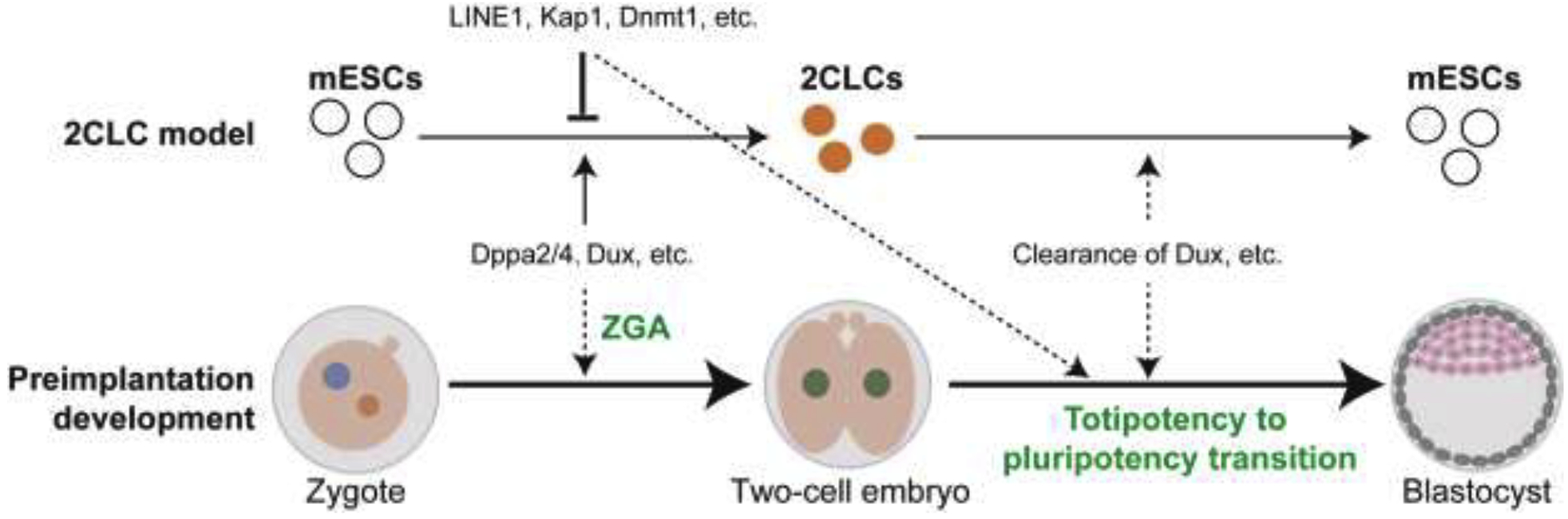
Figure 2.. Relationship of 2CLCs with mouse preimplantation development
2CLC are a rare two-cell-embryo-like cell population in cultured mESCs, which can serve as an in vitro model for studying preimplantation development. Factors, such as Dppa2/4 and Dux, that drive 2CLC formation may contribute to ZGA; while factors that impede 2CLC formation, such as LINE1, may drive totipotency to pluripotency transition in preimplantation embryos. 2CLCs spontaneously transit back to the pluripotent state and this reversal transition can serve as a model for understanding totipotency to pluripotency transition in embryos. For instance, the rapid clearance of Dux may contribute to both the reversal of the 2C-like state as well as the totipotency to pluripotency transition in preimplantation embryos. Dashed lines indicate the interactions merit further investigation.

References

    1. Chazaud C and Yamanaka Y, Lineage specification in the mouse preimplantation embryo. Development, 2016. 143(7): p. 1063–74. - PubMed
    1. Hamatani T, et al. , Dynamics of global gene expression changes during mouse preimplantation development. Dev Cell, 2004. 6(1): p. 117–31. - PubMed
    1. Xue Z, et al. , Genetic programs in human and mouse early embryos revealed by single-cell RNA sequencing. Nature, 2013. 500(7464): p. 593–7. - PMC - PubMed
    1. Wang L, et al. , Programming and inheritance of parental DNA methylomes in mammals. Cell, 2014. 157(4): p. 979–991. - PMC - PubMed
    1. Shen L, et al. , Tet3 and DNA replication mediate demethylation of both the maternal and paternal genomes in mouse zygotes. Cell Stem Cell, 2014. 15(4): p. 459–471. - PMC - PubMed

Publication types