Review
. 2020 Oct:64:135-142.
doi: 10.1016/j.conb.2020.05.002. Epub 2020 Jun 18.

Neural circuit mechanisms encoding motivational states in Drosophila

Affiliations
Review

Neural circuit mechanisms encoding motivational states in Drosophila

Sang Soo Lee et al. Curr Opin Neurobiol. 2020 Oct.

Abstract

Animals engage in motivated behaviors, such as feeding and mating behaviors, to ensure their own survival and the survival of their species. However, the neural circuits mediating the generation and persistence of these motivational drives remain poorly understood. Here we review recent studies on the circuit mechanisms underlying motivational states in Drosophila, with a focus on feeding, courtship, and aggression. These studies shed light on the molecular and cellular mechanisms by, which key drive neurons receive relevant input signals, integrate information, and decide on a specific behavioral output. We also discuss conceptual models for integrating these circuit mechanisms, distinguishing between those for homeostatically-regulated versus non-homeostatically-regulated motivated behaviors. We suggest that the ability to trigger persistence of a motivated behavior may be a feature of integrator or apex/command neurons.


Conflict of interest statement

Conflict of Interest Statement Nothing declared.

Figures
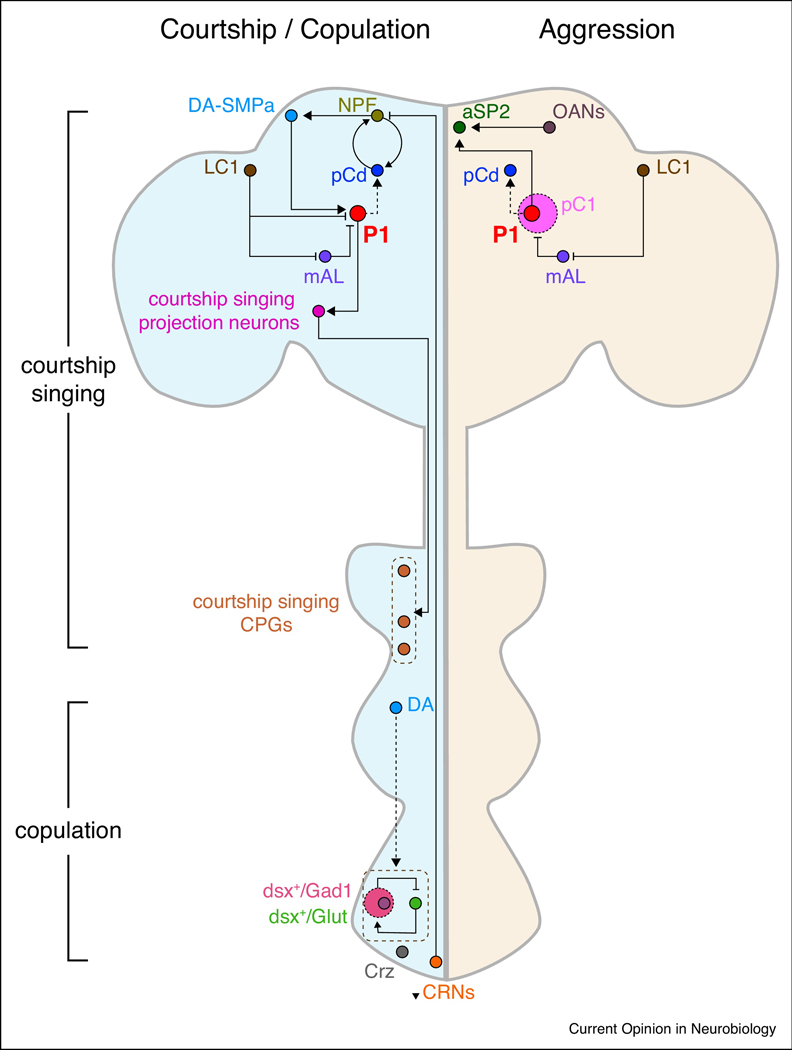
Figure 1:
Figure 1:
Neural circuit pathways mediating mating and aggression behaviors in male Drosophila. The schematic illustrates neurons regulating male courtship, aggression, and copulation discussed in this review. For clarity, sensory inputs to P1 neurons are not illustrated. Male courtship song is generated by a circuit consisting of fru+ neuronal clusters: P1 neurons, descending interneurons (P2b/plP10), and central pattern generators (“CPG”, dPR1/vPR6/vMS11). GABAergic LC1 neurons, via indirect or direct actions on P1 or pC1, shift behavior towards aggression. DA-SMPa neurons encode mating drive and desensitize P1 neurons to GABAergic inhibition from mAL neurons. A positive recurrent NPF-pCd circuit sustains motivation for courtship, which is inhibited by copulation reporting neurons (CRNs). An indirect action of P1 neurons on pCd neurons also promotes persistent courtship singing. For copulation, dsx+ glutamatergic motor neurons promote genital coupling, and this is suppressed by dsx+ GABAergic neurons. A small subset of these dsx+ GABAergic cells terminates copulation, while dopamine tone in the ventral nerve cord conversely maintains copulation. A cell-autonomous molecular timer (CaMKII) in corazonin (Crz)-releasing neurons also sustains copulation duration. Signals from P1 and octopaminergic (OA) neurons converge in aSP2 to promote aggression. Similar to courtship singing, an indirect action of P1 neurons on pCd neurons plays an important role for persistence of aggression. Data sources: aSP2 [56], CPGs [40], CRNs [47], Crz [52,53], DA [51], DA-SMPa [43,46,47], dsx+/Gad1 [50,51], dsx+/Glut [50], LC1 [55], mAL [55], NPF [47], OANs [56], P1 [,,–,–56,58], P2b [34], pC1 [55], pCd [47,58], plP10 [40].
Figure 2:
Figure 2:
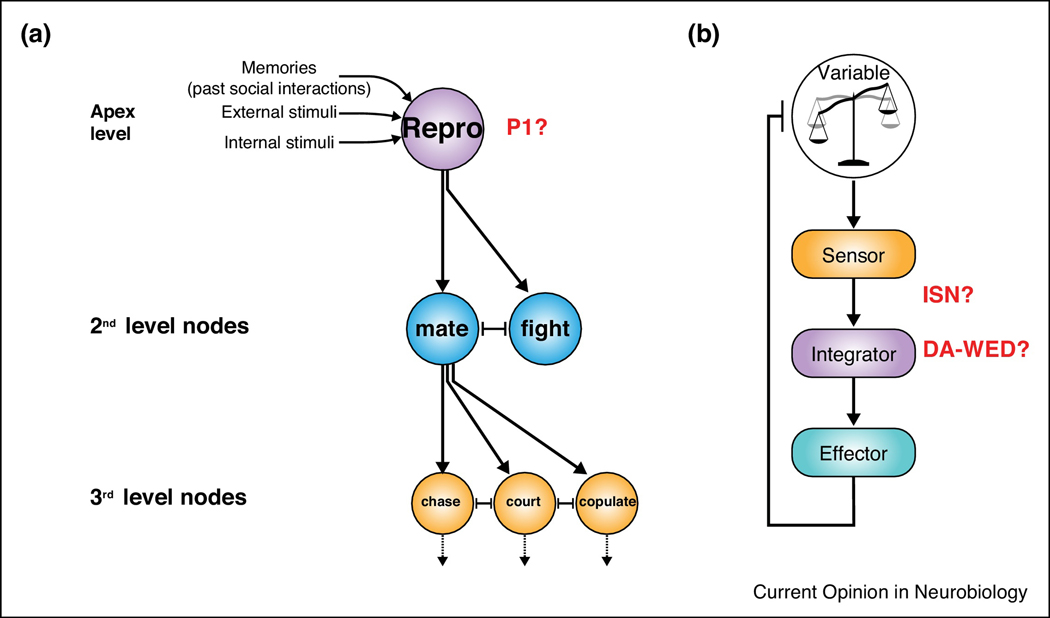
Circuit schemes for feedforward and homeostatically-regulated motivated behaviors. (a) Tinbergen’s hierarchical model for behavioral decisions, modified from [59]. The apex neurons (“Reproductive” program, e.g. P1 neurons) receive input from the environment, internal states, and prior social interactions. Based on this information, the apex neurons choose between different 2nd level downstream behavioral outputs, which tend to inhibit one another. These 2nd level nodes can further trigger specific aspects of the behavior. (b) The homeostatic controller system model, modified from [61]. The sensor detects the state variable and sends this information to the integrator component that computes the difference between the state variable and a setpoint. This difference generates drive to activate the effectors, which then provide feedback control on the state variable. The ISNs may act as sensorintegrators, and the DA-WED neurons may serve as an integrator component. Persistence of protein hunger is encoded by cell-autonomous plastic changes in the DA-WED cells.

References

    1. Hockenbury DH, Hockenbury SE: Psychology, 5th ed New York, NY, US: Worth Publishers; 2010.
    1. Cannon WB: The wisdom of the body. New York, NY, US: W W Norton & Co; 1932.
    1. Hull CL: Principles of behavior: an introduction to behavior theory. Oxford, England: Appleton-Century; 1943.
    1. Anderson DJ: Circuit modules linking internal states and social behaviour in flies and mice. Nat Rev Neurosci 2016, 17:692–704.

      **In this review article, the author argues persuasively that circuit mechanisms for 2 innate social behaviors (courtship and aggression) are shared and that this organization is an ancient evolutionarily conserved circuit motif.

    1. Sokolowski MB: Drosophila: genetics meets behaviour. Nat Rev Genet 2001, 2:879–890. - PubMed

Publication types

Substances

LinkOut - more resources