Case Reports
. 2020 Sep;121(4):442-444.
doi: 10.1016/j.jormas.2020.06.008. Epub 2020 Jun 18.

Facial pressure ulcers in COVID-19 patients undergoing prone positioning: How to prevent an underestimated epidemic?

Affiliations
Case Reports

Facial pressure ulcers in COVID-19 patients undergoing prone positioning: How to prevent an underestimated epidemic?

A Perrillat et al. J Stomatol Oral Maxillofac Surg. 2020 Sep.

Abstract

Prone positioning is an adjuvant therapy used to treat COVID-19 pneumonia complicated by acute respiratory distress syndrome. However, prolonged pressure on facial skin at the level of the bony structures may be responsible for facial pressure ulcers. In the context of severe COVID-19 pneumonia, we hypothesized that hypoxemia, microvascular injury and thrombosis can increase the risk of pressure ulcers. We described two cases in order to emphasize the risk of facial pressure ulcers as a result of prone positioning, so as to discuss their physiopathology and highlight the importance of appropriate preventive measures.

Keywords: COVID-19; Facial; Pressure ulcers; Prone positioning.


Figures

Fig. 1
Fig. 1
A 27-year-old man with morbid obesity presenting pressure ulcers on the right side of his face: on the forehead affecting the eyebrow, the cheekbone, the cheek next to the masseter (NPUAP stage 3), and the labial commissure (NPUAP stage 2) after prone position sessions (case 1).
Fig. 2
Fig. 2
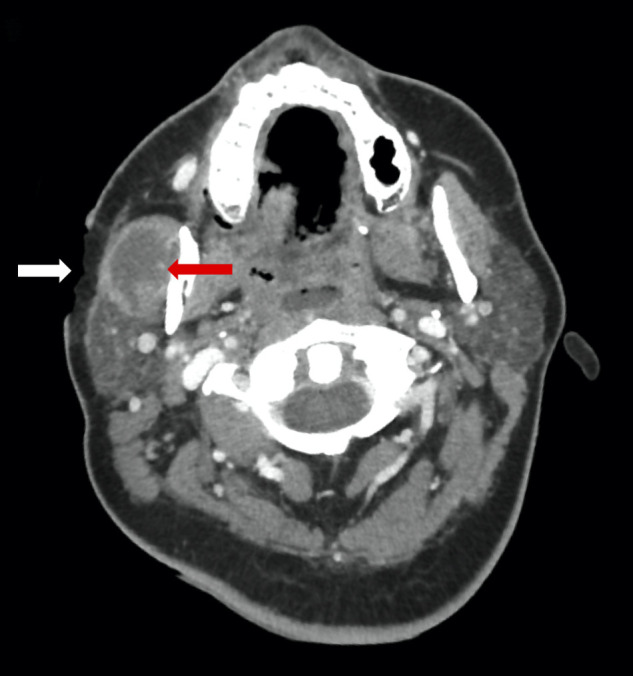
CT-scan of the head; an inflammatory edema of the masseter muscle (red arrow), without abscess at the puncture, is observed next to the cheek pressure ulcer (with arrow).
Fig. 3
Fig. 3
The optimal positioning of the head in prone position lies on a specific designed head cushion; this semi- lunar shaped cushion protects the bone structures with a wide peripheral contact without any pressure on the cheekbone, the probe or the eye (Eyes occlusion and care remain critical) (*). A non-circular device, such as a sticking-plaster, to hold the probe is preferred (**). A block placed under the shoulders prevents cervical over extension (***). Both adequate positioning and nurse cares to prevent maceration from excessive sweating should be performed every 8 hours or less.

References

    1. Ghelichkhani P., Esmaeili M. Prone position in management of COVID-19 patients; a commentary. Arch Acad Emerg Med. 2020;8:e48. - PMC - PubMed
    1. Archer S.L., Sharp W.W., Weir E.K. Differentiating COVID-19 pneumonia from Acute Respiratory Distress Syndrome (ARDS) and High Altitude Pulmonary Edema (HAPE): therapeutic implications. Circulation. 2020 doi: 10.1161/CIRCULATIONAHA.120.047915. - DOI - PMC - PubMed
    1. Kallet R.H. A comprehensive review of prone position in ARDS. Respir Care. 2015;60:1660–1687. doi: 10.4187/respcare.04271. - DOI - PubMed
    1. Kim R.S., Mullins K. Preventing facial pressure ulcers in Acute Respiratory Distress Syndrome (ARDS) J Wound Ostomy Continence Nurs. 2016;43:427–429. doi: 10.1097/WON.0000000000000247. - DOI - PubMed
    1. Lucchini A., Bambi S., Mattiussi E., Elli S., Villa L., Bondi H., et al. Prone position in acute respiratory distress syndrome patients: a retrospective analysis of complications. Dimens Crit Care Nurs DCCN. 2020;39:39–46. doi: 10.1097/DCC.0000000000000393. - DOI - PubMed

Publication types