


Nurture Early for Optimal Nutrition (NEON) programme: qualitative study of drivers of infant feeding and care practices in a British-Bangladeshi population
- PMID: 32565459
- PMCID: PMC7307527
- DOI: 10.1136/bmjopen-2019-035347
Nurture Early for Optimal Nutrition (NEON) programme: qualitative study of drivers of infant feeding and care practices in a British-Bangladeshi population
Abstract
Objectives: To explore optimal infant feeding and care practices and their drivers within the British-Bangladeshi population of East London, UK, as an exemplar to inform development of a tailored, coadapted participatory community intervention.
Design: Qualitative community-based participatory research.
Setting: Community and children's centres and National Health Service settings within Tower Hamlets, London, UK.
Participants: 141 participants completed the community study including: British-Bangladeshi mothers, fathers, grandmothers and grandfathers of infants and young children aged 6-23 months, key informants and lay community members from the British-Bangladeshi population of Tower Hamlets, and health professionals working in Tower Hamlets.
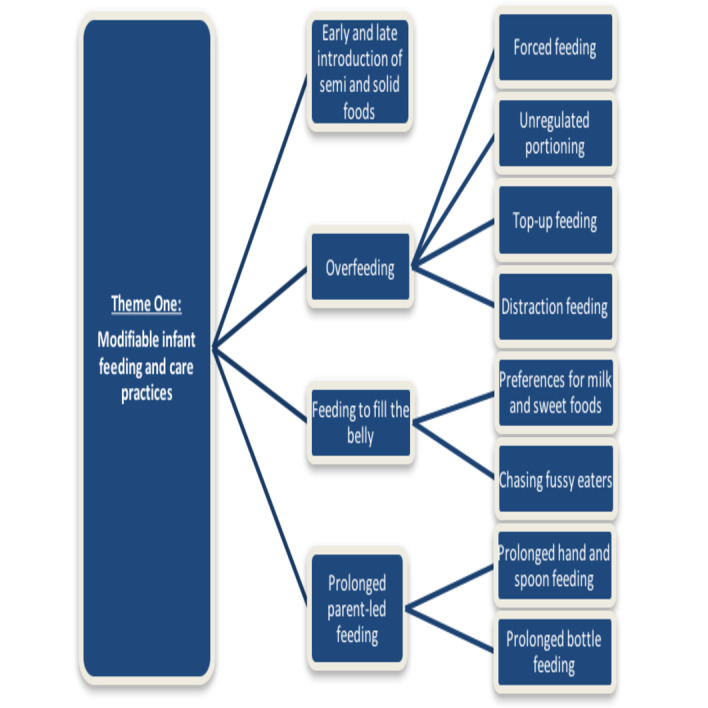
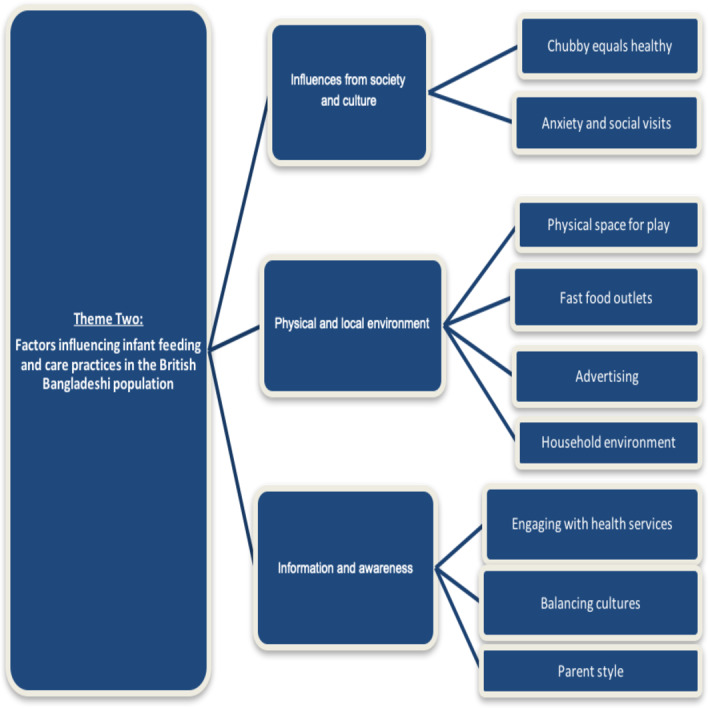
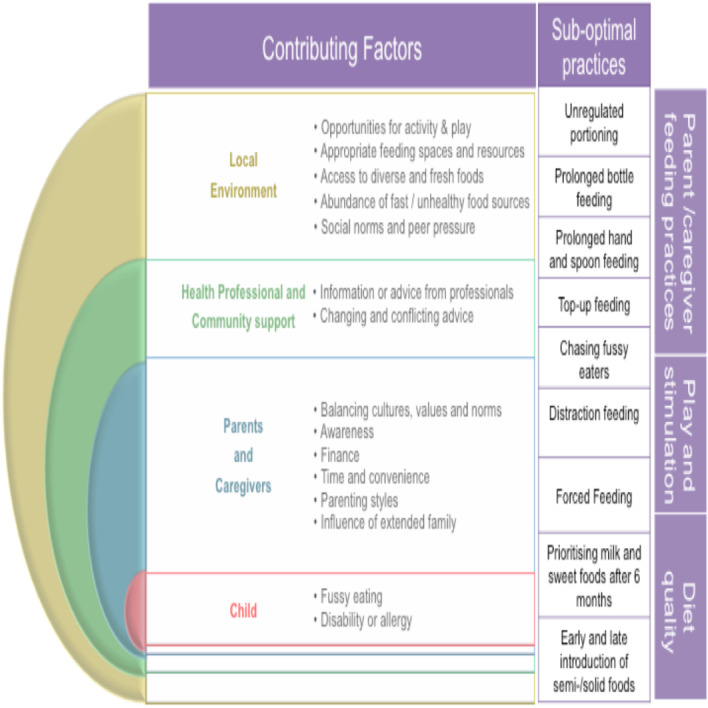
Results: 141 participants from all settings and generations identified several infant feeding and care practices and wider socioecological factors that could be targeted to optimise nutritional outcomes. Our modifiable infant feeding and care practices were highlighted: untimely introduction of semi and solid foods, overfeeding, prolonged parent-led feeding and feeding to 'fill the belly'. Wider socioecological determinants were highlighted, categorised here as: (1) society and culture (e.g. equating 'chubby baby' to healthy baby), (2) physical and local environment (e.g. fast food outlets, advertising) and (3) information and awareness (e.g. communication with healthcare professionals around cultural norms).
Conclusions: Parenting interventions should be codeveloped with communities and tailored to recognise and take account of social and cultural norms and influence from different generations that inform infant feeding and care practices and may be of particular importance for infants from ethnically diverse communities. In addition, UK infant feeding environment requires better regulation of marketing of foods for infants and young children if it is to optimise nutrition in the early years.
Keywords: British Bangladeshi; children; community; complementary feeding; early interventions; feeding practice; infant; nutrition; participatory.
© Author(s) (or their employer(s)) 2020. Re-use permitted under CC BY. Published by BMJ.
Conflict of interest statement
Competing interests: All authors have declared that no support from any organisations for the submitted work; no financial relationships with any organisations that might have an interest in the submitted work in the previous 3 years, no other relationships or activities that could appear to have influenced the submitted work.
Figures
References
-
- Schenker S. Briefing paper: undernutrition in the UK. BNF nutrition bulletin 2003;28:87–120.
-
- Butland B. "Foresight. Tackling obesities: future choices. Project report, 2007. - PubMed
-
- NHS Digital National Child Measurement Programme , 2019. Available: https://digital.nhs.uk/areas-of-interest/public-health/national-child-me... [Accessed 14 Jan 2006].
-
- WHO Health topics, noncommunicable diseases. obesity, data and statistics. Available: http://www.euro.who.int/en/health-topics/noncommunicable-diseases/obesit...
Publication types
MeSH terms
Grants and funding
LinkOut - more resources
Full Text Sources
Medical
