


Co-creating a patient and public involvement and engagement 'how to' guide for researchers
- PMID: 32566249
- PMCID: PMC7301967
- DOI: 10.1186/s40900-020-00208-3
Co-creating a patient and public involvement and engagement 'how to' guide for researchers
Abstract
Plain language summary: Research should benefit society at large. Involving citizens those who are affected by research may not only increase the quality, but can also push research towards generating greater societal benefits and relevant outcomes for citizens. Including citizens in research also has ethical implications, which necessitate structured guidance on 'how to' meaningfully involve them. In our project, we invited a multi-stakeholder group consisting of researchers from multiple disciplines, citizen scientists, youth and patient advocates to co-create a guide on 'how to' meaningfully involve citizens in research. In five consecutive workshops, we discussed how the characteristics of interactions between researchers and citizens (e.g., building trustful relationships and communication) and what a possible project steering structure enabling meaningful public involvement in research could look like. As a result of these workshops, the PPIE 'How to' Guide for Researchers was developed to support the implementation of 'Patient and Public Involvement and Engagement' (PPIE) activities and informed a PPIE Implementation Programme funding public involvement activities in Austria.
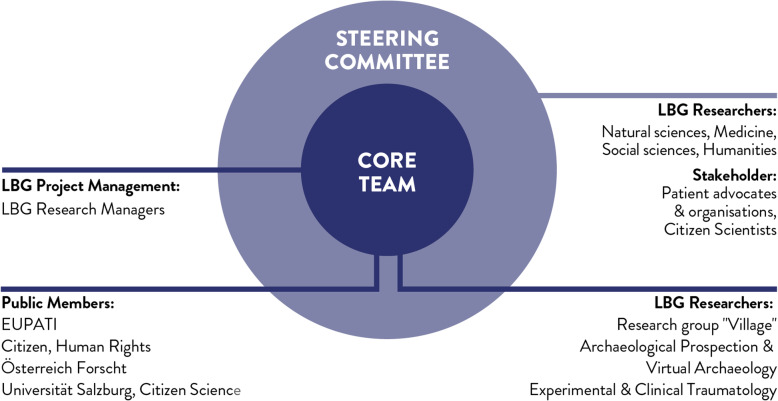
Abstract: Involving citizens in research is not widely utilised across research disciplines and countries. It requires the readiness of researchers and their organisations as well as guides on 'how to' successfully involve citizens in a meaningful way. Including the patient and citizen voice in research activities has been most frequently demonstrated in health research, however, is implemented along various degrees of involvement - from passively receiving information about science to actively involving the citizens in steering projects and research activities. In this commentary, we aim to report a multi-stakeholder co-creation process developing 'Patient and Public Involvement and Engagement' (PPIE) activities across disciplines to provide guidance for researchers and the public. We use Ludwig Boltzmann Society's (LBG) organisational framework as a case study, hence it consists of research institutes ranging from the life sciences to humanities and therefore represents a well-suited research environment for this endeavour. In a co-creation approach - to accomplish a shared understanding of public involvement in research among different stakeholders - a multi-stakeholder group comprising 11 researchers from natural sciences, life sciences, social sciences and humanities, and 13 citizens (such as patient advocates, young people and citizen scientists) were involved. In five consecutive workshops, we co-developed the nature of interactions between citizens and researchers, as well as governance structures enabling meaningful involvement in research. The workshops' content was informed by an initial literature review. As a result of this process, the PPIE 'How to' Guide for Researchers was developed to support the implementation of involvement activities in their research projects according to the public involvement principles. These principles informed assessment criteria for the newly established PPIE Implementation Programme at LBG. It provides funding and support for public involvement activities in research to embed a sustainable and meaningful implementation of public involvement activities in Austria.
Keywords: Co-creation; Multidisciplinary research; Patient and public involvement; Stakeholder involvement.
© The Author(s) 2020.
Conflict of interest statement
Competing interestsThe authors declare that they have no competing interests.
Figures

References
-
- Mazzucato M. Mission-Oriented Research & Innovation in the European Union. 2018.
-
- Maxwell K, Benneworth P. The construction of new scientific norms for solving grand challenges. Palgrave Communications. 2018;4(1):52. doi: 10.1057/s41599-018-0105-9. - DOI
LinkOut - more resources
Full Text Sources
Research Materials
