


Metabolic syndrome detection with biomarkers in childhood cancer survivors
- PMID: 32567553
- PMCID: PMC7424353
- DOI: 10.1530/EC-20-0144
Metabolic syndrome detection with biomarkers in childhood cancer survivors
Abstract
Purpose: Augmented survival of childhood nephroblastoma and neuroblastoma has increased long-term side effects such as metabolic syndrome (MetS). Risk stratification is difficult after abdominal radiation because waist circumference underestimates adiposity. We aimed to develop a strategy for determining MetS in irradiated survivors using an integrated biomarker profile and vascular ultrasonography.
Methods: The NCEP-ATPIII MetS-components, 14 additional serum biomarkers and 9 vascular measurements were assessed in a single-centre cohort of childhood nephroblastoma (n = 67) and neuroblastoma (n = 36) survivors and controls (n = 61). Multivariable regression models were used to study treatment effects. Principal component analysis (PCA) was used to study all biomarkers in a combined analysis, to identify patterns and correlations.
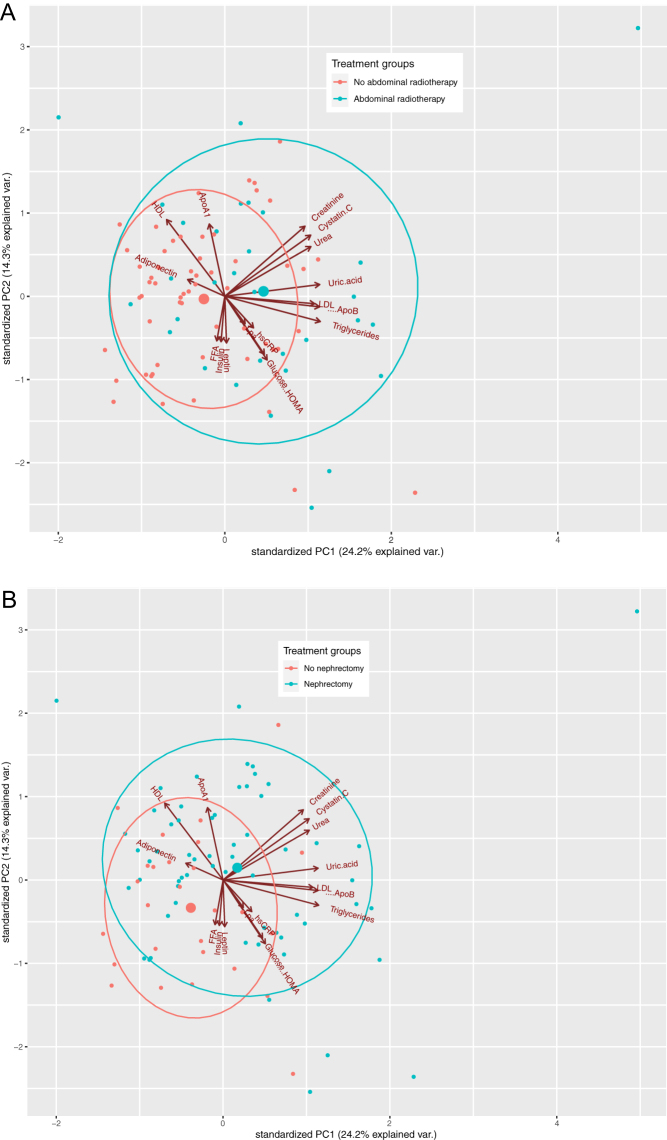
Results: After 27.5 years of follow-up, MetS occurred more often in survivors (14%) than controls (3%). Abdominal radiotherapy and nephrectomy, to a lesser extent, were associated with MetS and separate components and with several biomarker abnormalities. PCA of biomarkers revealed a pattern on PC1 from favourable lipid markers (HDL-cholesterol, adiponectin) towards unfavourable markers (triglycerides, LDL-cholesterol, apoB, uric acid). Abdominal radiotherapy was associated with the unfavourable biomarker profile (β = 1.45, P = 0.001). Vascular measurements were not of added diagnostic value.
Conclusions: Long-term childhood nephro- and neuroblastoma survivors frequently develop MetS. Additional assessment of biomarkers identified in PCA - adiponectin, LDL, apoB, and uric acid - may be used especially in abdominally irradiated survivors, to classify MetS as alternative for waist circumference. Vascular ultrasonography was not of added value.
Keywords: biomarker; childhood cancer survivor; metabolic syndrome; nephroblastoma; neuroblastoma; principal component analysis.
Figures
References
-
- ASCO. Wilms tumor – childhood: statistics. Alexandria, VA, USA: American Society of Clinical Oncology, 2019. (available at: https://www.cancer.net/cancer-types/wilms-tumor-childhood/statistics)
-
- ASCO. Neuroblastoma – childhood: statistics. Alexandria, VA, USA: American Society of Clinical Oncology, 2019. (available at: https://www.cancer.net/cancer-types/neuroblastoma-childhood/statistics)
-
- Geenen MM, Bakker PJ, Kremer LC, Kastelein JJ, van Leeuwen FE. Increased prevalence of risk factors for cardiovascular disease in long-term survivors of acute lymphoblastic leukemia and Wilms tumor treated with radiotherapy. Pediatric Blood and Cancer 2010. 55 690–697. (10.1002/pbc.22518) - DOI - PubMed
-
- Norsker FN, Rechnitzer C, Cederkvist L, Holmqvist AS, Tryggvadottir L, Madanat-Harjuoja LM, Ora I, Thorarinsdottir HK, Vettenranta K, Bautz A, et al Somatic late effects in 5-year survivors of neuroblastoma: a population-based cohort study within the Adult Life after Childhood Cancer in Scandinavia study. International Journal of Cancer 2018. 143 3083–3096. (10.1002/ijc.31631) - DOI - PubMed
LinkOut - more resources
Full Text Sources
Research Materials
Miscellaneous
