doi: 10.3201/eid2607.191490.
Carbapenem Resistance Conferred by OXA-48 in K2-ST86 Hypervirulent Klebsiella pneumoniae, France
- PMID: 32568057
- PMCID: PMC7323517
- DOI: 10.3201/eid2607.191490
Item in Clipboard
Carbapenem Resistance Conferred by OXA-48 in K2-ST86 Hypervirulent Klebsiella pneumoniae, France
Emerg Infect Dis.
2020 Jul.
Abstract
We recovered 2 carbapenem-resistant K2-ST86 hypermucoviscous Klebsiella pneumoniae isolates from patients in France. The isolates had genetic attributes of hypervirulent K. pneumoniae but differed in ability to cause mouse lethality. Convergence of hypervirulent K. pneumoniae toward resistance could cause a health crisis because such strains could be responsible for severe and untreatable infections.
Keywords: France; Klebsiella pneumoniae; OXA-48; antimicrobial resistance; bacteria; hypervirulent; next-generation sequencing; β-lactamase.
Figures
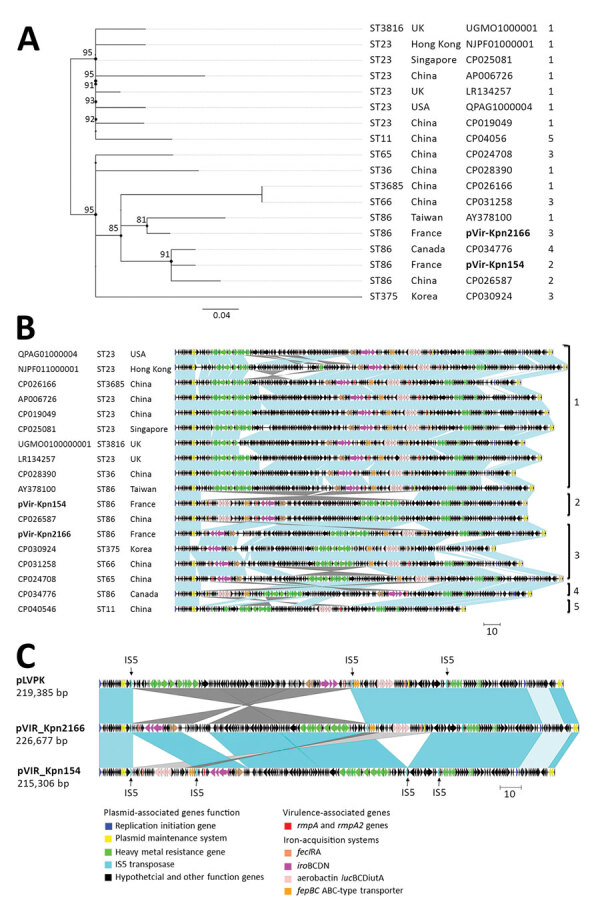
Comparison of pVIR-Kpn2166 and pVIR-Kpn154 Klebsiella pneumoniae isolates from 2 patients in France (bold) with 16 hypervirulent K. pneumoniae virulence plasmids recovered from the PATRIC database (http://www.patricbrc.org ). A) Single-nucleotide polymorphism–based phylogenetic tree built by RaxML from an alignment generated by Burrows-Wheeler Aligner and filtered to remove recombination using Gubbins as previously described (9). The ST and the geographic origin of bacterial hosts are shown. Scale bar indicates mean number of nucleotide substitutions per site. B) Synteny analysis of hypervirulent K. pneumoniae virulence plasmids based on data from blastn (https://blast.ncbi.nlm.nih.gov/Blast.cgi ). Virulence-based synteny groups are indicated and the operons encoding the virulence factors, virulence synteny groups of plasmids and the ST and the geographic origin of bacterial hosts. Scale bar indicates kbp. C) Comparison of the details of rearrangements observed in pVIR-Kpn2166 and pVIR-Kpn154 and in pLVPK. Scale bar indicates kbp. ST, sequence type.
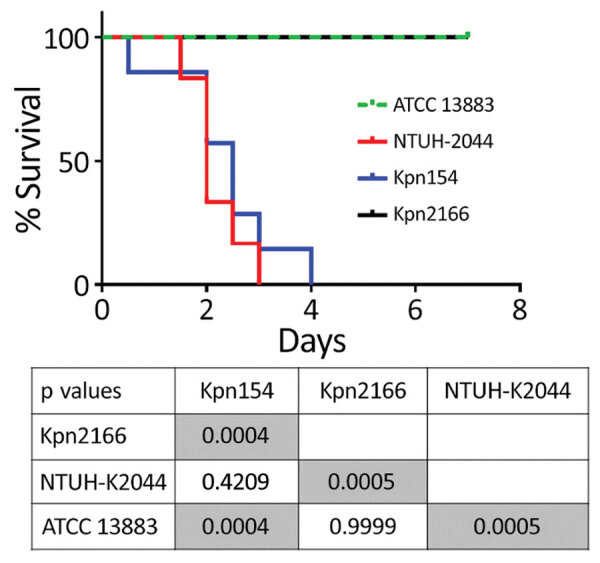
Kaplan–Meier survival curves of mice intraperitoneally challenged with Klebsiella pneumoniae strains Kpn154 and Kpn2166 from 2 patients in France, virulent strain NTUH-K2044, and nonvirulent ATCC 13883 strain, as previously described (10). Mice were injected with 103 CFUs and monitored for 96 h. p values were calculated from the Mantel-Cox log rank test for survival curve comparison. Gray shading indicates significant values. ATCC, American Type Culture Collection.
References
Publication types
MeSH terms
Substances
LinkOut - more resources
Full Text Sources
Molecular Biology Databases