


Toward Optimal Heparin Dosing by Comparing Multiple Machine Learning Methods: Retrospective Study
- PMID: 32568089
- PMCID: PMC7338927
- DOI: 10.2196/17648
Toward Optimal Heparin Dosing by Comparing Multiple Machine Learning Methods: Retrospective Study
Abstract
Background: Heparin is one of the most commonly used medications in intensive care units. In clinical practice, the use of a weight-based heparin dosing nomogram is standard practice for the treatment of thrombosis. Recently, machine learning techniques have dramatically improved the ability of computers to provide clinical decision support and have allowed for the possibility of computer generated, algorithm-based heparin dosing recommendations.
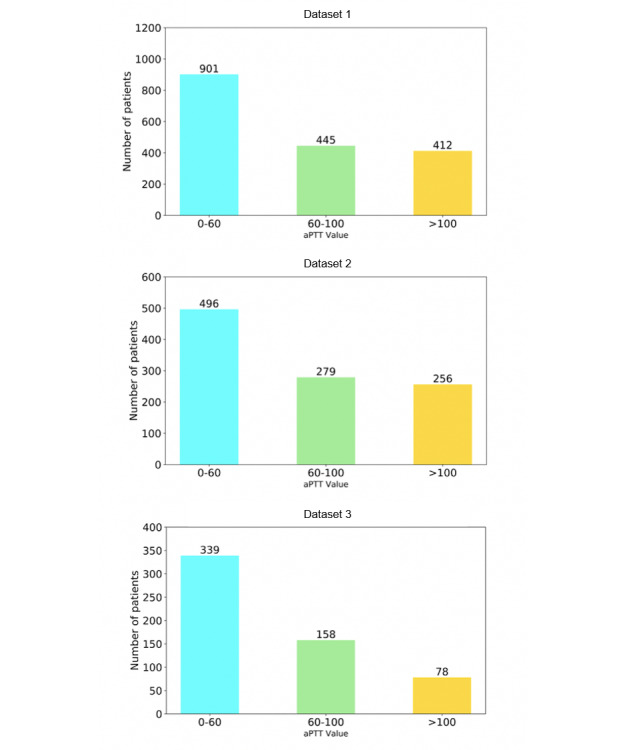
Objective: The objective of this study was to predict the effects of heparin treatment using machine learning methods to optimize heparin dosing in intensive care units based on the predictions. Patient state predictions were based upon activated partial thromboplastin time in 3 different ranges: subtherapeutic, normal therapeutic, and supratherapeutic, respectively.
Methods: Retrospective data from 2 intensive care unit research databases (Multiparameter Intelligent Monitoring in Intensive Care III, MIMIC-III; e-Intensive Care Unit Collaborative Research Database, eICU) were used for the analysis. Candidate machine learning models (random forest, support vector machine, adaptive boosting, extreme gradient boosting, and shallow neural network) were compared in 3 patient groups to evaluate the classification performance for predicting the subtherapeutic, normal therapeutic, and supratherapeutic patient states. The model results were evaluated using precision, recall, F1 score, and accuracy.
Results: Data from the MIMIC-III database (n=2789 patients) and from the eICU database (n=575 patients) were used. In 3-class classification, the shallow neural network algorithm performed the best (F1 scores of 87.26%, 85.98%, and 87.55% for data set 1, 2, and 3, respectively). The shallow neural network algorithm achieved the highest F1 scores within the patient therapeutic state groups: subtherapeutic (data set 1: 79.35%; data set 2: 83.67%; data set 3: 83.33%), normal therapeutic (data set 1: 93.15%; data set 2: 87.76%; data set 3: 84.62%), and supratherapeutic (data set 1: 88.00%; data set 2: 86.54%; data set 3: 95.45%) therapeutic ranges, respectively.
Conclusions: The most appropriate model for predicting the effects of heparin treatment was found by comparing multiple machine learning models and can be used to further guide optimal heparin dosing. Using multicenter intensive care unit data, our study demonstrates the feasibility of predicting the outcomes of heparin treatment using data-driven methods, and thus, how machine learning-based models can be used to optimize and personalize heparin dosing to improve patient safety. Manual analysis and validation suggested that the model outperformed standard practice heparin treatment dosing.
Keywords: dosing; heparin; intensive care unit; machine learning; optimization.
©Longxiang Su, Chun Liu, Dongkai Li, Jie He, Fanglan Zheng, Huizhen Jiang, Hao Wang, Mengchun Gong, Na Hong, Weiguo Zhu, Yun Long. Originally published in JMIR Medical Informatics (http://medinform.jmir.org), 22.06.2020.
Conflict of interest statement
Conflicts of Interest: None declared.
Figures
References
-
- Williams CN, Bratton SL, Hirshberg EL. Computerized decision support in adult and pediatric critical care. World J Crit Care Med. 2013 Dec 04;2(4):21–8. doi: 10.5492/wjccm.v2.i4.21. http://www.wjgnet.com/2220-3141/full/v2/i4/21.htm - DOI - PMC - PubMed
-
- Pirracchio Romain, Cohen Mitchell J, Malenica Ivana, Cohen Jonathan, Chambaz Antoine, Cannesson Maxime, Lee Christine, Resche-Rigon Matthieu, Hubbard Alan, ACTERREA Research Group Big data and targeted machine learning in action to assist medical decision in the ICU. Anaesth Crit Care Pain Med. 2019 Aug;38(4):377–384. doi: 10.1016/j.accpm.2018.09.008. https://www.sciencedirect.com/science/article/abs/pii/S2352556818302169?... - DOI - PubMed
-
- Raschke R, Gollihare B, Peirce J C. The effectiveness of implementing the weight-based heparin nomogram as a practice guideline. Arch Intern Med. 1996;156(15):1645–9. - PubMed
LinkOut - more resources
Full Text Sources
