


Association of Recreational Cannabis Laws in Colorado and Washington State With Changes in Traffic Fatalities, 2005-2017
- PMID: 32568378
- PMCID: PMC7309574
- DOI: 10.1001/jamainternmed.2020.1757
Association of Recreational Cannabis Laws in Colorado and Washington State With Changes in Traffic Fatalities, 2005-2017
Abstract
Importance: An important consequence of cannabis legalization is the potential increase in the number of cannabis-impaired drivers on roads, which may result in higher rates of traffic-related injuries and fatalities. To date, limited information about the effects of recreational cannabis laws (RCLs) on traffic fatalities is available.
Objective: To estimate the extent to which the implementation of RCLs is associated with traffic fatalities in Colorado and Washington State.
Design, setting, and participants: This ecological study used a synthetic control approach to examine the association between RCLs and changes in traffic fatalities in Colorado and Washington State in the post-RCL period (2014-2017). Traffic fatalities data were obtained from the Fatality Analysis Reporting System from January 1, 2005, to December 31, 2017. Data from Colorado and Washington State were compared with synthetic controls. Data were analyzed from January 1, 2005, to December 31, 2017.
Main outcome(s) and measures: The primary outcome was the rate of traffic fatalities. Sensitivity analyses were performed (1) excluding neighboring states, (2) excluding states without medical cannabis laws (MCLs), and (3) using the enactment date of RCLs to define pre-RCL and post-RCL periods instead of the effective date.
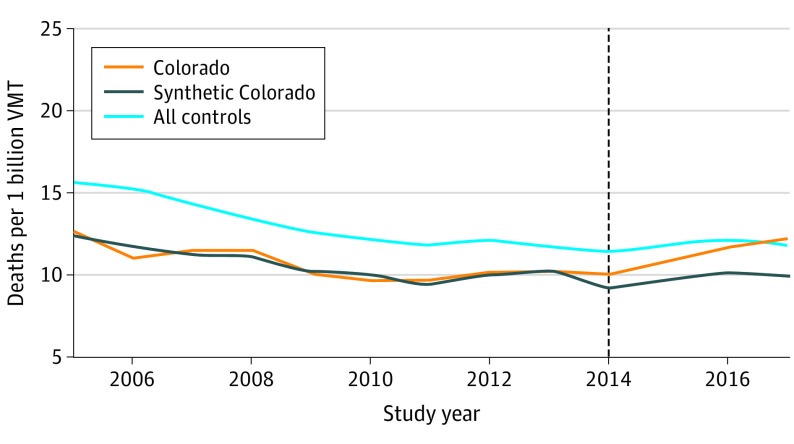
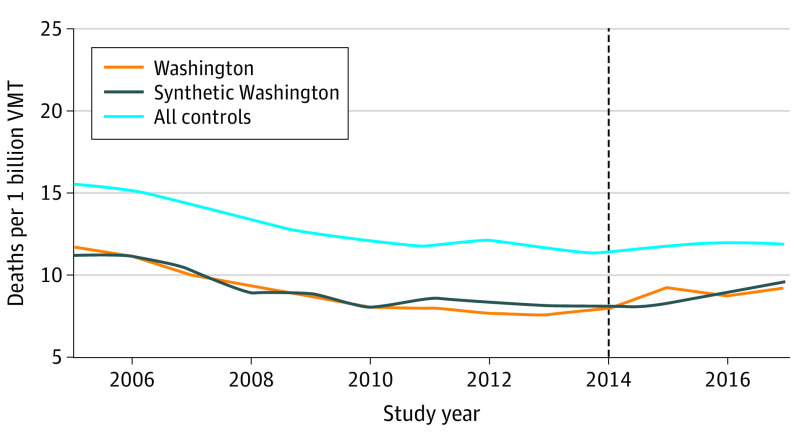
Results: Implementation of RCLs was associated with increases in traffic fatalities in Colorado but not in Washington State. The difference between Colorado and its synthetic control in the post-RCL period was 1.46 deaths per 1 billion vehicle miles traveled (VMT) per year (an estimated equivalent of 75 excess fatalities per year; probability = 0.047). The difference between Washington State and its synthetic control was 0.08 deaths per 1 billion VMT per year (probability = 0.674). Results were robust in most sensitivity analyses. The difference between Colorado and synthetic Colorado was 1.84 fatalities per 1 billion VMT per year (94 excess deaths per year; probability = 0.055) after excluding neighboring states and 2.16 fatalities per 1 billion VMT per year (111 excess deaths per year; probability = 0.063) after excluding states without MCLs. The effect was smaller when using the enactment date (24 excess deaths per year; probability = 0.116).
Conclusions and relevance: This study found evidence of an increase in traffic fatalities after the implementation of RCLs in Colorado but not in Washington State. Differences in how RCLs were implemented (eg, density of recreational cannabis stores), out-of-state cannabis tourism, and local factors may explain the different results. These findings highlight the importance of RCLs as a factor that may increase traffic fatalities and call for the identification of policies and enforcement strategies that can help prevent unintended consequences of cannabis legalization.
Conflict of interest statement
Figures
Comment in
-
Reducing Impaired Driving Fatalities: Data Need to Drive Testing, Enforcement, and Policy.JAMA Intern Med. 2020 Aug 1;180(8):1068-1069. doi: 10.1001/jamainternmed.2020.1984. JAMA Intern Med. 2020. PMID: 32568388 No abstract available.
References
-
- ProCon.org Legal recreational marijuana, states and DC: cannabis laws with possession and cultivation limits. Updated June 25, 2019. Accessed July 28, 2019. https://marijuana.procon.org/view.resource.php?resourceID=006868
-
- ProCon.org Legal medical marijuana, states and DC: laws, fees, and possession limits. Updated July 24, 2019. Accessed July 28, 2019. https://medicalmarijuana.procon.org/view.resource.php?resourceID=000881
Publication types
MeSH terms
Grants and funding
LinkOut - more resources
Full Text Sources
Medical
Miscellaneous
