


Climate change and viral emergence: evidence from Aedes-borne arboviruses
- PMID: 32569752
- PMCID: PMC7305058
- DOI: 10.1016/j.coviro.2020.05.001
Climate change and viral emergence: evidence from Aedes-borne arboviruses
Abstract
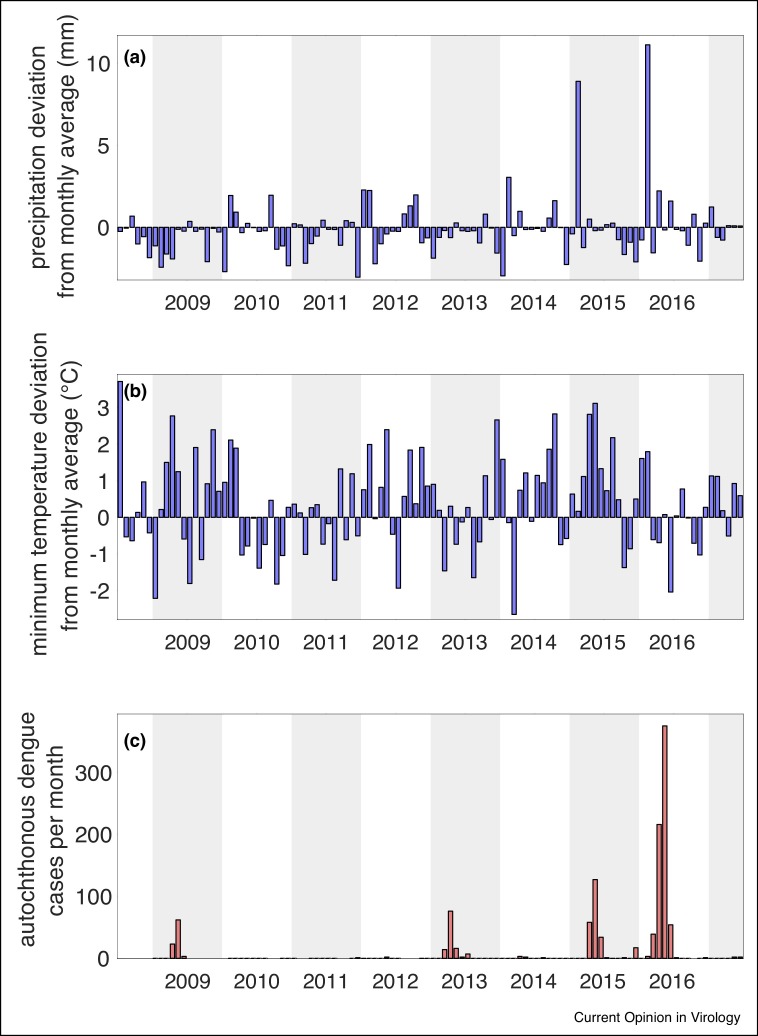
Climate change is leading to increases in global temperatures and erratic precipitation patterns, both of which are contributing to the expansion of mosquito-borne arboviruses and the populations of the mosquitos that vector them. Herein, we review recent evidence of emergence and expansion of arboviruses transmitted by Aedes mosquitos that has been driven in part by environmental changes. We present as a case study of recent work from Córdoba, Argentina, where dengue has been actively emerging in the past decade. We review recent empirical and modeling studies that aim to understand the impact of climate on future expansion of arboviruses, and we highlight gaps in empirical studies linking climate to arbovirus transmission at regional levels.
Copyright © 2020 Elsevier B.V. All rights reserved.
Figures
References
-
- Brady O.J., Hay S.I. The global expansion of dengue: how Aedes aegypti mosquitoes enabled the first pandemic arbovirus. Ann Rev Entomol. 2020;65:191–208. - PubMed
-
- Young P.R. Arboviruses: a family on the move. In: Hilgenfeld R., Vasudevan S.G., editors. Dengue and Zika: Control and Antiviral Treatment Strategies. Springer; 2018. pp. 1–10.
-
- Costa E.A.P. de A., Santos E.M. de M., Correia J.C., Albuquerque C.M.R. de. Impact of small variations in temperature and humidity on the reproductive activity and survival of Aedes aegypti (Diptera, Culicidae) Rev Bras entomol. 2010;54:488–493.
-
- Brady O.J., Johansson M.A., Guerra C.A., Bhatt S., Golding N., Pigott D.M., Delatte H., Grech M.G., Leisnham P.T., Maciel-de-Freitas R. Modelling adult Aedes aegypti and Aedes albopictus survival at different temperatures in laboratory and field settings. Parasites Vectors. 2013;6:351. - PMC - PubMed
Publication types
MeSH terms
LinkOut - more resources
Full Text Sources
Miscellaneous
