


Rapid Direct Nucleic Acid Amplification Test without RNA Extraction for SARS-CoV-2 Using a Portable PCR Thermocycler
- PMID: 32570810
- PMCID: PMC7349311
- DOI: 10.3390/genes11060664
Rapid Direct Nucleic Acid Amplification Test without RNA Extraction for SARS-CoV-2 Using a Portable PCR Thermocycler
Abstract
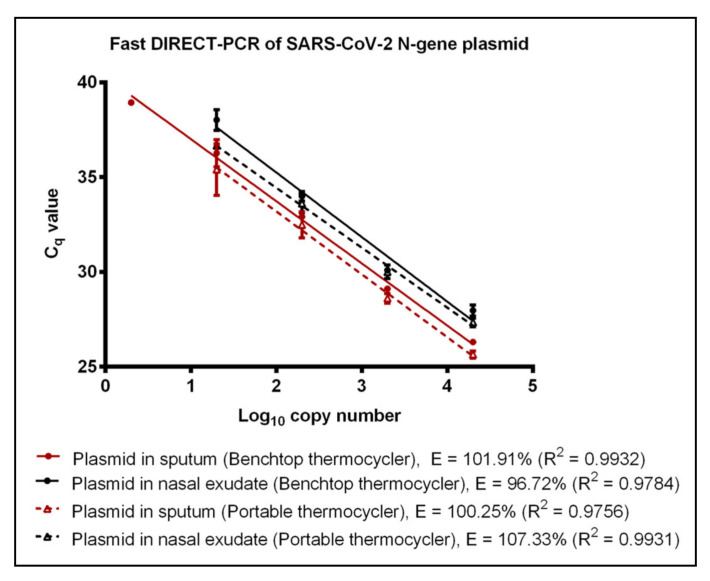
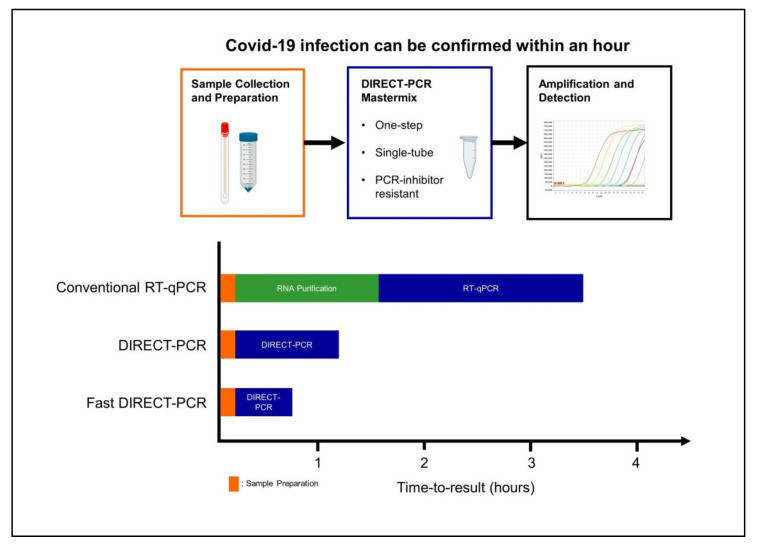
There is an ongoing worldwide coronavirus disease 2019 (Covid-19) pandemic caused by severe acute respiratory syndrome coronavirus 2 (SARS-CoV-2). At present, confirmatory diagnosis is by reverse transcription polymerase chain reaction (RT-PCR), typically taking several hours and requiring a molecular laboratory to perform. There is an urgent need for rapid, simplified, and cost-effective detection methods. We have developed and analytically validated a protocol for direct rapid extraction-free PCR (DIRECT-PCR) detection of SARS-CoV-2 without the need for nucleic acid purification. As few as six RNA copies per reaction of viral nucleocapsid (N) gene from respiratory samples such as sputum and nasal exudate can be detected directly using our one-step inhibitor-resistant assay. The performance of this assay was validated on a commercially available portable PCR thermocycler. Viral lysis, reverse transcription, amplification, and detection are achieved in a single-tube homogeneous reaction within 36 min. This minimizes hands-on time, reduces turnaround-time for sample-to-result, and obviates the need for RNA purification reagents. It could enable wider use of Covid-19 testing for diagnosis, screening, and research in countries and regions where laboratory capabilities are limiting.
Keywords: Covid-19; DIRECT-PCR; Diagnostics; Point-of-care; SARS-CoV-2; portable PCR.
Conflict of interest statement
The authors declare no conflict of interest. The funders had no role in the design of the study; in the collection, analyses, or interpretation of data; in the writing of the manuscript; or in the decision to publish the results.
Figures

References
-
- WHO WHO Director-General’s opening remarks at the media briefing on COVID-19 - 11 March 2020. [(accessed on 12 March 2020)]; Available online: https://www.who.int/dg/speeches/detail/who-director-general-s-opening-re....
-
- WHO COVID-19 Dashboard. [(accessed on 16 April 2020)]; Available online: https://covid19.who.int/
-
- Ng Y., Li Z., Chua Y.X., Chaw W.L., Zhao Z., Er B., Pung R., Chiew C.J., Lye D.C., Heng D., et al. Evaluation of the Effectiveness of Surveillance and Containment Measures for the First 100 Patients with COVID-19 in Singapore — January 2–February 29, 2020. MMWR. Morb. Mortal. Wkly. Rep. 2020;69:307–311. doi: 10.15585/mmwr.mm6911e1. - DOI - PMC - PubMed
Publication types
MeSH terms
Substances
Grants and funding
LinkOut - more resources
Full Text Sources
Other Literature Sources
Miscellaneous
