Review
. 2020 Jun 18;9(6):1486.
doi: 10.3390/cells9061486.

Hepatitis B Virus Entry into Cells

Affiliations
Review

Hepatitis B Virus Entry into Cells

Charline Herrscher et al. Cells. .

Abstract

Hepatitis B virus (HBV), an enveloped partially double-stranded DNA virus, is a widespread human pathogen responsible for more than 250 million chronic infections worldwide. Current therapeutic strategies cannot eradicate HBV due to the persistence of the viral genome in a special DNA structure (covalently closed circular DNA, cccDNA). The identification of sodium taurocholate co-transporting polypeptide (NTCP) as an entry receptor for both HBV and its satellite virus hepatitis delta virus (HDV) has led to great advances in our understanding of the life cycle of HBV, including the early steps of infection in particular. However, the mechanisms of HBV internalization and the host factors involved in this uptake remain unclear. Improvements in our understanding of HBV entry would facilitate the design of new therapeutic approaches targeting this stage and preventing the de novo infection of naïve hepatocytes. In this review, we provide an overview of current knowledge about the process of HBV internalization into cells.

Keywords: Hepatitis B virus; entry pathway; virus–host interaction.


Conflict of interest statement

The authors have no conflicts of interest to declare.

Figures
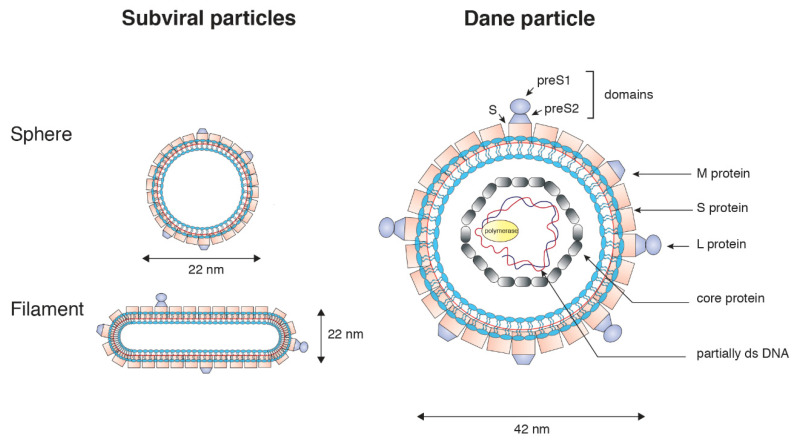
Figure 1
Figure 1
Schematic diagram of hepatitis B virus (HBV) particles.
Figure 2
Figure 2
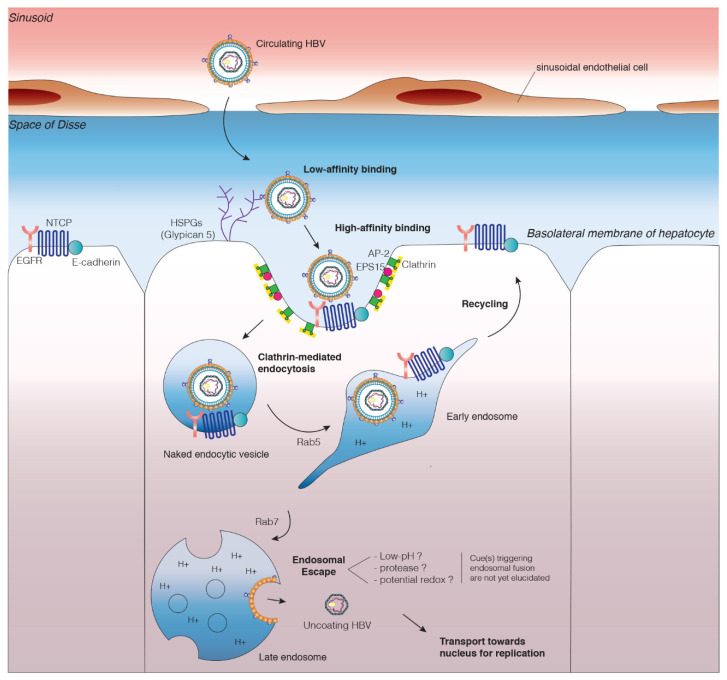
Early events in the life cycle of hepatitis B virus. HBV interacts with heparan sulfate proteoglycans (HSPGs), including glypican 5 in particular, on the hepatocyte cell membrane. HBV binds its receptor sodium taurocholate co-transporting polypeptide (NTCP) and its coreceptor epidermal growth factor receptor (EGFR). This internalization complex is associated with E-cadherin linked to N-glycosylated NTCP. This association permits the relocalization of NTCP to the plasma membrane. The HBV–NTCP–EGFR complex is taken up into the cell by clathrin-mediated endocytosis. The EGFR sorting machinery coordinates HBV transport in the endosomal network. Endosomal escape remains incompletely understood, but it has been suggested that the localization of HBV to late endosomes is crucial for productive infection and that fusion may occur in this compartment. The cues triggering endosomal fusion have yet to be clearly elucidated. Following endosomal escape, the free nucleocapsid is thought to use the microtubule network for transit to the nucleus, where it dissociates at the nuclear pore complex. Once within the nucleus, the relaxed circular DNA is converted into cccDNA, which acts as a template for transcription.

References

    1. Doms R.W., Moore J.P. HIV-1 Membrane Fusion. J. Cell Biol. 2000;151:F9–F14. doi: 10.1083/jcb.151.2.F9. - DOI - PMC - PubMed
    1. Wittels M., Spear P.G. Penetration of cells by herpes simplex virus does not require a low pH-dependent endocytic pathway. Virus Res. 1991;18:271–290. doi: 10.1016/0168-1702(91)90024-P. - DOI - PubMed
    1. Singh M., Jadhav H.R., Bhatt T. Dynamin Functions and Ligands: Classical Mechanisms Behind. Mol. Pharmacol. 2017;91:123–134. doi: 10.1124/mol.116.105064. - DOI - PubMed
    1. Henley J.R., Krueger E.W.A., Oswald B.J., McNiven M.A. Dynamin-mediated Internalization of Caveolae. J. Cell Biol. 1998;141:85–99. doi: 10.1083/jcb.141.1.85. - DOI - PMC - PubMed
    1. McMahon H.T., Boucrot E. Molecular mechanism and physiological functions of clathrin-mediated endocytosis. Nat. Rev. Mol. Cell Biol. 2011;12:517–533. doi: 10.1038/nrm3151. - DOI - PubMed

Publication types

MeSH terms

LinkOut - more resources