


Visual sense of number vs. sense of magnitude in humans and machines
- PMID: 32572067
- PMCID: PMC7308388
- DOI: 10.1038/s41598-020-66838-5
Visual sense of number vs. sense of magnitude in humans and machines
Abstract
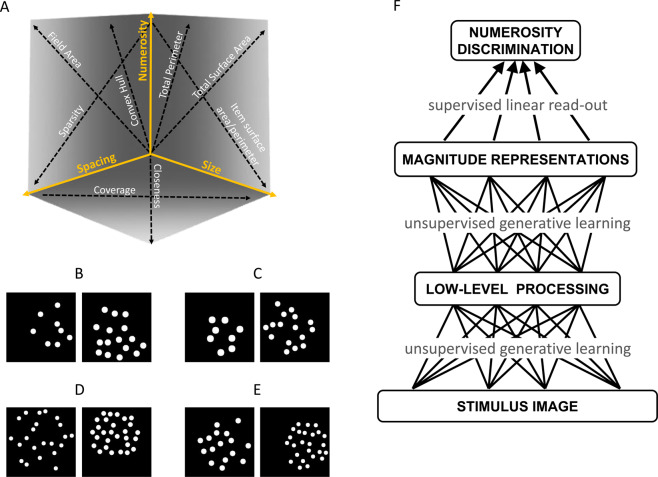
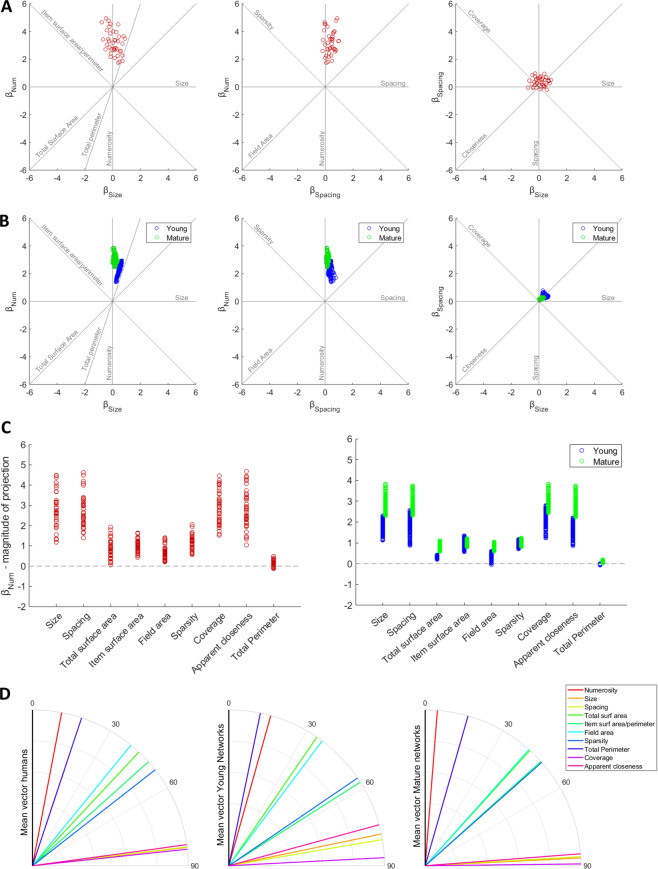
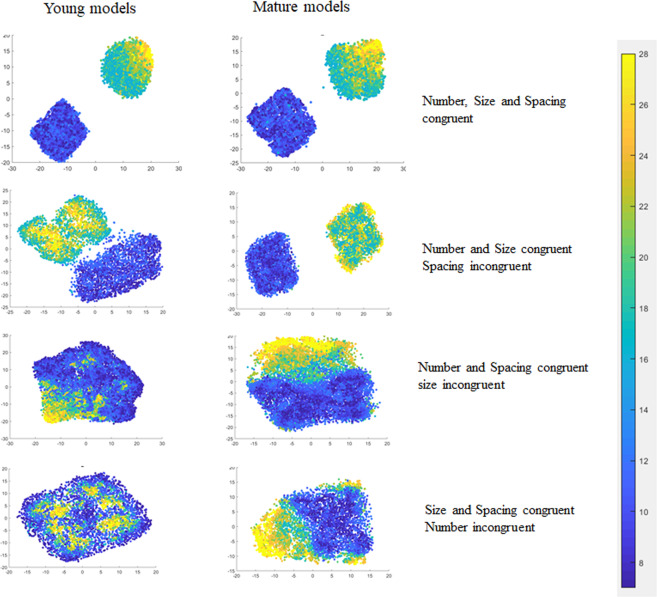
Numerosity perception is thought to be foundational to mathematical learning, but its computational bases are strongly debated. Some investigators argue that humans are endowed with a specialized system supporting numerical representations; others argue that visual numerosity is estimated using continuous magnitudes, such as density or area, which usually co-vary with number. Here we reconcile these contrasting perspectives by testing deep neural networks on the same numerosity comparison task that was administered to human participants, using a stimulus space that allows the precise measurement of the contribution of non-numerical features. Our model accurately simulates the psychophysics of numerosity perception and the associated developmental changes: discrimination is driven by numerosity, but non-numerical features also have a significant impact, especially early during development. Representational similarity analysis further highlights that both numerosity and continuous magnitudes are spontaneously encoded in deep networks even when no task has to be carried out, suggesting that numerosity is a major, salient property of our visual environment.
Conflict of interest statement
The authors declare no competing interests.
Figures


References
-
- Dehaene, S. The number sense: How the mind creates mathematics. (Oxford University Press, 2011).
-
- Piazza M. Neurocognitive start-up tools for symbolic number representations. Trends Cogn. Sci. 2010;14:542–551. - PubMed
-
- Butterworth, B. The mathematical brain. (Macmillan, 1999).
-
- Piazza M, Izard V, Pinel P, Le Bihan D, Dehaene S. Tuning curves for approximate numerosity in the human intraparietal sulcus. Neuron. 2004;44:547–555. - PubMed
-
- Agrillo C, Dadda M, Serena G, Bisazza A. Do fish count? Spontaneous discrimination of quantity in female mosquitofish. Anim. Cogn. 2008;11:495–503. - PubMed
Publication types
MeSH terms
LinkOut - more resources
Full Text Sources
