


Comment
doi: 10.1038/d41586-020-01569-1.
Tumour metabolites hinder DNA repair
- PMID: 32572248
- PMCID: PMC7576997
- DOI: 10.1038/d41586-020-01569-1
Item in Clipboard
Comment
Tumour metabolites hinder DNA repair
Nature.
2020 Jun.
No abstract available
Keywords: Cancer; Metabolism.
Figures
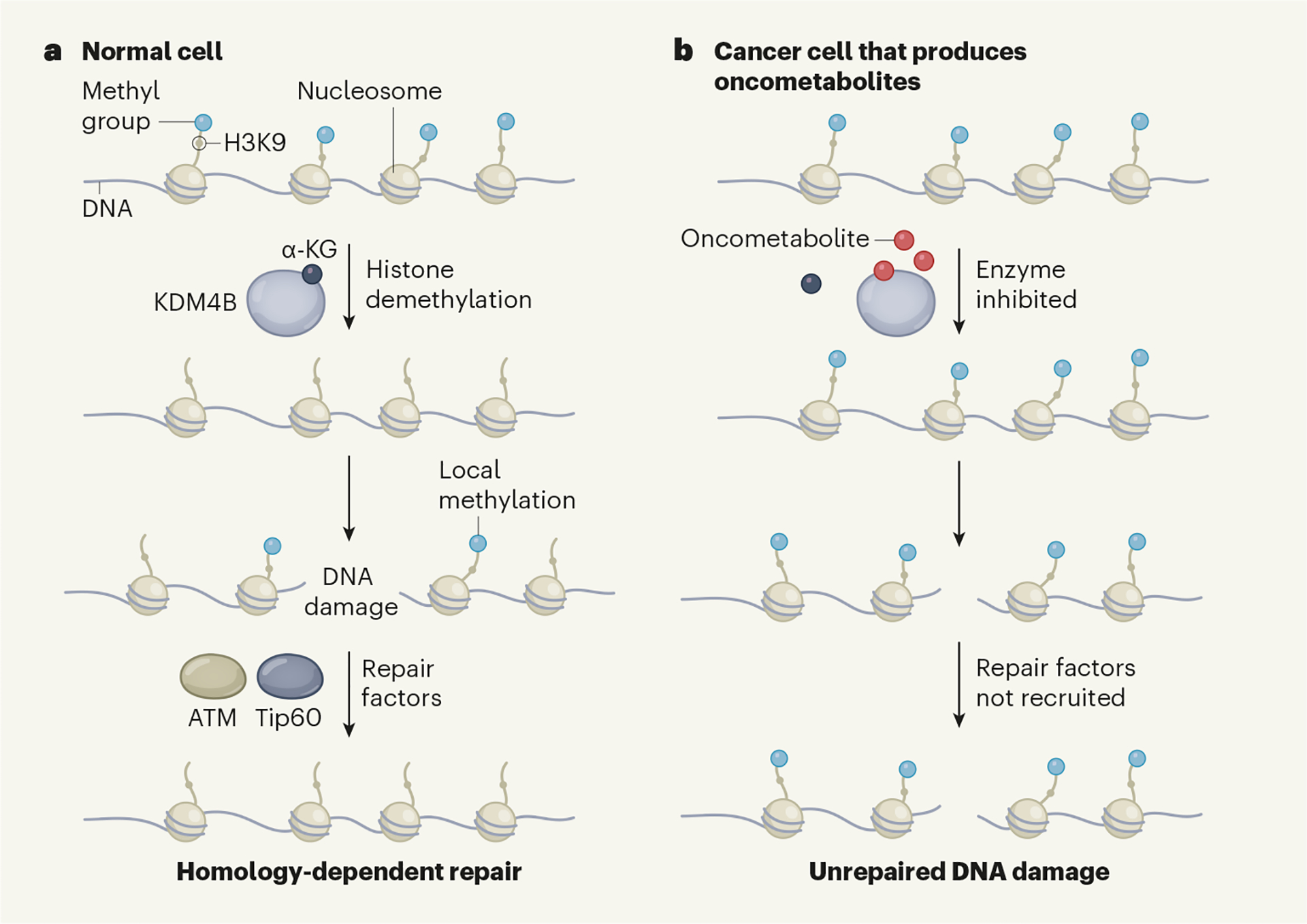
a, DNA wraps around histone proteins to form a structure called a nucleosome. In normal cells, the enzyme KDM4B catalyses the removal of methyl groups from the lysine 9 (K9) amino-acid residue of the protein histone 3 (H3) in the nucleosome. This H3K9 demethylation activity requires the small molecule α-ketoglutarate (α-KG). If a double-strand break in DNA occurs, H3K9 is methylated at the damage site and this local methylation signal recruits DNA-repair factors that include the proteins Tip60 and ATM. These fix the damage through a process called homology-dependent repair. b, As a result of certain mutations, some cancer cells accumulate small molecules termed oncometabolites that promote tumour growth. Sulkowski et al. have revealed a mechanism that underlies this phenomenon. Oncometabolites compete with α-KG for binding to KDM4B and thus inhibit the enzyme’s function. This results in H3K9 methylation across the genome. This global hypermethylation masks a local spike in H3K9 methylation occurring after DNA damage, and hinders the recruitment of DNA-repair factors. Unrepaired DNA damage can lead to genome instability and thus boost tumour growth.
Comment on
-
Oncometabolites suppress DNA repair by disrupting local chromatin signalling.Nature. 2020 Jun;582(7813):586-591. doi: 10.1038/s41586-020-2363-0. Epub 2020 Jun 3. Nature. 2020. PMID: 32494005 Free PMC article.
References
Publication types
MeSH terms
Substances
Grants and funding
LinkOut - more resources
Full Text Sources
Medical
