. 2020 May 27:7:260.
doi: 10.3389/fmed.2020.00260. eCollection 2020.

Textile Masks and Surface Covers-A Spray Simulation Method and a "Universal Droplet Reduction Model" Against Respiratory Pandemics

Affiliations

Textile Masks and Surface Covers-A Spray Simulation Method and a "Universal Droplet Reduction Model" Against Respiratory Pandemics

Alex Rodriguez-Palacios et al. Front Med (Lausanne). .

Abstract

The main form of COVID-19 transmission is via "oral-respiratory droplet contamination" (droplet: very small drop of liquid) produced when individuals talk, sneeze, or cough. In hospitals, health-care workers wear facemasks as a minimum medical "droplet precaution" to protect themselves. Due to the shortage of masks during the pandemic, priority is given to hospitals for their distribution. As a result, the availability/use of medical masks is discouraged for the public. However, for asymptomatic individuals, not wearing masks in public could easily cause the spread of COVID-19. The prevention of "environmental droplet contamination" (EnvDC) from coughing/sneezing/speech is fundamental to reducing transmission. As an immediate solution to promote "public droplet safety," we assessed household textiles to quantify their potential as effective environmental droplet barriers (EDBs). The synchronized implementation of a universal "community droplet reduction solution" is discussed as a model against COVID-19. Using a bacterial-suspension spray simulation model of droplet ejection (mimicking a sneeze), we quantified the extent by which widely available clothing fabrics reduce the dispersion of droplets onto surfaces within 1.8 m, the minimum distance recommended for COVID-19 "social distancing." All textiles reduced the number of droplets reaching surfaces, restricting their dispersion to <30 cm, when used as single layers. When used as double-layers, textiles were as effective as medical mask/surgical-cloth materials, reducing droplet dispersion to <10 cm, and the area of circumferential contamination to ~0.3%. The synchronized implementation of EDBs as a "community droplet reduction solution" (i.e., face covers/scarfs/masks and surface covers) will reduce COVID-19 EnvDC and thus the risk of transmitting/acquiring COVID-19.

Keywords: COVID-19; SARS-Cov-2; cloth masks; coronavirus; public droplet safety; respiratory pandemic; spray simulation model; textiles.


Figures

Figure 1
Figure 1
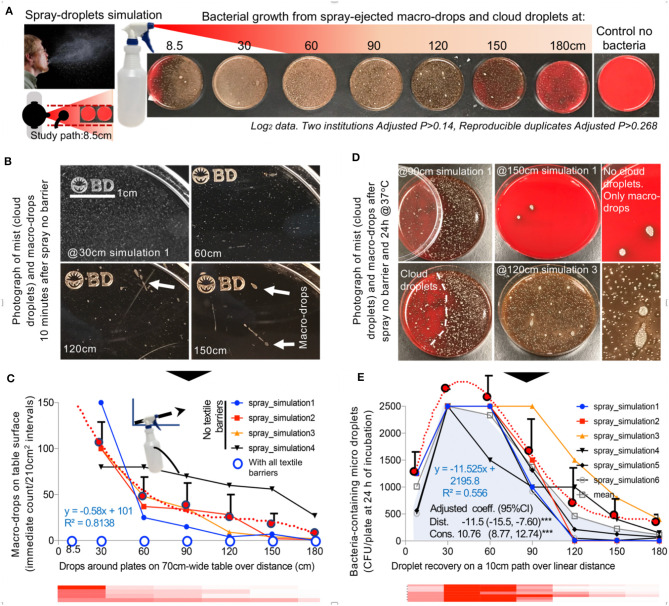
Simulation of a cloud of airborne bacteria-containing macro-drops and micro-droplets to quantify barrier potential of household textiles. (A) Graphical overview of the spray model. Inset, Photograph of a human sneeze, public domain, James Gathany, CDC image ID11162). (B) Photographs of short and long-range visible droplets immediately after spray. Note the color, number, size, and relative location and distribution of the bacteria colonies growing from “invisible” microdroplets (CFU) shown as whitish spots on the agar surface. Bacterial growth alters the red color of the fresh non-inoculated agar leading to a brownish discoloring of the petri agars, which is more pronounced as the number of bacterial colonies increase. (C) Number of macro-drops for four simulations over distance. The overall linear equation that best describes the mean spray macro-droplet dynamics linearized/depicted as the heatmap is y = −8E−05x3 + 0.0305x2 – 3.9405x + 198.42, with an R2 = 0.9829. Note that large drops of liquids observed with the spray alone (no textile barrier) were not observed with any of the textile barriers tested. (D) Photographs of bacterial CFUs on agar plates illustrating ability of cloud micro-droplets to move around spaces driven by cloud turbulence (left images, agar plates were partially covered with lid at moment of spray), concurrent contamination with macro- and micro-droplets. (E) Number of CFU/plate (56.75 cm2) for 6 simulations over distance. The overall linear equation that best describes the mean dispersal of bacteria-carrying micro-droplets over distance, also depicted as the red heatmap, is y = −4E−05x4 + 0.0177x3 – 2.8522x2 + 155.63x – 58.504, with an R2 = 0.9994.
Figure 2
Figure 2
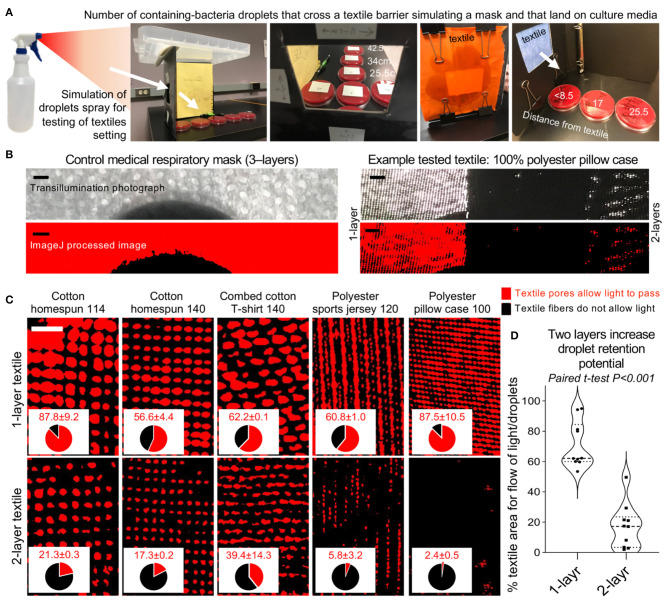
Spray-droplet model to quantify reduction rate of long-range droplet dispersion across 1- and 2-layer textiles. (A) Graphical overview of spray-droplet setting (see Methods). Tryptic soy agar supplemented with 5% defibrinated sheep blood plates incubated aerobically at 37°C for 24 h. (B) Photograph and low-resolution ImageJ processed image compares medical mask material to that of single- and double-layered textile example (Supplementary Figure 1, all textiles used). Scale bar, 1 mm. (C) High resolution ImageJ binary analysis of representative textiles photographed as single and double layers to illustrate the percentage of the textile barrier “open area” that allows the passage of light/droplets. Scale bar, 1 mm. (D) Paired analysis of reduction of the textile “open area” when textile is tested as two layers.
Figure 3
Figure 3
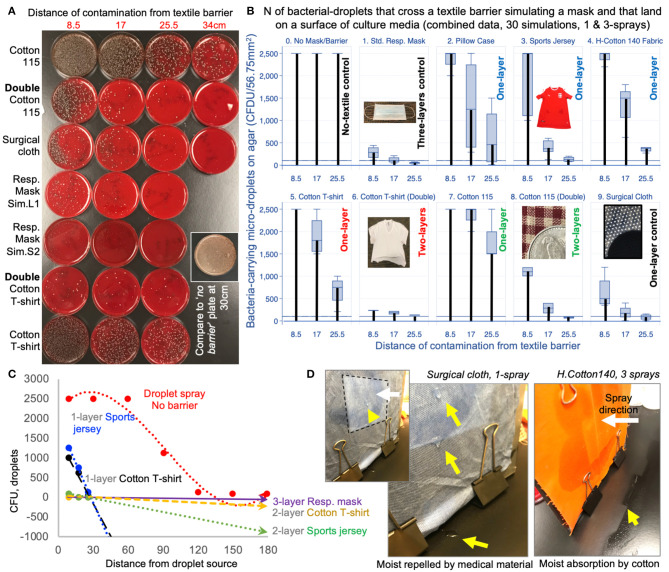
Using two layers of household textiles markedly retain liquid droplets. (A) Tryptic soy agar plates illustrate effective bacterial-droplet reduction by 2-layer textiles. (B) Pooled results from two spray-simulations (1- and 3-sprays; Supplementary Figure 2). Vertical thick black bars connect baseline values at 0 to the means. (C) Linear regressions for EnvDC reduction over distance for no-barrier vs. selected textiles. Compared to no textile (EDB) barrier (red dotted line), the reduction in CFUs illustrate the profound effect of using household textiles to retain droplets. Line slopes that are closer to the horizontal grid line at 0, and closer to the “Resp. mask”-dotted line are more effective strategies (commercial masks are made of 2-or-3-layers) compared to single layers (Supplementary Figure 4, equations and R2). (D) Photographs of differences in condensate after 1-spray on the side of the textile being sprayed. Arrowheads, drops/accumulation.
Figure 4
Figure 4
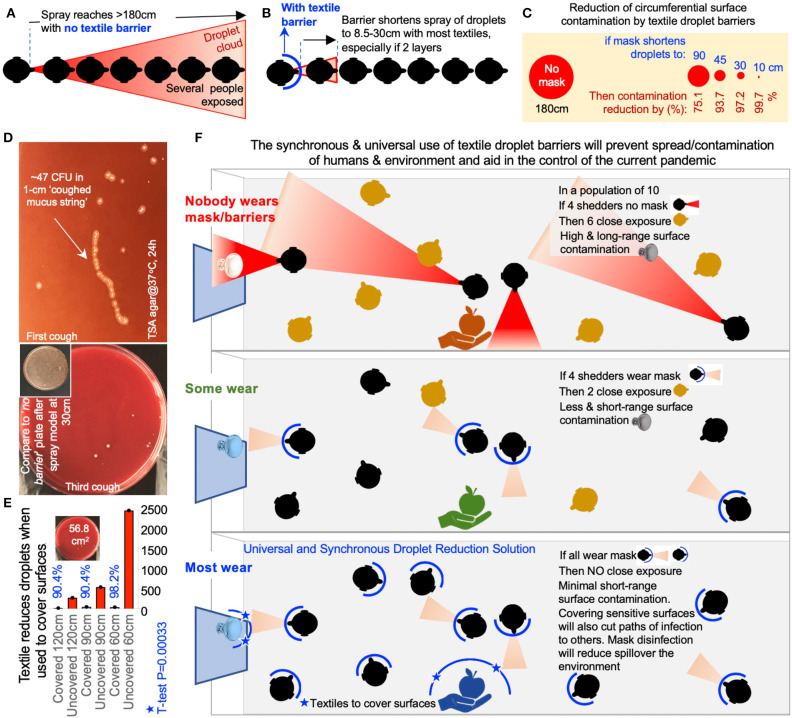
Environmentally-focused “Universal Droplet Reduction Model” against pandemics due to infectious agents transmitted via oral-respiratory fluids. (A) Graphical representation of a model where the lack of face barrier/cover could result in the contamination of a large circumferential area, or nearby contact with a higher number of susceptible individuals, within a 180 cm radius. (B) Graphical representation illustrating the benefit of wearing textile-face barriers to reduce the circumferential area contaminated with droplets (two-layers/single-layers) and to reduce the number of droplet contacts with susceptible individuals. (C) The benefit of using face cover/barriers drastically increases in surface area (cm2) as the efficiency of the droplet barrier increases (distance of droplet contamination, cm). (D) Coughed material-associated bacteria in agar. Large viscous secretions will be retained by textile-EDB. (E) Bacteria-carrying droplet counts on agar plates covered with 1-layer cotton t-shirt material, after one-spray, over distance. Colony-forming units were estimated on paired TSA agar plates (covered and uncovered) following the spraying of the bacterial-carrying solution over the plates, and 48 h of aerobic incubation. (F) Environmental droplet reduction model. Protective masks and surface covers in the community. Supplementary Table 2, list of current and proposed actions against COVID-19.

References

    1. Oaklander M. Health experts are telling healthy people not to wear face masks for coronavirus. So why are so many doing? Time (2020, March 04). Available online at: https://time.com/5794729/coronavirus-face-masks/ (accessed March 20, 2020).
    1. Tufekci Z. Why telling people they don't need masks backfired. To help manage the shortage, the authorities sent a message that made them untrustworthy. The New York Times. (2020, March 17). Available at https://www.nytimes.com/2020/03/17/opinion/coronavirus-face-masks.html (accessed March 24, 2020).
    1. Du Z, Nugent C, Cowling B, Meyers L. Hundreds of severe pediatric COVID-19 infections in Wuhan prior to the lockdown. medRxiv [preprint]. (2020). 10.1101/2020.03.16.20037176 - DOI
    1. Chughtai AA, Seale H, Dung TC, Hayen A, Rahman B, Raina MacIntyre C. Compliance with the use of medical and cloth masks among healthcare workers in Vietnam. Ann Occup Hyg. (2016) 60:619–30. 10.1093/annhyg/mew008 - DOI - PubMed
    1. WHO World Health Organization. Coronavirus Disease (COVID-19) Advice for the Public: When and How to Use Masks. (2020). Available online at: https://www.who.int/emergencies/diseases/novel-coronavirus-2019/advice-f... (accessed March 18, 2020).