. 2020 Sep 1:201:112408.
doi: 10.1016/j.ejmech.2020.112408. Epub 2020 Jun 13.

Development of small-molecule inhibitors of fatty acyl-AMP and fatty acyl-CoA ligases in Mycobacterium tuberculosis

Affiliations

Development of small-molecule inhibitors of fatty acyl-AMP and fatty acyl-CoA ligases in Mycobacterium tuberculosis

Marzena Baran et al. Eur J Med Chem. .

Abstract

Lipid metabolism in Mycobacterium tuberculosis (Mtb) relies on 34 fatty acid adenylating enzymes (FadDs) that can be grouped into two classes: fatty acyl-CoA ligases (FACLs) involved in lipid and cholesterol catabolism and long chain fatty acyl-AMP ligases (FAALs) involved in biosynthesis of the numerous essential and virulence-conferring lipids found in Mtb. The precise biochemical roles of many FACLs remain poorly characterized while the functionally non-redundant FAALs are much better understood. Here we describe the systematic investigation of 5'-O-[N-(alkanoyl)sulfamoyl]adenosine (alkanoyl adenosine monosulfamate, alkanoyl-AMS) analogs as potential multitarget FadD inhibitors for their antitubercular activity and biochemical selectivity towards representative FAAL and FACL enzymes. We identified several potent compounds including 12-azidododecanoyl-AMS 28, 11-phenoxyundecanoyl-AMS 32, and nonyloxyacetyl-AMS 36 with minimum inhibitory concentrations (MICs) against M. tuberculosis ranging from 0.098 to 3.13 μM. Compound 32 was notable for its impressive biochemical selectivity against FAAL28 (apparent Ki = 0.7 μM) versus FACL19 (Ki > 100 μM), and uniform activity against a panel of multidrug and extensively drug-resistant TB strains with MICs ranging from 3.13 to 12.5 μM in minimal (GAST) and rich (7H9) media. The SAR analysis provided valuable insights for further optimization of 32 and also identified limitations to overcome.

Keywords: Acyl-AMS analogs; FAAL28; FACL19; Fatty acyl-AMP ligases; Fatty acyl-CoA ligases; Mycobacterium tuberculosis.


Conflict of interest statement

Declaration of competing interest The authors declare that they have no known competing financial interests or personal relationships that could have appeared to influence the work reported in this paper.

Figures
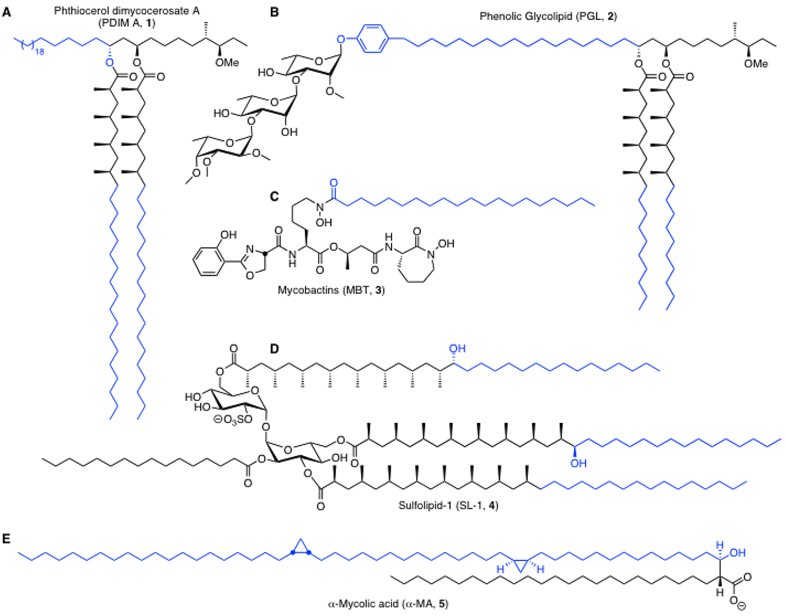
Fig. 1.
Fig. 1.. Unique lipids found in cell envelope of Mtb.
All of the molecules shown exist as a suite of related isomers that vary in the lipid chain length. If reported, the major isomer is shown otherwise a representative molecule is depicted. Specific FadDs are responsible for installation of the lipid chains highlighted in blue. A. PDIM A (1) biosynthesis requires FAAL26 and FAAL28 for synthesis of phthiocerol and mycocerosic acid moieties, respectively. B. PGLs (2) require FAAL22 and FAAL29 for assembly of the phenolphthiocerol lipid as well as FAAL28 for the two mycocerosic acids. C. MBTs (3) employ FAAL33 for installation of the C-20 lipid residue on the central lysine moiety. D. Sulfolipids represented by SL-1 (4) require FAAL23 for biosynthesis of the phthioceranic acid and two hydroxyphthioceranic acid groups. E. The mycolic acids represented by the most abundant α-MA (5) employ FAAL32 for introduction of the meromycolic acid subunit.
Fig. 2.
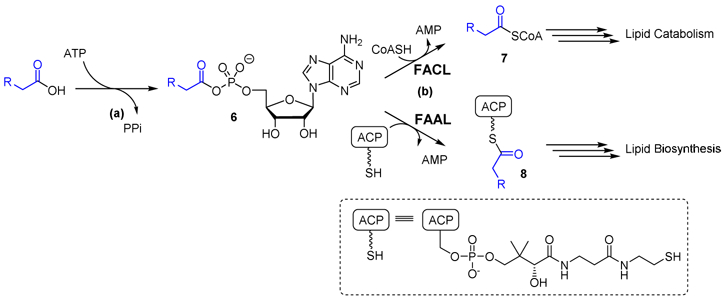
Fig. 2.. FadD enzyme mechanism.
FadDs catalyze a two-step reaction. In the first step (a) FadDs catalyze the adenylation of a fatty acid to afford an intermediate acyladenylate 6. In the second reaction (b) FadDs catalyze the acylation of an acceptor molecule resulting in thioester products 7 or 8. FadDs that form CoA esters 7 are classified as fatty acyl CoA ligases (FACLs) whereas FadDs that load the ACP domain of polyketide synthase enzymes to provide 8 are known as fatty acyl AMP ligases (FAALs).
Fig. 3.
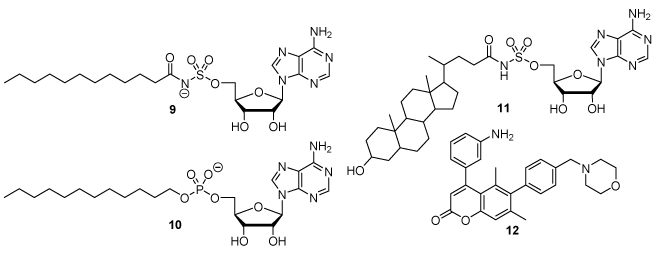
Fig. 3.. Previously described nucleoside-based FadD inhibitors.
Fig. 4.
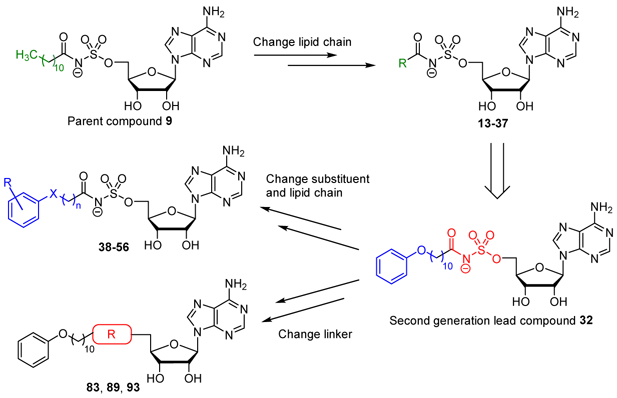
Fig. 4.. Rational design of the new acyl-sulfamoyl adenosine-based inhibitors.
Scheme 1.
Scheme 1.
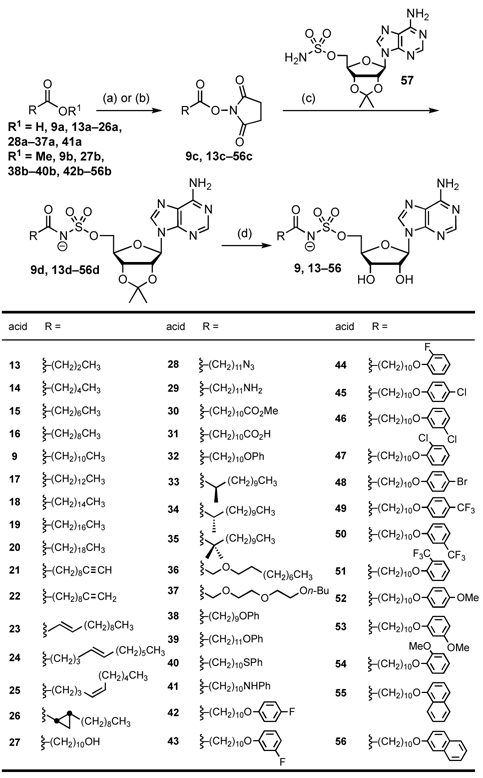
Synthesis of acyl sulfamate inhibitors 9 and 13–56. Reaction conditions: (a) N-hydroxysuccinimide, DCC, CH2Cl2; (b) 1 N aqueous NaOH/MeOH, 100 °C, then N-hydroxysuccinimide, EDC, CH2Cl2; (c) Cs2CO3, DMF, 78–93%; (d) 80% aqueous TFA, 18–89%.
Scheme 2.
Scheme 2.
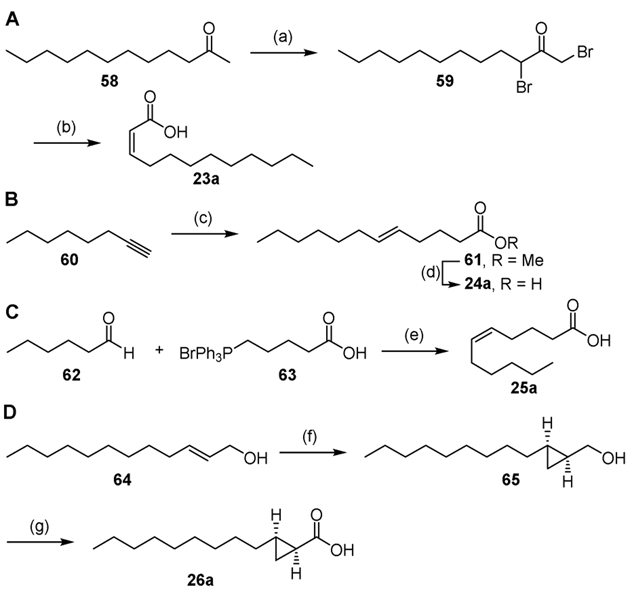
Synthesis of acids 23a–26a. Reaction conditions: (a) HBr (aq), Br2, 99%; (b) NaOH (aq), then HCl (aq), 87%; (c) Cp2ZrHCl, Pd2(dba)3, LiBr, NMP/THF, then ethyl 4-bromobutyrate, 79%; (d) LiOH, MeOH/H2O, 70%; (e) NaHMDS, THF, 40%; (f) (4R,5R)-2-butyl-N,N,NN′-tetramethyl-1,3,2-dioxaborolane-4,5-dicarboxamide, Zn(CH2I)2, CH2Cl2, 66%; (g) CrO3, H2SO4, H2O/acetone, 75%.
Scheme 3.
Scheme 3.
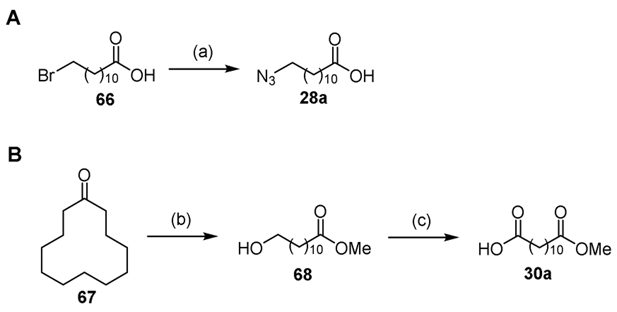
Synthesis of acids 28a and 30a. Reaction conditions: (a) NaN3, DMSO, 97%; (b) H2SO4, K2S2O8, MeOH, 83%; (c) CrO3, H2SO4, H2O/acetone, 57%.
Scheme 4.
Scheme 4.
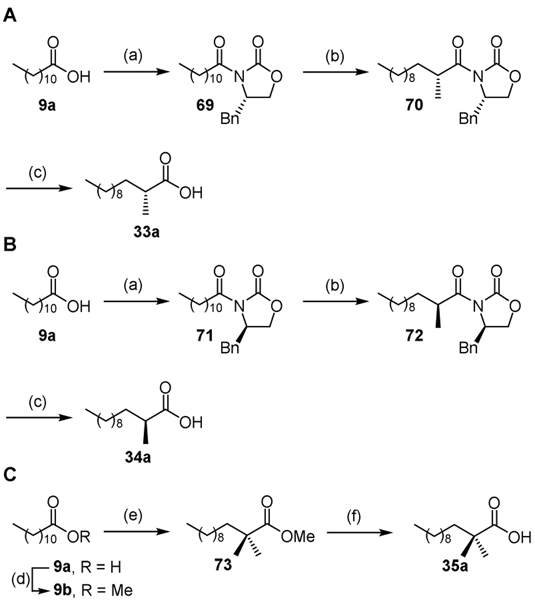
Synthesis of acids 33a–35a. Reaction conditions: (a) PivCl, DIPEA, THF, then n-BuLi, (S) or (R)-4-benzyl-2-oxazolidinone, THF, 97%; (b) NaHMDS, MeI, THF, 78%; (c) 30% H2O2, LiOH, THF/H2O, 99%; (d) H2SO4, MeOH, 99%; (e) LDA, THF, then MeI, repeated 2×, 53% (2 steps), (f) LiOH, THF/MeOH/H2O, 88%.
Scheme 5.
Scheme 5.
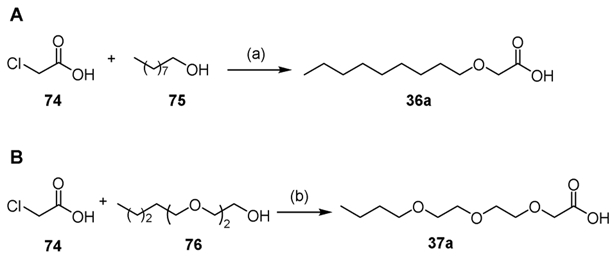
Synthesis of 36a and 37a. Reaction conditions: (a) NaH, THF: 30% (36a), 55% (37a).
Scheme 6.
Scheme 6.
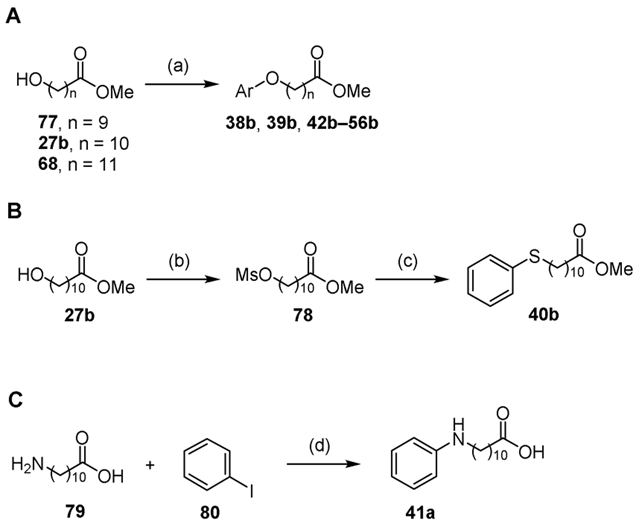
Synthesis of 41a, 38b56b. Reaction conditions: (a) ArOH, DIAD, PPh3, THF, 65–95%; (b) MsCl, Et3N, THF, 97%; (c) NaH, THF, thiophenol, 98%; (d) 10 mol% CuI, K3PO4·H2O, H2O/decanol, 84%.
Scheme 7.
Scheme 7.
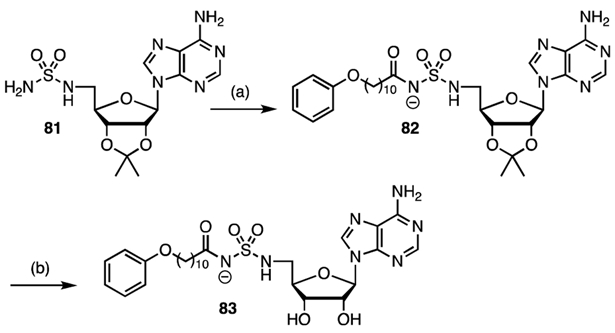
Synthesis of acylsulfamide 83. Reaction conditions: (a) Cs2CO3, DMF, 32c; (b) 80% aqueous TFA, 42% (2 steps).
Scheme 8.
Scheme 8.
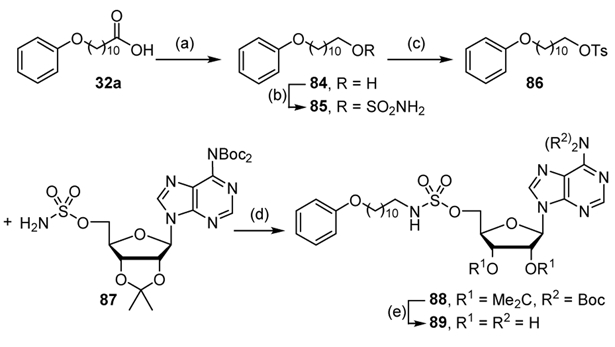
Synthesis of sulfamate 89. Reaction conditions: (a) LiAlH4, THF, 80%; (b) ClSO2NH2, NaH, THF, 100%; (c) TsCl, DMAP, CH2Cl2, 100%; (d) Cs2CO3, DMF, 22%; (e) 80% aqueous TFA, 97%.
Scheme 9.
Scheme 9.
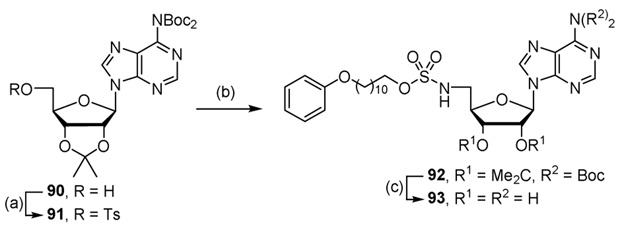
Synthesis of reverse sulfamate 93. Reaction conditions: (a) TsCl, DMAP, CH2Cl2, 98%; (b) Cs2CO3, DMF, 85; (c) 80% aqueous TFA, 11% (2 steps).

References

    1. WHO 2019 Global Tuberculosis Report, World Health Organization: France, 2019; Chapter 3, pp 27–70. https://apps.who.int/iris/handle/10665/329368 (accessed April 4, 2020).
    1. WHO 2019 consolidated guidelines on drug-resistant tuberculosis treatment, World Health Organization: Switzerland, 2019; pp 19–41. https://www.who.int/tb/publications/2019/consolidated-guidelines-drug-re... (accessed April 4, 2020). - PubMed
    1. Gokhale RS, Saxena P, Chopra T, Mohanty D, Versatile polyketide enzymatic machinery for the biosynthesis of complex mycobacterial lipids, Nat Prod Rep, 24 (2007) 267–277. - PubMed
    1. Quadri LE, Biosynthesis of mycobacterial lipids by polyketide synthases and beyond, Critical reviews in biochemistry and molecular biology, 49 (2014) 179–211. - PubMed
    1. Takayama K, Wang C, Besra GS, Pathway to synthesis and processing of mycolic acids in Mycobacterium tuberculosis, Clinical microbiology reviews, 18 (2005) 81–101. - PMC - PubMed

MeSH terms

LinkOut - more resources