. 2020 Sep;184(1):518-528.
doi: 10.1104/pp.20.00485. Epub 2020 Jun 23.

The Tomato DELLA Protein PROCERA Promotes Abscisic Acid Responses in Guard Cells by Upregulating an Abscisic Acid Transporter

Affiliations

The Tomato DELLA Protein PROCERA Promotes Abscisic Acid Responses in Guard Cells by Upregulating an Abscisic Acid Transporter

Hagai Shohat et al. Plant Physiol. 2020 Sep.

Abstract

Plants reduce transpiration through stomatal closure to avoid drought stress. While abscisic acid (ABA) has a central role in the regulation of stomatal closure under water-deficit conditions, we demonstrated in tomato (Solanum lycopersicum) that a gibberellin response inhibitor, the DELLA protein PROCERA (PRO), promotes ABA-induced stomatal closure and gene transcription in guard cells. To study how PRO affects stomatal closure, we performed RNA-sequencing analysis of isolated guard cells and identified the ABA transporters ABA-IMPORTING TRANSPORTER1 1 (AIT1 1) and AIT1 2, also called NITRATE TRANSPORTER1/PTR TRANSPORTER FAMILY4 6 in Arabidopsis (Arabidopsis thaliana), as being upregulated by PRO. Tomato has four AIT1 genes, but only AIT1 1 and AIT1 2 were upregulated by PRO, and only AIT1 1 exhibited high expression in guard cells. Functional analysis of AIT1 1 in yeast (Saccharomyces cerevisiae) confirmed its activity as an ABA transporter, possibly an importer. A clustered regularly interspaced short palindromic repeats-Cas9-derived ait1 1 mutant exhibited an increased transpiration, a larger stomatal aperture, and a reduced stomatal response to ABA. Moreover, ait1 1 suppressed the promoting effects of PRO on ABA-induced stomatal closure and gene expression in guard cells, suggesting that the effects of PRO on stomatal aperture and transpiration are AIT1.1-dependent. Previous studies suggest a negative crosstalk between gibberellin and ABA that is mediated by changes in hormone biosynthesis and signaling. The results of this study suggest this crosstalk is also mediated by changes in hormone transport.


Figures

Figure 1.
Figure 1.
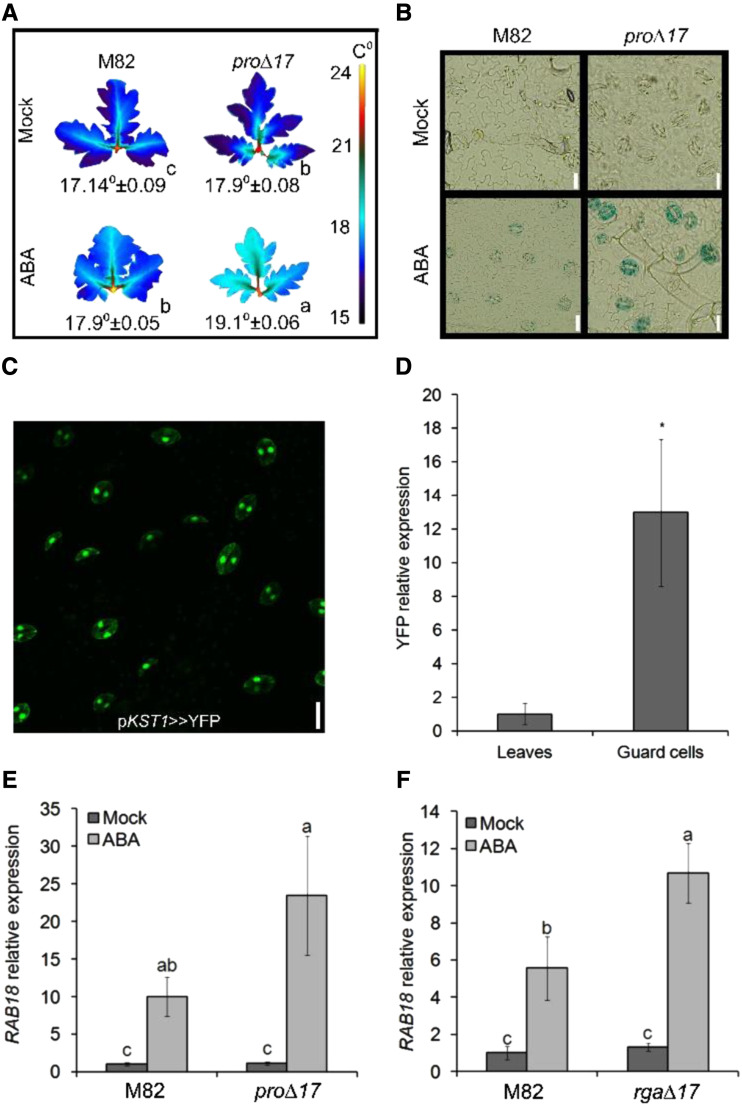
PRO promotes ABA responses in guard cells. A, Thermal imaging of leaves (leaf no. 4 below the apex) taken from M82 and 35S:pro∆17 treated or not (Mock) with 10 μm of ABA. Leaves were digitally extracted for comparison. Number below leaves are the calculated leaf-surface temperature and the values are means of three plants, measured 20 times ± se. Small letters above the numbers represent significant differences between respective treatments (Tukey–Kramer HSD test, P < 0.05). B, Representative images of GUS staining of epidermal peels treated or not (Mock) with 10 μm of ABA. Peels were taken from leaf no. 4 below the apex of M82 and 35S:pro∆17 expressing the reporter GUS under the regulation of the MAPKKK18 promoter. C, YFP signal in guard cells of pKST1>>YFP transactivated epidermal peel. Scale bars = 20 μm. D, YFP expression in whole leaf tissue and guard-cell–enriched samples. Values are means of four biological replicates ± se. Stars above the columns represents significant differences between respective treatments by Student’s t test (P < 0.05). E and F, RT-qPCR analysis of RAB18 expression in guard-cell–enriched samples isolated from leaves no. 3 and 4 below the apex of M82 and 35S:pro∆17 (E) or 35S:rga∆17 (F). Values in E and F are means of four biological replicates ± se. Small letters above the columns represent significant differences between respective treatments by Tukey–Kramer HSD (P < 0.05). The value for leaves in D was set to 1 and the value for M82 Mock in E and F was set to 1.
Figure 2.
Figure 2.
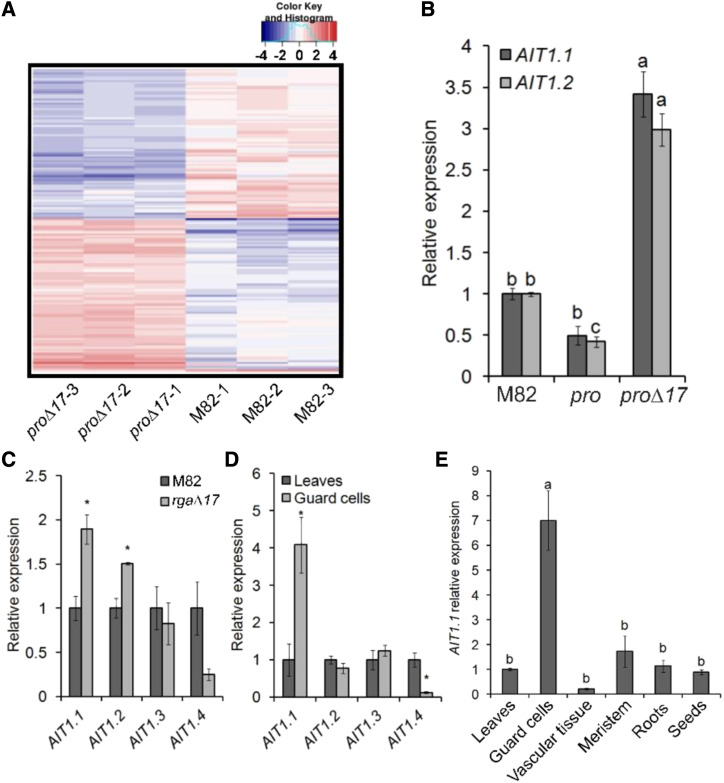
RNA-seq analysis identified the ABA transporter AIT1.1 as upregulated by PRO in guard cells. A, Clustered heatmap of PRO-regulated genes (proΔ17 versus M82, three samples each) generated from RNA-seq analysis shows 81 PRO upregulated and 81 downregulated genes. Genes were grouped based on their pattern of expression. Coloring of the genes is according to the color bar on the upper-right side (Log2 fold change). The complete list of PRO-regulated genes is provided in Supplemental Dataset 1. B, RT-qPCR analysis of AIT1.1 and AIT1.2 expression in M82, pro, and 35S:proΔ17 (proΔ17) guard cells isolated from leaves no. 3 and 4 below the apex. Values are means of three biological replicates ± se. Lowercase letters represent significant differences between lines by Tukey–Kramer HSD (P < 0.05). C, Expression of all tomato AIT1 genes in M82 and 35S:rgaΔ17 (rgaΔ17) isolated guard cells. D, Expression of all tomato AIT1 genes in leaves and isolated guard cells. E, Expression of AIT1.1 in different tissues: leaves (leaf no. 4 below the apex), guard cells, vascular tissue (isolated from leaf no. 4 below the apex), meristems (apices including leaf primordia), young roots, and imbibed seeds. Values in C, D and E are means of four replicates ± se. Stars (C and D) and lowercase letters (E) above the columns represent significant differences between respective treatments by Student’s t test (P < 0.05). The values for M82 in B and C were set to 1 and the values for leaves in D and E were set to 1.
Figure 3.
Figure 3.
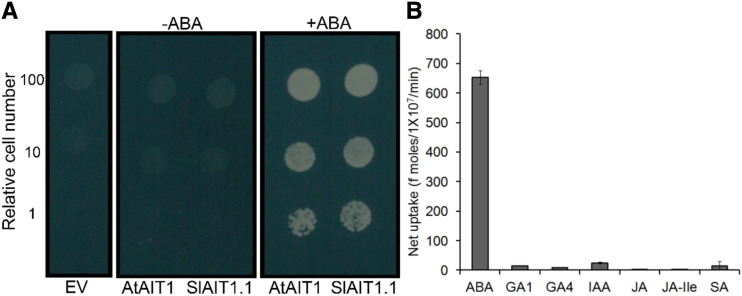
AIT1.1 mediates ABA uptake into yeast cells. A, Effects of AIT1.1 on the interactions between the ABA receptor and protein phosphatase 2C. Tomato AIT1.1 (SlAIT1.1) or Arabidopsis AIT1 (AtAIT1) was expressed in yeast containing a yeast two-hybrid system with the Arabidopsis PYR1 ABA receptor fused to the GAL4 DNA binding domain and the ABI1 protein phosphatase fused to the GAL4 activation domain, and the cells were inoculated on selection media (SD, -Leu, -Trip, -Ura, and -His) containing 0.5 μm of ABA (+ABA) or without ABA (−ABA). An empty vector (EV) was transformed as a negative control. Photos were taken 3 d after inoculation. B, Hormone transport activities of AIT1.1. Yeast cells expressing tomato AIT1.1 were incubated with solutions containing 10 μm of ABA, GA1, GA4, IAA, JA, JA-Ile, or salicylic acid (SA), and the amounts of compounds taken into the cells were quantified with LC-MS/MS.
Figure 4.
Figure 4.
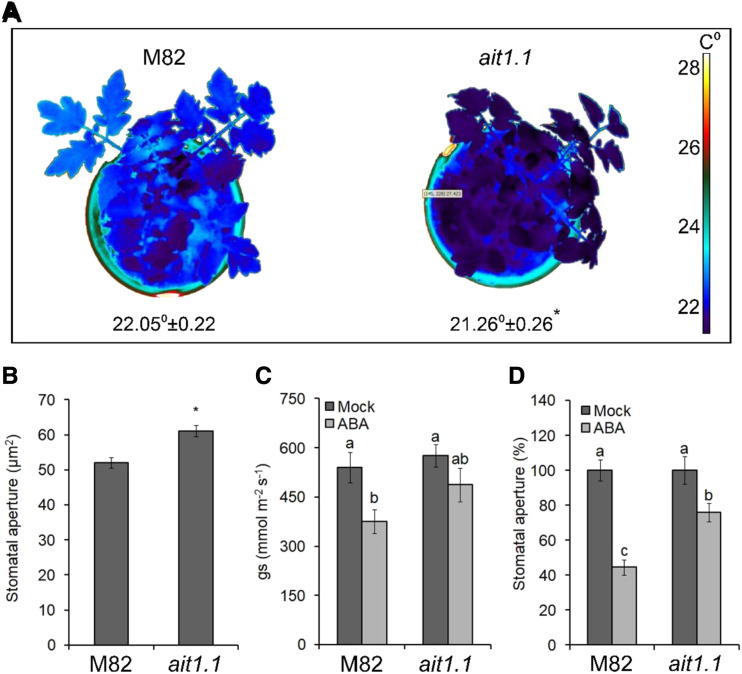
Loss of the ABA transporter AIT1.1 increased transpiration and inhibited ABA responses in guard cells. A, Thermal imaging of M82 and CRISPR-Cas9–derived ait1.1 mutant. Images were digitally extracted for comparison. Numbers below plants are the leaf-surface temperature, and the values are means of three replicates, each measured 20 times ± se. Star above the number represents significant differences between lines by Student’s t test (P < 0.05). B, Stomatal aperture measured on imprints of abaxial epidermis taken at 11:00 am from leaves no. 3 and 4 below the apex. Values are means of four replicates, each with ∼100 measurements (stomata) ± se. Star above the column represents significant difference between respective treatments (Student’s t test, P < 0.05). C, Stomatal conductance (gs) in the fourth leaf below the apex in M82 and ait1.1 plants, 1 h after treatment with 10 μm of ABA (or Mock). Values are means of six measurements taken from three different plants ± se. D, Stomatal aperture in M82 and ait1.1 epidermal peels (taken from leaves no. 3 and 4 below the apex) treated or not treated (Mock) with 10 μm of ABA. One hour after the ABA treatment, stomatal aperture was measured. Values are mean percentage of mock of four replicates, each with ∼100 measurements (stomata) ± se. Different letters above the columns in C and D represent significant differences between lines and treatments by Tukey–Kramer HSD test (P < 0.05).
Figure 5.
Figure 5.
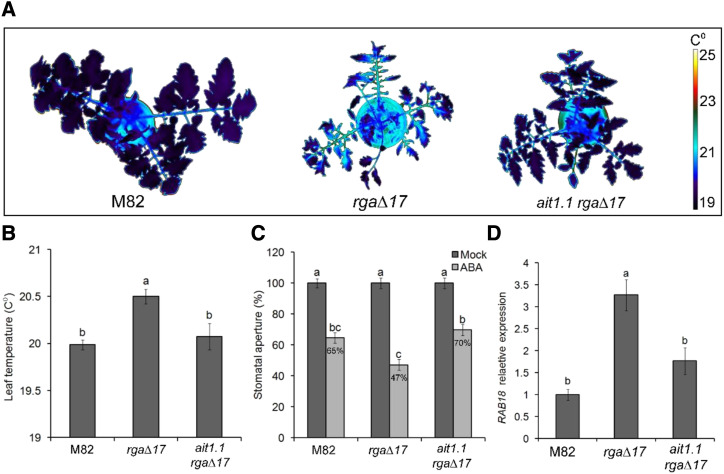
ait1.1 suppressed the effect of PRO on ABA responses in guard cells. A, Thermal imaging of M82, 35S:rgaΔ17 (rgaΔ17), and rgaΔ17 ait1.1. Images were digitally extracted for comparison. B, Leaf-surface (leaves no. 3 and 4 below the apex) temperature of M82, rgaΔ17, and rgaΔ17 ait1.1. plants. Values are means of three replicates measured 20 times ± se. C, Stomatal aperture in M82, rgaΔ17, and rgaΔ17 ait1.1 epidermal peels (from leaves no. 3 and 4 below the apex) treated or not treated (Mock) with 10 μm of ABA. One hour after the ABA treatment, stomatal aperture was measured. Values are mean percentage of Mock of four replicates, each with ∼100 measurements (stomata) ± se. D, RT-qPCR analysis of RAB18 expression in M82, rgaΔ17, and rgaΔ17 ait1.1 guard cells, isolated from leaves no. 3 and 4 below the apex. Values are means of four biological replicates ± se. Different letters above the columns in B and D represent significant differences between lines by Student’s t test (P < 0.05). Different letters above the columns in C represent significant differences between lines and treatments by Tukey–Kramer HSD test (P < 0.05). The values for M82 were set to 1.
Figure 6.
Figure 6.
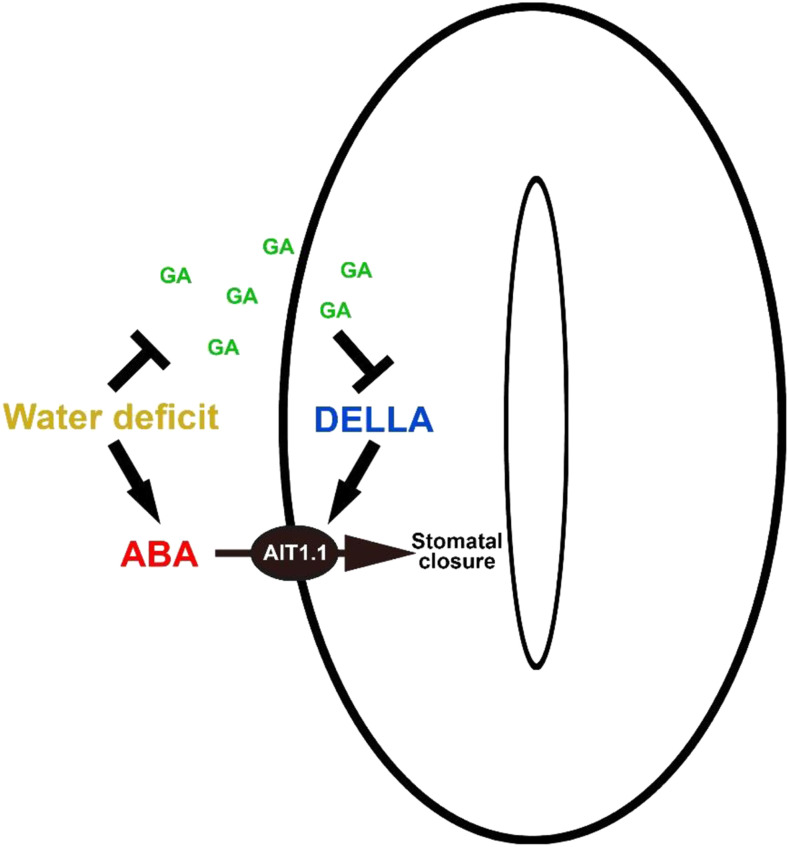
Suggested model of the crosstalk between GA and ABA in guard cells. Water-deficit conditions suppress GA accumulation (Colebrook et al., 2014), leading to DELLA (PRO) stabilization. In guard cells, PRO promotes the expression of the ABA importer AIT1.1, facilitating ABA uptake into guard cells, and stomatal closure.

References

    1. Achard P, Cheng H, De Grauwe L, Decat J, Schoutteten H, Moritz T, van der Straeten D, Peng J, Harberd NP(2006) Integration of plant responses to environmentally activated phytohormonal signals. Science 311: 91–94 - PubMed
    1. Anders S, Pyl PT, Huber W(2015) HTSeq—a Python framework to work with high-throughput sequencing data. Bioinformatics 31: 166–169 - PMC - PubMed
    1. Bassel GW, Mullen RT, Bewley JD(2008) Procera is a putative DELLA mutant in tomato (Solanum lycopersicum): Effects on the seed and vegetative plant. J Exp Bot 59: 585–593 - PubMed
    1. Bauer H, Ache P, Lautner S, Fromm J, Hartung W, Al-Rasheid KA, Sonnewald S, Sonnewald U, Kneitz S, Lachmann N, et al. (2013) The stomatal response to reduced relative humidity requires guard cell-autonomous ABA synthesis. Curr Biol 23: 53–57 - PubMed
    1. Benjamini Y, Hochberg Y(1995) Controlling the false discovery rate: A practical and powerful approach to multiple testing. J R Stat Soc 57: 289–300

Publication types

MeSH terms